

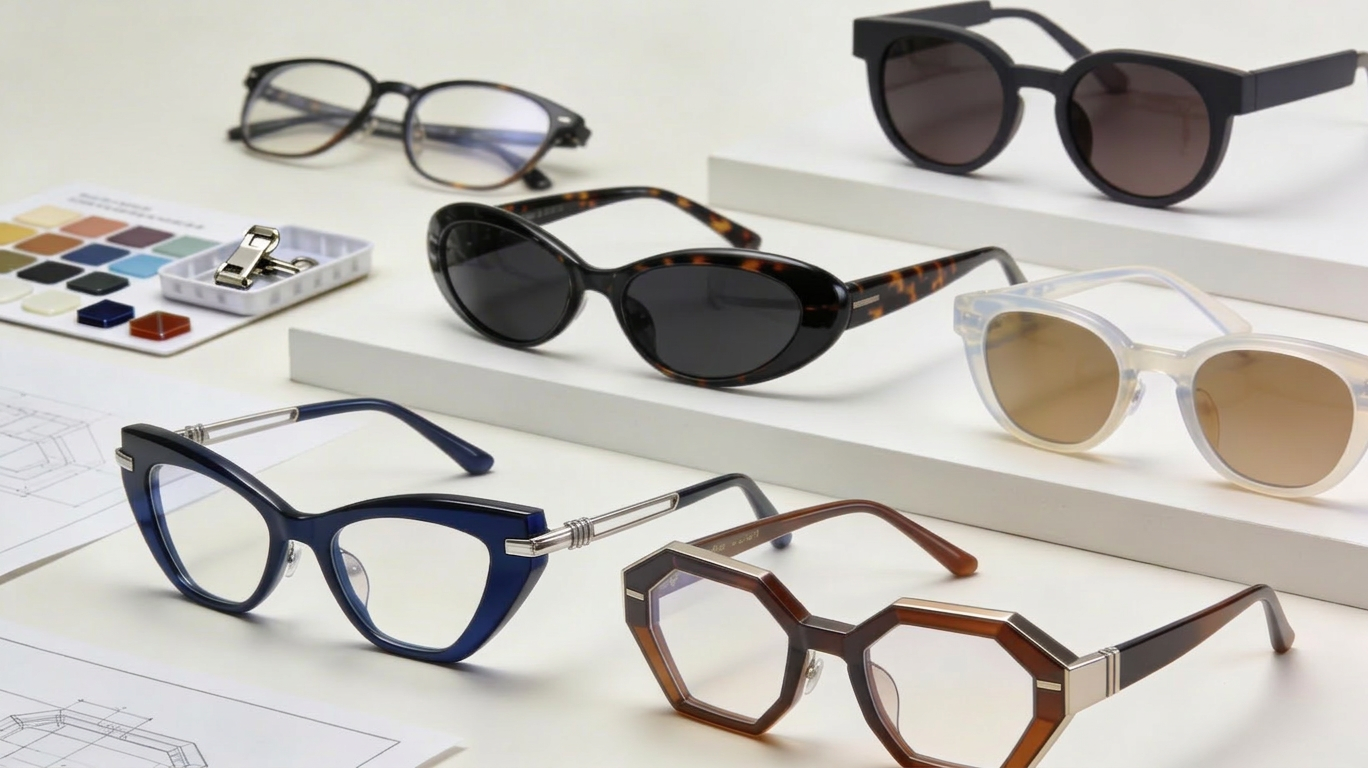
Brand owners and sourcing managers planning new collections for 2026 need to align design decisions with both global trends and Vietnam’s OEM/ODM capabilities. Concept Eyewear operates facilities in Vietnam that combine Western-level quality control with flexible MOQs, helping brands translate trend concepts into reliable mass production.
This guide covers the key frame shapes, color directions, and materials you should prioritize when briefing Vietnam manufacturers for 2026 collections.
Popular Eyewear Shapes by Brand Tier
1. Top Luxury Brands: Experimental, Architectural Geometry
At the top of the market, luxury brands emphasize experimental geometries such as softened hexagons, octagons, and architectural cat-eyes. These profiles create distinctive silhouettes while maintaining balanced proportions, making them ideal for limited runs and capsule collections.
Designers increasingly combine titanium structures with organic curves and acetate rims, delivering a structured yet lightweight presence that feels premium in-hand. For OEM in Vietnam, these shapes require tighter tolerances, more complex tooling, and additional QC steps, brands should expect higher development costs and longer lead times compared with standard shapes.
2. Mid-Tier Brands: Minimalist Ovals, Pilots, and Rectangles
Mid-tier collections focus on commercial shapes that still offer a design point of view. Minimalist ovals, pilot-inspired aviators, and oversized rectangles with clean lines perform well across optical and sun categories because they fit a wide range of face shapes.
These frames often use lightweight metals, thin titanium temples, and subtle retro curves. For Vietnam OEM production, these designs are efficient to scale, familiar tooling, moderate complexity, and repeatable finishing workflows make them ideal for regional chains and DTC brands targeting mid-range price points.
3. Value and Entry-Price Brands: Proven Basics for Volume
At the value end, brands stay with proven shapes for mass-market consumers: classic rectangles, simple rounds, and basic squares. These silhouettes are straightforward to fit in both prescription and plano lenses, supporting high sell-through in supermarket, fast-fashion, and pharmacy channels.
Most value collections use acetate or injected plastics with minimal metal detailing, keeping BOM costs low and assembly simple. Vietnam OEM producers can run these shapes at high volume with stable yields. Typical MOQs range around 400–600 units per style and color, with scalability for large retail groups.
Brand Tier Quick Reference
| Brand Tier | Key Shapes | Common Features |
|---|---|---|
| Top Luxury | Soft hexagons, octagons, sculpted cat-eyes | Titanium hybrids, fine engravings, architectural lines |
| Mid-Tier | Ovals, pilots/aviators, oversized rectangles | Lightweight metals, retro curves, comfort-focused fit |
| Low-Priced | Rectangles, rounds, basic squares | Acetate basics, matte tones, easy mass production |
Color Preferences and What They Mean for Vietnam OEM
1. Everyday Palettes: Tone-on-Tone and Translucent Neutrals
Across price tiers, tone-on-tone palettes dominate: midnight blue, charcoal, olive green, dusty rose, and taupe are strong in both sun and optical frames. Translucent neutrals such as champagne, smoke, and soft honey add depth while keeping frames easy to wear with multiple outfits.
Timeless black, brown, and tortoiseshell remain top sellers in almost every market, forming the backbone of any commercial assortment. From a Vietnam OEM perspective, these color stories favor bio-acetate and high-quality cellulose acetate, which can be dyed in nuanced shades with good batch consistency. Vietnam’s supply chains support repeatable color runs with export-ready QC for US, European, and Australian customers, without forcing very high MOQs per color.
2. Youth-Driven Colors: Bold Primaries and Soft Pastels
Among younger consumers and fashion-driven segments, bright primaries (cobalt blue, emerald green, cherry red) and pastels (lilac, powder blue, sorbet orange) are gaining share. These colors often work best as accent pieces, temple tips, laminations, or interior layers, rather than full saturated fronts for conservative markets.
For DTC and social-first brands, these hues offer strong visual hooks for campaign imagery and UGC. Vietnam OEM partners can support short color runs for seasonal drops, provided brands communicate forecasted repeats early.
3. Manufacturing Considerations: Metallics, Gradients, and UV Stability
Color-matching metallic shines, mirror coatings, and complex gradients remains more challenging than standard solids. Vietnam manufacturers can manage these effects but often require more sampling rounds and clear tolerance definitions from brands.
Vietnam facilities are experienced in using UV-stable pigments and export-compliant coatings, crucial for sunwear sold into highly regulated markets. Trend-forward blues, greens, and earth tones implemented with these pigments give brands both a modern palette and robust outdoor performance. For buyers diversifying sourcing away from China, Vietnam can offer approximately 10–20% cost savings depending on material mix and order structure.
Materials for Customized Eyewear: What to Specify in Briefs
1. Acetate and Bio-Acetate
Acetate remains the dominant material for fashion eyewear because of its color vibrancy, depth, and ability to be milled into many shapes and thicknesses. Bio-acetate, produced with more renewable components, is increasingly requested by lifestyle and fashion brands aiming for sustainability messaging.
Bio-acetate supports rich solids, layered effects, and subtle translucency, suitable for both conservative colorways and bold statement pieces. When briefing a Vietnam manufacturer, brand owners should detail: target thicknesses, polish level (high gloss vs. satin), nose fit preferences by region, and any sustainability claims they intend to make.
2. Titanium and Lightweight Metals
Titanium remains the premium choice for metal frames thanks to its high tensile strength, corrosion resistance, and low weight. It is ideal for pilots, minimal ovals, and thin rectangles where long-term comfort is critical, especially for optical wearers.
Lightweight stainless steel and beta-titanium alloys offer a balance of cost and performance, attractive for mid-tier lines. They allow slim profiles, flexible temples, and modern silhouettes without the full expense of high-purity titanium in every component.
3. Hybrid Constructions: Acetate–Metal Combinations
Hybrid acetate–metal frames combine acetate fronts with metal bridges and temples, balancing weight, aesthetics, and structural integrity. This construction supports on-trend looks like browline frames, thin metal under-frames, and sculpted acetate rims around metal cores.
Hybrid constructions are particularly suitable for scalable customization: brands can maintain one core structure while rotating acetate colors or metal finishes to create multiple SKUs with limited new tooling. Vietnam factories with integrated acetate and metal workshops are best positioned to deliver consistent quality on these builds.
Injected Metal Parts: Opportunities and Limitations
Why Brands Use Injected Metal Parts
Injected metal parts , often zinc or zinc alloy components , are common for hinges, bridges, decorative plaques, and structural elements in mid- to low-tier eyewear. Injection allows precise replication of complex shapes, including detailed logos or multi-level bridges, at attractive unit costs.
For high-volume aviators and fashion frames, double bridges or decorative elements can be produced via injection and then plated to match the surrounding metal. MOQs for injected parts are typically accessible , around 500–1,000 units per color or design, supporting market testing without large commitments.
Main Constraints and When to Choose Titanium Instead
Injected zinc alloy components have lower inherent durability than solid titanium or stainless parts. They can be prone to corrosion in humid climates, and if molds are not maintained, weight and dimensional consistency may drift over long production campaigns.
Post-processing steps such as polishing and plating add time and cost, and must be carefully controlled to avoid peeling or color shifts. For ultra-light luxury lines or frames sold into harsh environments, titanium or high-grade stainless steel remains the safer long-term choice. Vietnam OEMs mitigate these risks with optimized alloy recipes and rigorous salt-spray and sweat-resistance testing.
FAQ: 2026 Eyewear Trends and Vietnam OEM
What MOQs apply for 2026 trend shapes in Vietnam?
Typically 400–600 units per style/color, scalable for chains. Concept Eyewear adjusts based on complexity and material combinations.
Can Vietnam produce tone-on-tone colors reliably?
Yes. Vietnam factories offer consistent acetate dyeing and QC processes that match Western standards for export to the US, Europe, and Australia.
What are the best metals for custom pilot frames?
Titanium for lightness and long-term durability; injected zinc alloy for cost-effective volume production with plating options. The right choice depends on your target price point and market.
How do 2026 trends impact sustainable material choices?
Rising consumer demand for eco-friendly products is driving rapid growth in bio-acetate adoption. Vietnam OEM supply chains increasingly align with eco-friendly dyes and renewable material sourcing, making them a strong fit for lifestyle and sustainability-focused brands. Concept Eyewear has qualified certificates such as ISCC to ensure the whole supply chain would consistently stick to verified sustainability standards. The ISCC (International Sustainability and Carbon Certification) provides brand partners with full traceability across the bio-acetate supply chain, from raw material sourcing through to finished frames, giving end consumers verified confidence in the eco-friendly claims on their eyewear.