

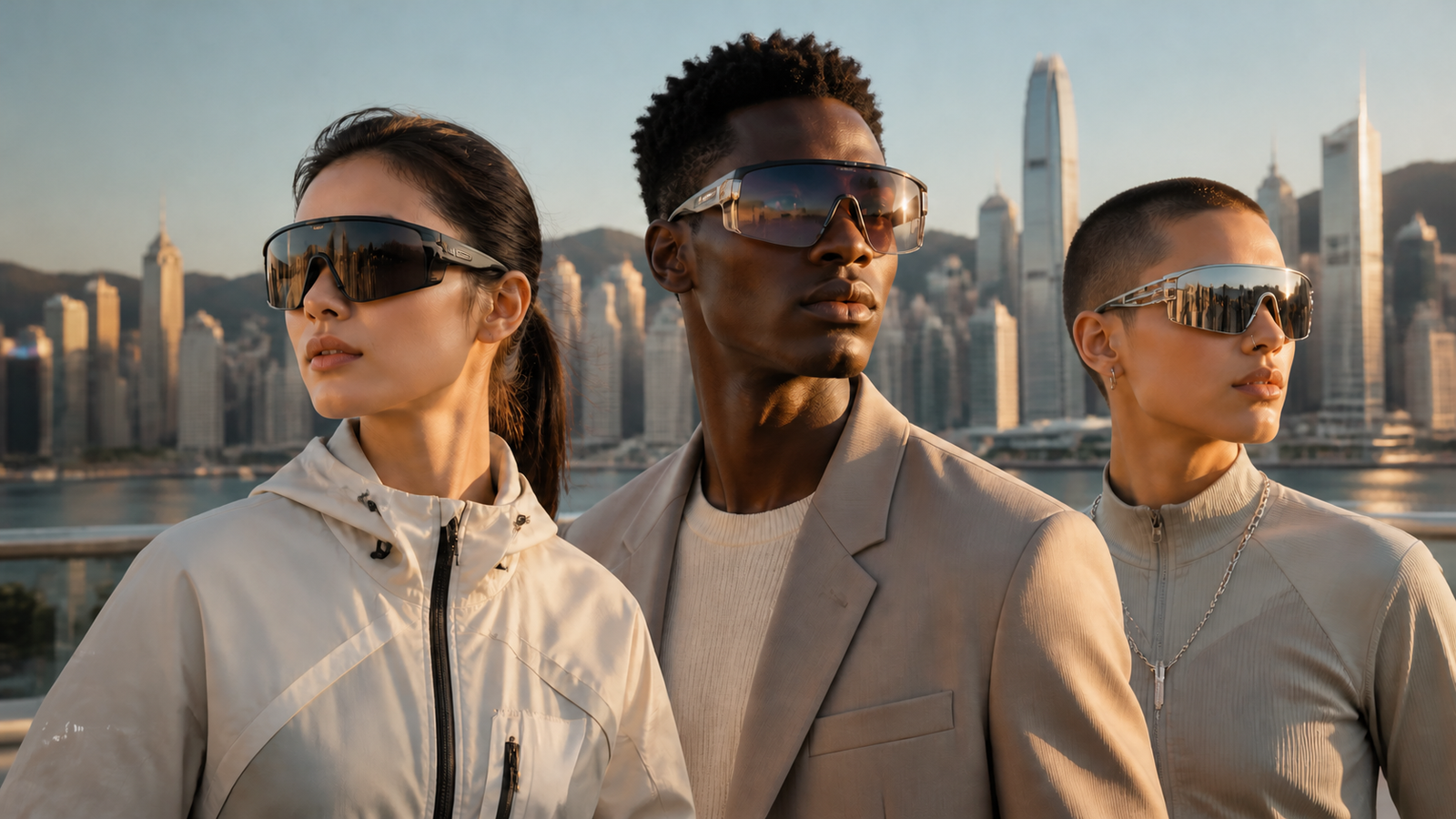
Oversized wrap sunglasses move from niche sports gear to front-row fashion in 2026.
They offer shield-style coverage, athletic performance, and refined detailing across EU, US, and Asian markets.
This creates a high-impact OEM/ODM opportunity for brands with Concept Eyewear in Vietnam and Hong Kong.
Why are oversized wrap sunglasses leading 2026 sun-wear trends?
Across 20/20 Magazine, trend blogs and fashion media, wraparound and curved frames are consistently highlighted as key silhouettes.
Moreover, they will continue trending into 2026.
As a result, Oversized Wrap Sunglasses appear in discussions about dramatic shields and wrap lenses.
Fashion titles from Vogue to L’Officiel spotlight them as summer wardrobe essentials, styled with tailored looks.
For brands, this means oversized wrap sunglasses have moved firmly into the mainstream trend set, sitting alongside bold retro and soft statement frames rather than on a separate sports-only rail. The commercial upside is significant: one silhouette can stretch from performance sport to streetwear and luxury fashion tiers with smart changes in materials, finishes and merchandising.
What defines an oversized wrap sunglasses look in 2026?
Additionally, the new generation of oversized wrap sunglasses combines a wide, face-hugging lens curvature with slimmer, more architectural lines.
Moreover, they are more architectural than earlier, bulkier sport shields.
Thus, they feature softened corners, tapered edges, and careful proportioning around the brow to flatter more faces.
Color and finish are also evolving in line with wider 2026 eyewear trends, with warm tortoise, deep browns, milky neutrals and refined metallics replacing loud neons as the main statement. Lens colors tend toward deep browns, smoke, warm greens and subtle mirrors that enhance skin tone while still delivering a powerful, almost cinematic shield aesthetic.
How do oversized wrap sunglasses balance fashion and performance?
The look is undeniably fashion-led.
Oversized Wrap Sunglasses retain serious performance DNA, including wide lateral coverage.
They offer improved wind and dust protection and a stable fit during movement.
Recent launches in performance sun-wear show 8‑base wraps and mask-style shields being optimized for airflow, fog resistance and all-day comfort, often using adjustable nose pads and sculpted temples.
Sport lens technologies have also advanced so that wrapped frames can carry high-quality prescription and non-prescription optics with minimized aberrations across the lens.
At the same time, lifestyle collections from fashion houses are softening the pure sport look by slimming temple thickness, reducing aggressive venting details and integrating more refined surface treatments. This hybrid approach allows retailers to merchandise oversized wrap sunglasses both in performance zones and in curated fashion edits, increasing turn and making the silhouette relevant to more customer profiles.
Which lens technologies matter most for this trend?
For 2026 assortments, core lens specifications for oversized wrap sunglasses typically include 100 percent UV protection to meet ISO 12312 sun-wear requirements, with many brands adding polarization for glare control in driving and water environments. Photochromic options are gaining visibility as brands introduce wrapped styles whose lenses adapt to changing light while maintaining slim, aerodynamic profiles. Sport-specific lenses with contrast-enhancing tints and mirror coatings remain key for higher price tiers, especially for cycling, running and water sports capsules where performance remains central to the storytelling.
What materials and engineering define next-gen oversized wrap sunglasses?
Frame engineering for oversized wrap sunglasses is built around managing curvature, stiffness and weight so the front does not feel bulky or unstable in wear. Many performance brands are using injected TR‑90, high-performance nylon or proprietary blends for the front to deliver an 8‑base or mask-like curvature with sufficient torsional rigidity. For more fashion-driven interpretations, thinner acetate or stainless steel chassis support a shield lens, creating a lighter, more minimal profile while still hugging the face.
Temples and touch points are being refined with adjustable or rubberized tips, sculpted grips and flexible hinges to stabilize the larger front without creating pressure points. Lens materials are typically polycarbonate or nylon for impact resistance, with premium lines using high‑definition optics and oleophobic and hydrophobic coatings to maintain clarity on a larger exposed surface. From an OEM/ODM perspective, success depends on precise base-curve control, tooling tolerances and repeatable assembly methods so the shield lens indexes correctly every time without stress marks or warping.
How should brands think about fit, comfort and inclusive design?
Because oversized wrap sunglasses cover more of the face, fit strategy has a disproportionate impact on perceived quality and return rates. Best practice in 2026 is to combine multiple fit profiles, including global fit and Asia-focused bridge and angle geometries, so the brow line follows or slightly lifts the wearer’s brow without cutting through it or resting on the cheeks. Lightweight construction is also crucial; trend forecasters highlight a wider shift toward comfort-led design where bold frames still feel effortless over long wear.
In manufacturing, this translates into careful weight budgeting per size, using lighter materials, hollowed temple cores and optimized lens thickness, alongside soft-adjustable nose pads where appropriate. Well-engineered frames not only look better in motion and profile, as trend stylists emphasize, they also convey a more premium impression at retail, which supports higher price points for this dramatic silhouette.
How do EU, US and Asia markets differ for oversized wrap sunglasses?
In EU markets, especially in outdoor and cycling-driven countries, sport-inspired wraps were already familiar.
Additionally, 2026 sees a move toward more fashion-conscious interpretations.
These can still satisfy demanding sun protection and safety expectations.
Oversized Wrap Sunglasses align with this trend.
Retailers balance performance assortments with cleaner shield frames.
They pair easily with minimalist wardrobes, focusing on lens quality, UV claims and ISO 12312.
In the US, the trend intersects with athleisure, streetwear and celebrity influence, making oversized wrap sunglasses a key storytelling piece for social media and e‑commerce imagery. Buyers typically plan a wide price ladder from entry-level polarized wraps to premium designer collaborations, and there is also strong opportunity in safety-adjacent capsules that reference Z87 impact language while positioning the product primarily as lifestyle eyewear.
Across Asia, including markets such as Hong Kong, Japan and Korea, consumers are highly receptive to futuristic silhouettes, clean shield lines and translucent materials, but demand precise fit and lighter weights. Asian-fit bridges, adjusted pantoscopic angles and slimmer temples are essential to avoid slipping and cheek contact, and color stories often lean into milky translucence, soft gradients and high-gloss finishes that echo broader regional fashion trends.
How can brands localize one oversized wrap platform for multiple regions?
A common approach is to create a global design platform for oversized wrap sunglasses, then adapt lens colors, fit packages and merchandising for each region. For example, EU capsules might emphasize polarized and contrast-enhancing lenses for cycling and water sports, US capsules might highlight celebrity styling and driving comfort, and Asian capsules might prioritize lighter constructions and translucent fashion colors.
Working with an experienced OEM/ODM partner such as Concept Eyewear in Vietnam and Hong Kong allows brands to map these variations into shared tooling and component sets, maximizing economies of scale while preserving localized differentiation. Careful BOM planning can keep lens and color variants modular while locking core chassis engineering so quality and standards compliance remain consistent across markets.
What does a commercially focused oversized wrap sunglasses range look like?
When planning an oversized wrap sunglasses program for 2026, brands typically build out a small but strategic range that covers price tiers, regions and usage occasions. Below is an example of how three SKUs built on a shared platform could be positioned through OEM/ODM production with Concept Eyewear in Vietnam and Hong Kong.
| Concept / SKU | Target region | Price tier | Key features | Standards focus |
|---|---|---|---|---|
| Urban Shield Wrap | US / global e‑commerce | Mid | 8‑base wrap, polarized lens, bold solid colors, everyday athleisure styling | ISO 12312 UV compliance, lifestyle impact messaging around Z87 influence |
| Trail Pro Shield | EU outdoor / cycling | Upper mid | Higher wrap for wind protection, contrast sport tint, adjustable nose pads, rubber temples | ISO 12312, impact-resistant lens materials, clear sports-protection narrative |
| Coastal Light Wrap | Asia (Hong Kong, Japan, Korea) | Accessible premium | Slim shield front, translucent acetates, gradient lenses, Asian-fit geometry, lighter weight | ISO 12312, comfort-led positioning, optional Z87-inspired capsule story |
This kind of tiered range lets retailers present oversized wrap sunglasses as a mini story on shelf and online, with clear upsell paths from entry to premium. By anchoring all SKUs to one core platform, brands can plug in seasonal color and lens updates while maintaining BOM stability and reliable factory yields.
How should brands brief an OEM/ODM partner in Vietnam and Hong Kong for this trend?
To capture the oversized wrap sunglasses opportunity efficiently, brands should build a highly structured OEM/ODM brief that connects trend insight with engineering and standards requirements. At Concept Eyewear, development typically starts with defining the base curve and shield architecture, then working backward into temple design, fit variants and lens specifications that can be realized consistently in volume production out of Vietnam and Hong Kong facilities.
Key elements to include in a brief for oversized wrap sunglasses include: target base curve, shield or two-piece lens construction, material choices for front, temples and lenses, intended usage occasions, regional fit priorities, ISO 12312 compliance targets and whether any Z87-aligned impact or coverage messaging is required. Early alignment on price tier and forecast volumes also allows the factory team to propose the most efficient mix of tooling, surface treatments and component families.
What advantages do Vietnam and Hong Kong offer for oversized wrap sunglasses OEM/ODM?
Vietnam has become a powerful base for eyewear manufacturing thanks to competitive labor costs, a growing ecosystem of component suppliers and improving logistics into EU and US markets. For oversized wrap sunglasses specifically, access to modern injection facilities, precision tooling and high-quality lens finishing allows OEM/ODM partners to hit demanding curvature and surface requirements at scale.
Hong Kong remains a strategic hub for design collaboration, materials sourcing and international trade compliance, connecting brand design teams with Vietnamese production through efficient communication and quality control loops. Concept Eyewear leverages this Vietnam–Hong Kong combination to support multi-language communication, rapid sampling cycles and robust documentation for standards, testing and customs, which is especially important for complex silhouettes such as oversized wrap sunglasses.
How can brands manage testing, standards and quality for oversized wrap sunglasses?
Because oversized wrap sunglasses present a large lens area and high coverage, rigorous testing is essential to maintain optical performance and safety as the trend scales. ISO 12312 requires verification of UV protection, transmittance categories, robustness and labeling, and its procedures are especially relevant when experimenting with bold gradients, mirrors and fashion tints on large shield surfaces. For brands that want to reference workplace or safety-inspired storytelling, Z87 performance criteria around impact resistance, coverage and optical clarity can guide higher-spec capsules, even if the final product is merchandised in lifestyle categories.
An experienced OEM/ODM partner like Concept Eyewear can integrate standards thinking from the earliest CAD stages, specifying lens thickness, material choices and frame geometries that will pass internal testing before third-party lab submission. Documented testing workflows, golden samples and clear AQL frameworks are particularly important for oversized wrap sunglasses because even small deviations in lens curvature, mounting pressure or coating can become visually obvious at retail.
What is the go-to-market playbook for oversized wrap sunglasses in 2026?
On the commercial side, the most successful oversized wrap sunglasses launches align trend storytelling, merchandising and digital content from the start. Trend coverage from sources such as 20/20 Magazine has already primed both consumers and industry buyers to expect wraparound and curved frames to remain important into 2026, so using this language in sell-in decks and retail training helps validate the story. Partnering this with strong lifestyle photography that shows the frames from front and side angles, as styling experts recommend, ensures that the dramatic silhouette reads as intentional and premium from every viewpoint.
E‑commerce pages for oversized wrap sunglasses benefit from clear fit notes, profile shots, close-ups of nose pads and temples, and simple explanations of lens technology and standards. Internal content hubs such as the Concept Eyewear website at concepteyewear.com can support this with OEM/ODM case studies, while external editorial references such as 20/20 Magazine’s frame reports reinforce that the trend is part of a broader industry movement. For additional perspective on how industry media is framing sports-influenced shields and wraps, brands can study coverage on platforms like 20/20 Magazine.
Why partner with Concept Eyewear in Vietnam and Hong Kong for oversized wrap sunglasses?
Concept Eyewear specializes in OEM/ODM eyewear manufacturing from Vietnam and Hong Kong, combining deep experience in curved and shield sun-wear tooling with a strong understanding of EU, US and Asian market expectations. For brands building oversized wrap sunglasses programs, this means access to a partner who can connect trend intelligence with engineering, supply chain optimization and the testing frameworks required to meet ISO 12312 and, where relevant, Z87-aligned performance.
If your brand is planning 2026 or 2027 launches and wants to anchor its sun-wear story around oversized wrap sunglasses, now is the time to lock in platforms, tooling and standards strategy with your OEM/ODM partner. By collaborating with Concept Eyewear across Vietnam and Hong Kong, you can develop collections that translate the sporty shield trend into commercially powerful, regionally tuned assortments that perform in EU, US and Asian markets while staying tightly aligned with your brand’s design language and pricing architecture.
