

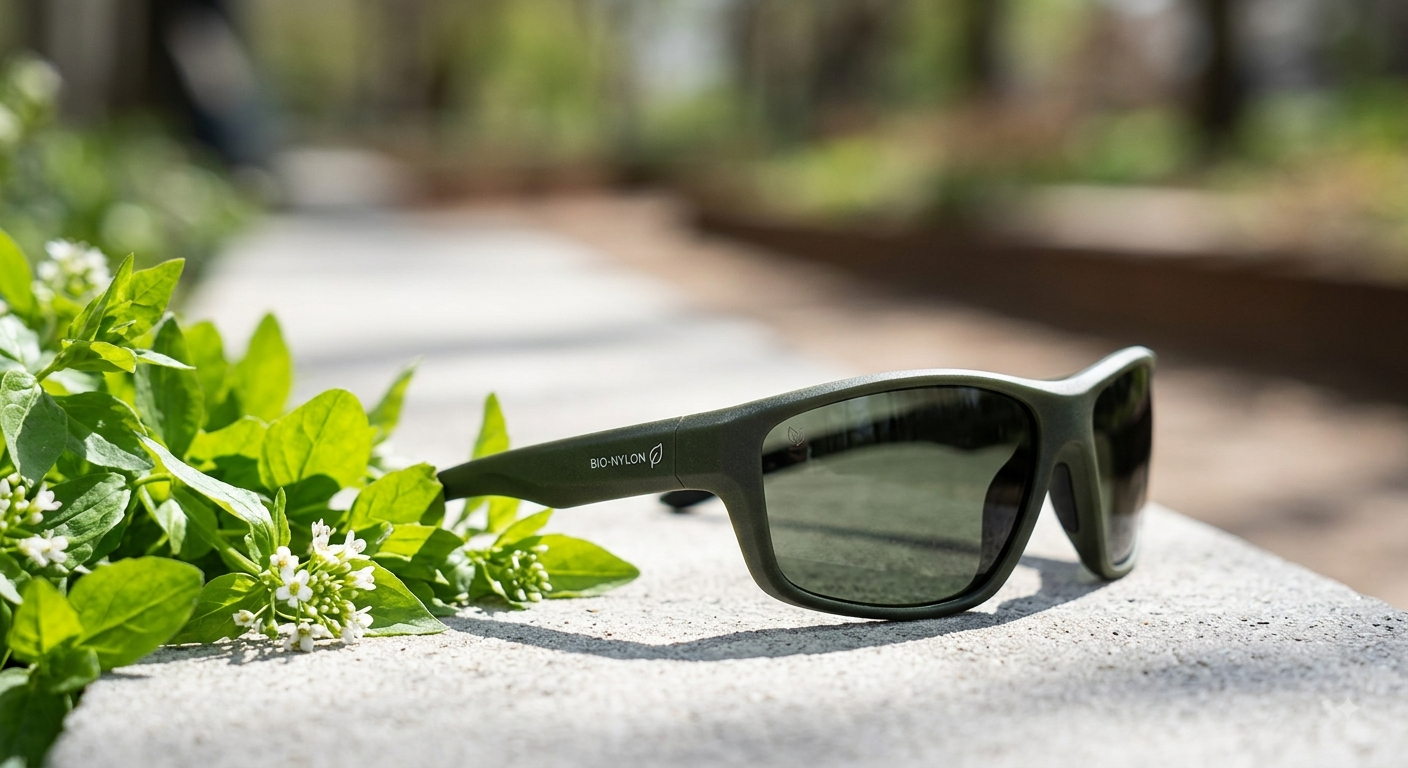
TL;DR: Bio-nylon sunglasses are emerging as one of 2026’s most important performance and sustainability trends, combining ultra-light comfort, strong mechanical properties and lower-impact materials. For brands, bio-nylon sunglasses offer an ideal platform to launch globally consistent collections that can be tuned to EU, US and Asia standards, price tiers and fit profiles while aligning with ESG commitments and next-generation retail storytelling.
Why are bio-nylon sunglasses defining the 2026 performance eyewear trend?
Across 2026 collections, brands are moving beyond traditional petroleum-based plastics into bio-nylon derived from renewable sources such as castor oil, especially for performance-driven sunglasses. Bio-nylon sunglasses give designers an attractive balance of low weight, high tensile strength and excellent UV resistance, so frames stay comfortable and visually stable even under intense sun exposure or high humidity.
At the same time, consumers are demanding sunglasses that feel technical but look refined, without the aggressive “sports only” styling of classic wrap frames. Bio-nylon sunglasses allow brands to engineer thinner profiles and sculpted temples that keep weight around 20–25 grams while still feeling solid in the hand, which fits perfectly with the 2026 direction toward quiet performance and “stealth wealth” aesthetics.
For sourcing teams and product managers, this material shift is also strategic. Bio-nylon sunglasses can be tooled once and then localized with regional lens packages, nose-bridge solutions and color stories, enabling global assortments with fewer base SKUs. When paired with a capable OEM/ODM partner in Vietnam and Hong Kong, brands can deliver faster seasons, lower landed costs and clearer sustainability narratives without compromising durability or standards compliance.
What makes bio-nylon sunglasses different from conventional acetate and metal frames?
Traditional acetate and metal sunglasses remain essential for fashion collections, but they were not originally engineered for modern multi-sport, multi-climate lifestyles. Bio-nylon sunglasses bring a more technical polymer platform, delivering higher impact resistance than standard injected plastics and better fatigue performance at the hinge and temple areas.
From an engineering point of view, bio-nylon sunglasses offer:
- Lower density than acetate, helping keep full-rim sun styles under 25 grams even with larger eye sizes.
- High tensile strength and flexural modulus, so thin sections around the bridge and end pieces still feel secure.
- Excellent temperature and humidity stability, reducing warping or loosening when sunglasses are left in cars, on dashboards or in beach conditions.
Compared with metal, bio-nylon sunglasses also solve several comfort challenges. Where metal can create pressure points on the nose or behind the ears, bio-nylon temples can be milled or molded with variable thickness, integrated grip textures and soft curve transitions. This is especially valuable for Asia-fit and global-fit programs, where brands need one design language but multiple ergonomic solutions for EU, US and Asia consumers.
How should brands design bio-nylon sunglasses for 2026 consumers?
Designing successful bio-nylon sunglasses in 2026 means combining sculpted silhouettes, subtle color play and performance-driven lens choices in a way that feels premium rather than purely technical. Instead of extreme wrap shapes, many brands are moving toward semi-wrapped rectangular, navigator or softened square fronts that reference performance without looking like competition gear.
Which shapes and details work best for bio-nylon sunglasses?
The material properties of bio-nylon sunglasses allow clean, reduced geometry with just enough faceting to catch the light. Popular directions include elongated rectangles, softened D-shapes, slim shields and compact wrap-inspired navigators that offer good side coverage without overwhelming smaller faces. Because bio-nylon can hold sharp definition, brands can introduce bevels along the brow, hinge or temple to create a sculpted look that photographs well for e-commerce and social media.
Temple engineering is a key differentiator. Bio-nylon sunglasses can integrate flexible core zones, ventilation cut-outs or discreet rubber-like inlays for grip without adding visible clutter. This keeps the line clean for fashion accounts while still delivering the secure fit demanded by active users who run, cycle or travel with a single pair they wear all day.
How can lens technology elevate bio-nylon sunglasses?
Lens choice is where bio-nylon sunglasses can step from “nice” to “must-have.” Thin, impact-resistant lenses with advanced coatings are now expected in the upper mid to premium tiers, especially in the US and EU. For 2026, we see strong demand for:
- Polarized lenses optimized for digital glare and water or snow reflections.
- High-contrast tints for driving, urban commuting and light outdoor sports.
- Gradient tints that keep the eye area open for style while maintaining UV protection from above.
- Mirror or flash finishes tuned to the color story of the frame rather than overpowering it.
From a compliance perspective, all sun lenses in a collection centered on bio-nylon sunglasses should be designed and validated against ISO 12312 requirements for UV protection and optical quality, with ANSI Z87-level impact performance offered on selected SKUs for sports, outdoor work or industrial partners. This lets brands extend a single design language into both lifestyle and protective ranges using compatible components and testing workflows.
How can brands tune fit and comfort across regions?
Bio-nylon sunglasses are ideal for global-fit strategies because the material can accommodate both slim and deeper nose-bridge geometries without losing strength. For EU and US markets, brands might focus on slightly narrower bridges with standard saddle or keyhole designs, whereas Asia-focused SKUs benefit from deeper, wider nose pads and slightly shorter pantoscopic tilt to avoid cheek contact.
As an OEM/ODM partner, Concept Eyewear can tool bio-nylon sunglasses with interchangeable nose pad systems and multiple temple lengths, allowing you to cover more faces with fewer base designs. This is critical for retail chains and DTC brands that want a unified visual identity but need precise comfort across Canada, the US, Europe, Japan and Southeast Asia.
How do bio-nylon sunglasses support sustainability and ESG goals?
Bio-nylon sunglasses give brands a concrete, verifiable sustainability story that goes beyond generic “eco” claims. Because the polymer backbone is partially derived from renewable feedstocks like castor beans, the material can reduce reliance on fossil-based plastics and lower total life-cycle emissions when paired with responsible manufacturing and logistics.
Beyond the frame material, brands can design entire bio-nylon sunglasses programs as low-impact collections by aligning:
- Frame materials: bio-nylon fronts and temples, recycled stainless steel components, and, where appropriate, bio-based rubber-style temple tips.
- Lenses: thinner lenses that maintain mechanical performance with less material; where possible, lenses made with recycled or bio-attributed polymers that still meet ISO 12312 and Z87 performance targets.
- Packaging: recycled or FSC-certified cartons, plant-based inks and reduced plastic inserts, all clearly labeled for consumer communication.
Because bio-nylon sunglasses can last for many seasons without yellowing or brittleness, they align with a shift from fast fashion to durable, repairable premium accessories. This positions your brand as both environmentally responsible and quality-focused, supporting higher price points and longer product lifecycles in wholesale and DTC channels.
How do bio-nylon sunglasses perform across EU, US and Asia markets?
Each major region approaches sunglasses slightly differently in terms of aesthetics, price tier and standards emphasis. A successful 2026 program built around bio-nylon sunglasses should be designed with these market nuances in mind, while still sharing core tooling and engineering.
In the EU, bio-nylon sunglasses resonate strongly when framed as low-impact, long-lasting objects with subtle styling and clear conformity with CE marking and ISO 12312 testing. In the US, there is higher appetite for polarized and performance-positioned SKUs, as well as opportunities to extend bio-nylon sunglasses into ANSI Z87-rated products for outdoor work, fishing, boating and lifestyle sports. Across Asia, fit and complexion harmony are critical; lighter front weights, Asian-fit bridges and tone-on-tone gradients that complement skin tones often outperform overly bold palettes.
The following table illustrates how three bio-nylon sunglasses concepts can be tuned for specific regional strategies while sharing a common engineering platform:
| Concept SKU | Primary Region | Price Tier | Material & Construction | Lens & Standards Focus | Retail Positioning |
|---|---|---|---|---|---|
| BN-01 Urban Minimal | EU / UK | Upper mid | Bio-nylon full-rim rectangular front, slim sculpted temples, stainless steel hinges | Non-polar gradient lenses, ISO 12312-compliant, CE-marked documentation kit | Premium optical boutiques and lifestyle fashion stores focused on quiet luxury |
| BN-02 Active Coastal | US / Canada | Mid to upper | Bio-nylon semi-wrap front with ventilated temples, soft-grip end tips | Polarized lenses, optional ANSI Z87 impact configuration for selected channels | Outdoor specialty, fishing, travel retail and DTC e-commerce performance pages |
| BN-03 City Light | Japan / Greater Asia | Mid | Bio-nylon softened D-shape, global-fit nose pads, lighter overall thickness | High-clarity gradient lenses tuned for lower glare and all-day indoor/outdoor wear | Urban department stores, optical chains and online fashion platforms with Asian fit focus |
All three bio-nylon sunglasses concepts can share a core tool family, yet each is optimized to local preferences. This modular approach keeps engineering and quality control centralized while allowing your marketing, sales and retail partners to position each SKU precisely for local demand.
Why does the bio-nylon sunglasses trend help brands grow strategically?
Bio-nylon sunglasses are not just another seasonal shape or color story; they are a structural platform that helps brands solve several strategic growth challenges at once. First, they support premiumization by combining advanced materials and high-spec lenses in an ultra-light, comfort-first package that justifies stronger MSRPs and healthier margins. Consumers intuitively feel the difference when a pair is lighter and more stable on the face, which makes upselling easier both in store and online.
Second, bio-nylon sunglasses make assortment complexity more manageable. Rather than carrying dozens of unrelated SKUs, brands can build families around one or two chassis with interchangeable lens packages, regional fit variants and color capsules. This reduces inventory risk and simplifies forecasting, while still appearing fresh through seasonal drops and collaborations.
Third, bio-nylon sunglasses give your marketing and ESG teams a unified storyline that works across regions and channels. A clear narrative about renewable-source materials, rigorous ISO 12312 testing and optional Z87 performance provides hooks for PR, social content, in-store training and B2B presentations. Over time, this strengthens your brand’s perceived expertise in technical, sustainable eyewear, making it harder for low-cost competitors to copy your positioning.
Finally, because the bio-nylon sunglasses trend aligns with broader moves into sustainability, performance lifestyles and AI-driven personalization, it keeps your brand relevant for the next three to five years instead of just one season. Collections designed today can evolve through lens technology, color stories and minor ergonomic upgrades without needing a complete re-tool, increasing return on your initial design and mold investment.
How can brands collaborate with Concept Eyewear on bio-nylon sunglasses development?
Bringing a successful bio-nylon sunglasses program to market requires more than selecting a new material. It demands reliable tooling, disciplined quality control, standards-driven testing and an OEM/ODM partner who can translate design language into scalable production. As a specialist manufacturer with operations in Vietnam and China and a head office in Hong Kong, Concept Eyewear is structured specifically to support global brands, retailers and emerging labels on projects like this.
From our Vietnam production hub, we can industrialize bio-nylon sunglasses with:
- DFM (Design for Manufacturing) input on wall thickness, hinges and lens interface to optimize mold life and reduce scrap.
- Integrated testing workflows for ISO 12312 sunglasses performance and, where relevant, Z87 impact protection on designated SKUs.
- Flexible MOQs that let you pilot a capsule bio-nylon sunglasses collection before scaling to full chain rollout.
Our Hong Kong head office coordinates sampling, communication and logistics with your sourcing, design and merchandising teams. This structure allows us to support US, EU and Asia buyers in real time, offering both fashion-first and standards-focused perspectives. Internal digital tools and e-commerce readiness mean that we can also provide content packages, fit information and merchandising guidelines that align your online and offline channels around the same bio-nylon sunglasses story.
If you would like to see how a bio-nylon sunglasses capsule could fit into your current assortment, you can review our capabilities and case studies on the Concept Eyewear website, then share your regional targets and deadlines with our OEM/ODM team.
What are practical next steps for launching a bio-nylon sunglasses line in 2026?
For brands, retailers and sourcing teams, moving from interest to execution with bio-nylon sunglasses is best handled through a phased approach. Start with a clear brief that defines your hero consumer, price tier, target markets and standards requirements, then map this against existing bestsellers to avoid cannibalizing core SKUs. From there, a focused development track for bio-nylon sunglasses can create incremental growth rather than just trading volume between similar products.
A typical roadmap might include:
- Concept definition: Choose 1–3 chassis for your first bio-nylon sunglasses family, aligning on shapes, coverage and lens story.
- Technical scoping: Work with Concept Eyewear’s engineering team in Vietnam to validate material grades, hinge choices and lens interface for ISO 12312 and optional Z87 compliance.
- Sampling and wear testing: Run accelerated fit trials with target consumers in EU, US and Asia, refining nose pads, temple grip and colorways.
- Assortment planning: Decide which SKUs will carry polarized lenses, which will be fashion gradient, and which will be standards-focused or industrial channel variants.
- Launch toolkit: Prepare storytelling assets, sustainability claims and product training that clearly explain why your bio-nylon sunglasses are lighter, more durable and more responsible.
To strengthen your internal case, you may want to benchmark your brief against independent trend coverage from sources like 20/20 Magazine, Vision Monday and other industry titles that highlight the shift toward sustainable materials and high-performance, ultra-light frames. This external validation helps align product, merchandising and leadership around the same direction.
When you are ready, Concept Eyewear can help you move from initial sketches to production-ready bio-nylon sunglasses that integrate seamlessly into your global assortment. As an OEM/ODM partner based in Hong Kong with a strong manufacturing base in Vietnam and China, we are positioned to bridge design ambition, regional requirements and factory reality.
Reach out to our team to explore how a dedicated bio-nylon sunglasses capsule, tested to ISO 12312 and, where needed, Z87 standards, can become the next growth engine in your 2026–2027 collections. Together, we can build sunglasses that feel lighter on the face, lighter on the planet and heavier in strategic impact for your brand.
