

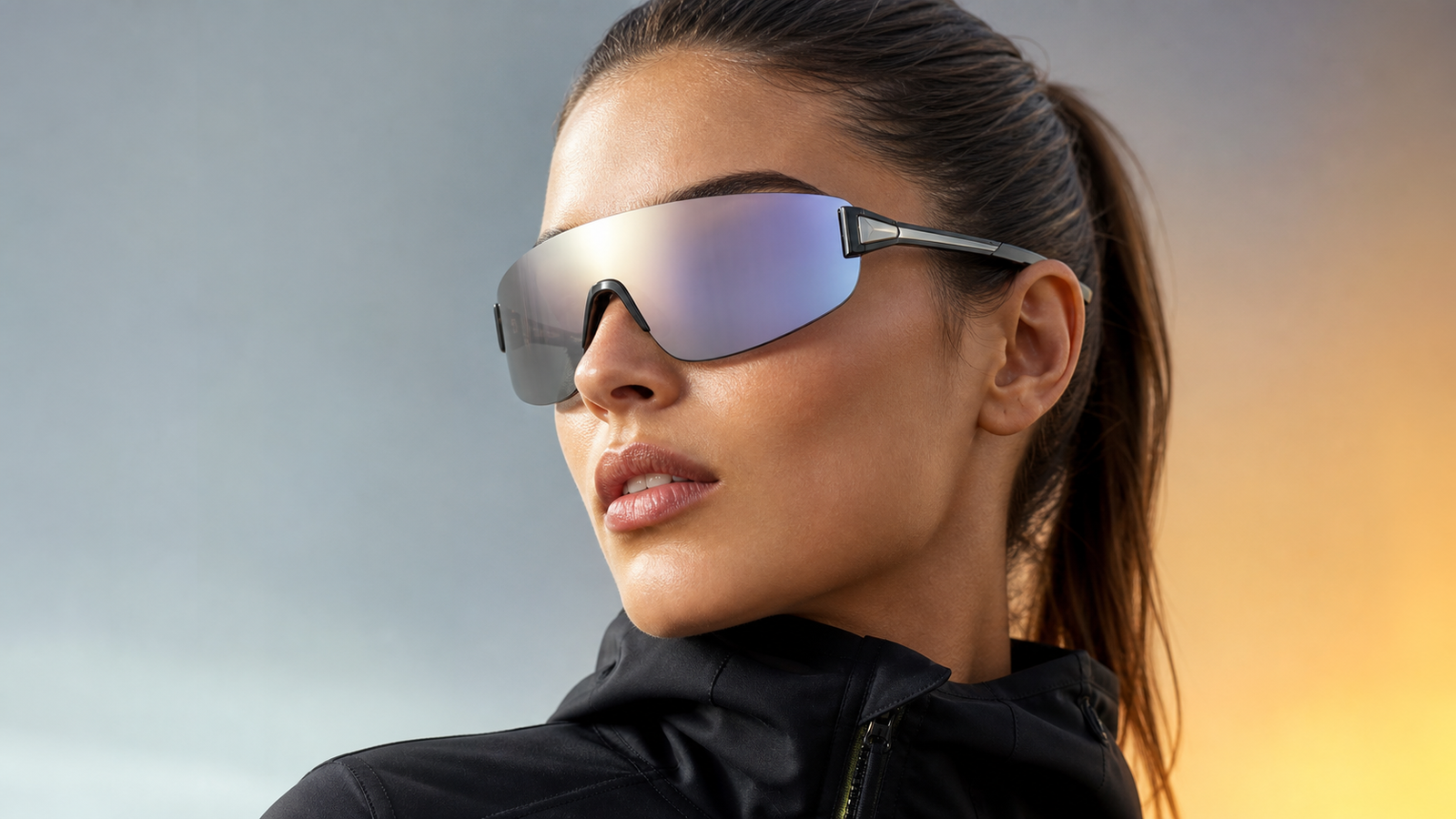
TL;DR: Shield sunglasses OEM collections are one of the most powerful 2026 eyewear trends, merging sport-luxe aesthetics with panoramic protection and giving brands a fast route to standout, standards-ready products manufactured at scale with Concept Eyewear in Vietnam and Hong Kong.
Why are shield sunglasses leading the 2026 sport-luxe eyewear trend?
Across runway coverage, fashion media and optical trade magazines, shield silhouettes have moved from niche sport gear into mainstream, high-fashion sunwear for 2026. The newest shield sunglasses are cleaner, more wearable and often paired with tailoring or minimal outfits, so the lens and frame become a confident style statement instead of purely technical equipment.
At the same time, consumers are spending more time outdoors and expect real protection from UV, glare, wind and dust, not just an aesthetic accessory. Modern shield sunglasses deliver a contiguous lens area, strong side coverage and high base curves, which align naturally with the performance expectations behind ISO 12312 sunglasses standards while still leaving room for bold color, mirror and gradient treatments.
For brands, this combination of high-visibility styling and genuine function makes shield sunglasses OEM projects ideal for capsule drops, collabs and flagship SKUs that can headline both e-commerce and retail windows.
What defines modern shield sunglasses OEM collections?
Today’s shield sunglasses OEM collections are much more refined than earlier, purely athletic shields. The core design language is a single, continuous lens or a near-continuous lens array that wraps the face, supported by slim or sculptural frame structures that keep the front clean while adding ergonomics and stability around the brow and temples.
Base curves typically sit in the six to eight diopter range, with wrap angles around 10–25 degrees, which creates a panoramic field of view while still allowing prescription integration for selected SKUs when engineered correctly. Temples often feature subtle venting, rubberized inserts or contouring for grip without bulk, supporting both everyday wear and light sports use.
From an OEM perspective, the trend is characterized by three main axes: elevated front lens geometry, carefully managed weight and balance, and precise fit across a wider range of face shapes, particularly for global customers in the US, EU and Asia-Pacific.
How should shield sunglasses OEM designs balance fashion, comfort and performance?
Shield sunglasses OEM projects succeed when design teams resist the temptation to make everything oversized and heavy. The fashion signal must be strong, but comfort determines whether a customer keeps the product for multiple seasons. This means balancing lens area, material thickness and frame architecture to hit target weights that feel premium but never fatiguing.
Fashion-luxury collections may prioritize bolder lens heights, sculpted nose bridges and metal detailing, while performance-led shields keep the front more minimal, focusing on aerodynamic curvature and unobstructed peripheral vision. In both cases, hinge selection and temple geometry are critical: too much clamping force and the frame becomes uncomfortable; too little and the shield feels unstable during movement.
OEM partners like Concept Eyewear can simulate fit and pressure distribution in development, using rapid prototyping and test fittings in Vietnam production facilities while gathering feedback from international fit panels to refine final dimensions before tooling.
Which materials and lens technologies work best for shield sunglasses OEM projects?
For the lens, polycarbonate and nylon are the dominant choices in shield sunglasses OEM production because they combine impact resistance, light weight and optical clarity suitable for ISO 12312-compliant sunglasses. Nylon often offers slightly better flex and chemical resistance, which is useful for shields with aggressive base curves and frequent cleaning, while high-quality polycarbonate remains ideal for value and mid-tier SKUs.
Lens treatments are a major differentiator in the 2026 trend. Polarized options address glare in driving and coastal markets; mirror coatings in chrome, bronze and colored finishes deliver the futuristic sport-luxe aesthetic; and gradient tints in warm ambers, browns and honey tones echo fashion’s shift toward richer, earthier palettes. Photochromic shields add convenience for commuters and light-sensitive users, especially when marketed as everyday performance eyewear rather than technical gear.
On frames, premium acetate fronts combined with metal temples can raise perceived value, but for wrap-heavy shields many brands opt for injection-molded TR-90 or other advanced nylons to keep weight low and geometry precise. Rubberized temple tips, adjustable nose pads and thermoforming options ensure a secure fit for active wear. For safety-oriented variants, integrating impact-resistant lens materials and engineering toward Z87-style performance parameters allows brands to tell a protection story that resonates with work, cycling or motorsport audiences.
How can shield sunglasses OEM strategies help brands grow strategically?
Shield sunglasses OEM strategies help brands grow because they create clear visual separation from ordinary rectangles or classic aviators while sitting squarely inside a fast-growing fashion narrative. When the market is crowded with familiar shapes, a well-executed shield becomes an instant differentiator that customers recognize from social media, sports broadcasts and runway recaps.
This opens opportunities for tiered assortments: brands can anchor collections with a hero shield silhouette, then build supporting SKUs in more conservative shapes that borrow color stories, lens finishes and logo placements from the shield line. That strategy drives halo effects across the entire sunglasses category and justifies higher price points for flagship items without alienating more cautious buyers.
From a budgeting standpoint, shield sunglasses OEM projects focus investment into fewer, high-impact SKUs. Tooling and engineering are concentrated on clear winners, which simplifies inventory and reduces the risk of over-indexing into low-visibility styles. When paired with disciplined storytelling and consistent photography, shield capsules can become the backbone of global campaigns and influencer partnerships.
Why does this shield sunglasses OEM trend help brands grow strategically?
The shield sunglasses OEM trend helps brands grow strategically because it sits at the intersection of three growth drivers: performance credibility, fashion visibility and geographic adaptability. Consumers who adopt shields often view them as both gear and statement, which increases usage frequency and justifies repeat purchases across colorways or lens types.
For brand teams, this dual positioning supports long-term platform thinking. Rather than launching isolated models, they can build multi-season shield families that evolve through new materials, collaborations or sustainability narratives while retaining recognizable silhouettes. This makes marketing spend more efficient, as creative assets and retail merchandising can be reused or refreshed around a stable design language rather than rebuilt from scratch each year.
Because shield silhouettes also lend themselves to smart eyewear, audio integration and future technologies, the trend offers a bridge into adjacent categories without abandoning the brand’s core sunglass identity. Early exploration of smart-ready temples, battery compartments or modular side shields can pave the way for future expansion while today’s collections remain fully fashion-focused.
How should shield sunglasses OEM collections be adapted for EU, US and Asia markets?
Shield sunglasses OEM planning must account for regional expectations in fit, color, lens categories and compliance. In the EU, many retailers and optical chains prioritize UV protection messaging aligned with ISO 12312 and harmonized standards, plus CE-marking visibility on packaging. Lens category selection (for driving, intense sunlight or urban wear) and neutral, everyday tints often matter more than extreme mirror finishes.
In the US, the shield trend connects strongly to sports culture, driving and outdoor leisure. Customers respond well to performance narratives referencing impact resistance, polarization, Z87-style toughness and comfort during long drives, beach days or festivals. Mirrored shields, strong logos and bold chrome or neon accents fit naturally into this environment, especially when supported by clear claims around UV400 protection and durability.
Across Asia, face shape diversity, climate and fashion cycles require careful tuning. Many consumers favor lighter-weight frames, narrower bridges and refined temple angles that avoid slipping in hot, humid conditions. Warm gradient lenses, slimmer shield silhouettes and more subtle branding often perform better in everyday urban contexts, with specific markets (like Japan and Korea) embracing minimal, tech-forward color palettes.
What fit, color and compliance choices matter most across regions?
Fit begins with bridge and wrap geometry. For EU and US markets, slightly larger lens heights and broader bridges can be acceptable, but for many Asian customers lower bridges and carefully sculpted nose pads are essential to avoid sliding. OEM collections should therefore include at least one global-fit shield and one Asia-fit variant, sharing core styling but with distinct ergonomics.
Color choices should mirror regional wardrobes. Earthy tortoiseshells, deep bronzes and gradient browns match the quiet-luxury direction in Europe and premium coastal brands in markets like Australia. In the US, bold mirrors, red accents and vivid lens hues remain strong, often influenced by sports franchises and streetwear. Asia tends to reward delicately tinted gradients, cool neutrals and crystal acetates that feel refined rather than aggressive.
On compliance, ISO 12312 should be treated as the baseline for all shield sunglasses OEM SKUs aimed at global distribution. Where relevant, engineering toward Z87-level performance (and, when required, testing against ANSI Z87.1 or comparable standards) positions selected models as crossover products for work, cycling or industrial applications. Concept Eyewear can coordinate third-party lab testing and documentation, ensuring that marketing and packaging claims remain accurate while brands avoid over-promising.
How does OEM/ODM collaboration with Concept Eyewear work for shield sunglasses?
Concept Eyewear operates OEM/ODM shield sunglasses programs out of Vietnam production facilities, supported by Hong Kong head-office design, sourcing and customer service teams. This dual base allows brands to benefit from competitive manufacturing costs, diversified supply chains and responsive communication across time zones.
OEM projects typically begin with a design brief covering target market, price tier, standards requirements and desired fashion direction. Concept Eyewear’s team then translates that brief into technical drawings, material selections and initial lens specifications suited for shield geometries. ODM clients can also start from existing Concept Eyewear shield platforms, customizing colors, lens treatments, logo applications and packaging for faster speed-to-market.
The Vietnam manufacturing base is optimized for volume production, with dedicated assembly, coating and quality-control processes tailored to wraparound and shield fronts. Hong Kong supports international logistics, documentation and coordination with testing labs, making it easier for US, EU and Asia-based brands to manage projects without adding internal complexity.
Which OEM/ODM project phases ensure on-time, compliant shield sunglasses launches?
Successful shield sunglasses OEM and ODM projects follow a disciplined phase structure. First comes concept and feasibility, where silhouettes, target base curves and wrap angles are defined, and teams verify that desired prescriptions or standards (ISO 12312, Z87-style performance) are achievable within budget.
Next, prototype sampling and wear testing validate fit, weight, lens clarity and perceived quality. This is where design tweaks to nose pads, temple lengths and curvature are made. Once prototypes are approved, tooling and pre-production runs in Vietnam confirm production reliability, coating consistency and assembly tolerances.
Finally, full-scale production and outbound QA ensure every shipment matches the approved standard. Throughout, Concept Eyewear maintains communication from its Hong Kong head office, providing status updates, test reports and logistics documentation so brand teams can align marketing and retail launch calendars with confidence.
Which shield sunglasses OEM SKUs make sense for different price tiers and regions?
To unlock the full commercial potential of shield sunglasses OEM collections, brands should plan a structured SKU architecture that spans entry, core and premium tiers while mapping each to specific regional strategies. A clear matrix makes it easier for buying, merchandising and e-commerce teams to allocate budgets and space.
| SKU concept | Price tier | Regional focus | Standards focus |
|---|---|---|---|
| Urban Shield Luxe | Premium | EU fashion boutiques, US coastal cities | ISO 12312 sunglasses with polarized and mirror options |
| Performance Shield Pro | Mid-to-high | US sports retailers, global online | ISO 12312 base, engineered toward Z87-style impact performance |
| Essential Shield OEM | Accessible core | Asia-Pacific chains, value-focused EU channels | ISO 12312-compliant UV400 lenses for everyday wear |
By anchoring the assortment in a hero SKU such as “Urban Shield Luxe”, brands gain a strong visual identity and storytelling hook. Supporting models like “Performance Shield Pro” can then target enthusiast segments, while “Essential Shield OEM” covers high-volume needs in chains and e-commerce. Concept Eyewear can help right-size MOQs, color splits and regional allocations so each SKU’s role is clear and margins are protected.
How can brands future-proof shield sunglasses OEM collections through digital and merchandising strategy?
Shield sunglasses OEM success does not stop at the factory gate. In 2026, brands must prepare digital assets and merchandising strategies that reflect the three-dimensional drama of shield frames. High-quality side views, video rotations and fit photography are particularly important, because customers want to see how the curvature sits on the face and how lens finishes behave in real light.
On retail floors, shield silhouettes deserve dedicated spotlight areas: window displays, endcaps and mannequin styling that show the frames with both sport and tailored outfits. In e-commerce, filters for lens type (polarized, mirror, gradient), intended use (urban, driving, outdoor) and fit (global vs Asia) clarify choices and reduce returns.
Concept Eyewear can support digital readiness by supplying 3D models, technical specifications and photography guidelines tailored to each shield sunglasses OEM project. This makes it easier for brand partners to integrate shields into omnichannel experiences, from augmented-reality try-on to social campaigns.
What is the best next step for brands considering shield sunglasses OEM production in Vietnam and Hong Kong?
Brands that want to capitalize on shield sunglasses OEM momentum in 2026 should begin with a focused brief and a clear business goal: whether that is capturing sport-luxe streetwear, upgrading driving ranges or introducing standards-leaning shields that nod toward Z87-style performance. From there, engaging an experienced OEM/ODM partner with a proven shield, wraparound and sunwear track record becomes critical.
Concept Eyewear offers that combination of design insight, material expertise and scalable manufacturing in Vietnam, backed by Hong Kong-based commercial support. Working together, brands can define hero shield silhouettes, align them with ISO 12312 compliance, and, where appropriate, engineer selected SKUs toward Z87 performance narratives that resonate with safety-conscious and sports audiences.
For market validation and inspiration, teams can review trade coverage such as the 20/20 Magazine frame trend report to see how performance shapes and curved frames are expected to grow into 2026, then build shield sunglasses OEM assortments that complement wraparound and other sport-driven styles.
If you are ready to explore shield sunglasses OEM collections aligned with 2026 trends, regional fit requirements and modern standards, contact Concept Eyewear to initiate a structured OEM/ODM project. Our Vietnam manufacturing base and Hong Kong head office will guide you from design exploration through testing and delivery, helping you launch shield sunglasses OEM capsules that stand out on shelves, comply with ISO 12312 and connect naturally to Z87-style performance expectations.
