

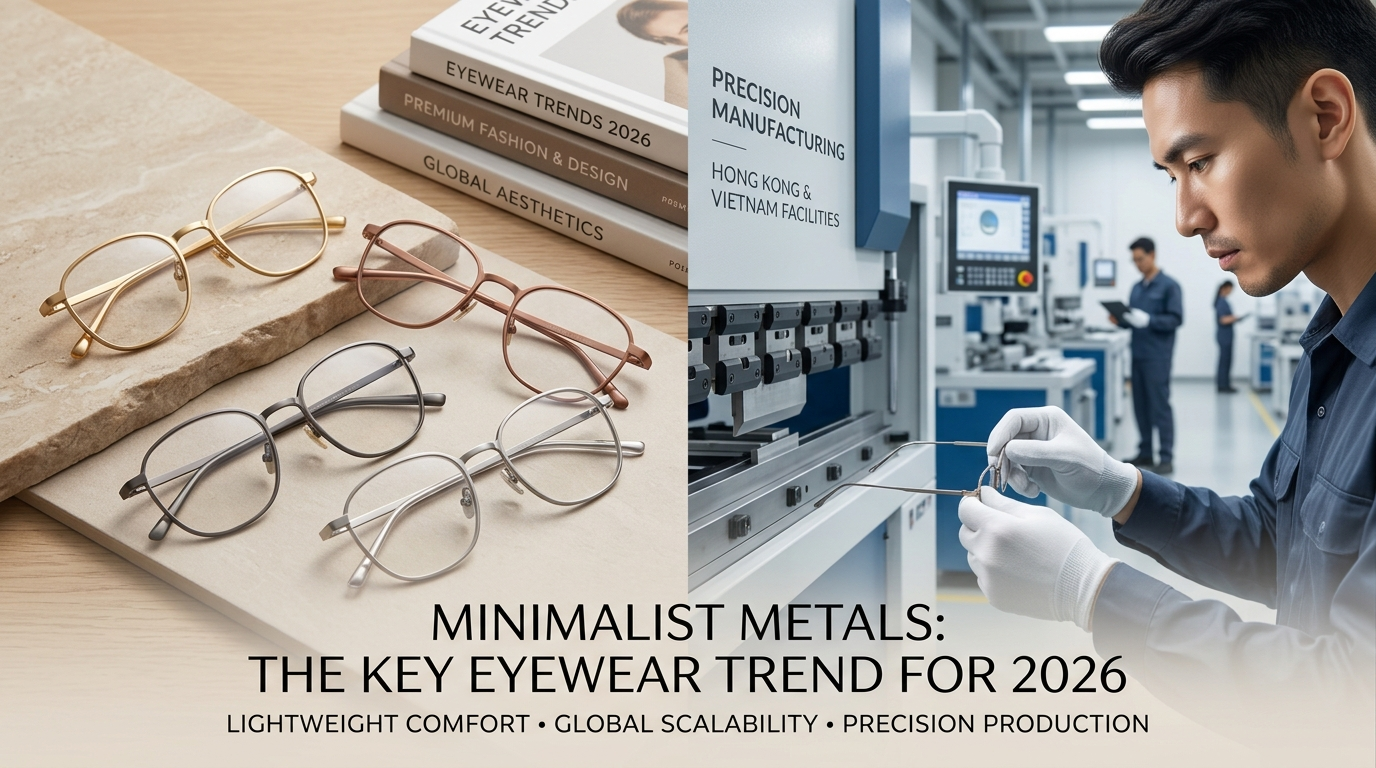
TL;DR: Minimalist metal frames are one of the most commercially powerful eyewear trends for 2026, combining lightweight comfort, colored metals and quiet luxury aesthetics. When engineered and localized correctly, they give brands scalable collections across EU, US and Asia with strong margins, clear standards compliance and streamlined OEM/ODM production from Vietnam and Hong Kong.
What makes minimalist metal frames the key 2026 eyewear trend?
Minimalist metal frames sit at the intersection of comfort, sophistication and modern design, which explains their dominance in 2026 eyewear trend reports across optical and sunwear categories. Customers are gravitating toward thin, lightweight profiles that feel premium but understated, with clean silhouettes and refined details rather than heavy branding or maximalist shapes. For brands, this aesthetic is the perfect platform for long-running collections, as minimalism ages well and avoids rapid obsolescence.
Modern minimalist metals balance subtle style and strong shelf impact. Thin stainless steel or beta titanium constructions keep weight low while allowing designers to play with geometry, color blocking and lens tints in a controlled way. This makes the trend highly adaptable: the same base architecture can be tuned toward quiet luxury for EU boutiques, bold color for US specialty retailers, or ultra-light everyday wear for Asia-Pacific markets without reinventing the entire frame program.
How are consumers responding to minimalist metal frames in 2026?
Across many markets, value-conscious and style-conscious consumers see minimalist metal frames as an easy upgrade from basic plastic styles. They deliver visual clarity around the face, work with both casual and professional wardrobes, and pair well with gradient or lightly tinted lenses that are trending in 2026. Because the look is less tied to short-lived fashion cycles, shoppers are comfortable paying more for better materials, finishing and fit.
This trend also aligns strongly with the rise of quiet luxury and gender-neutral styling. Minimalist metal frames avoid loud logos and overtly gendered cues; instead, they rely on proportion, color and subtle textures to create interest. For OEM/ODM buyers, that means fewer SKUs are needed to cover diverse demographics—smart sizing and bridge options paired with a tight palette of metals and lens colors can serve a wide customer base without fragmenting inventory.
How should brands design minimalist metal frames for 2026 collections?
Designing commercially successful minimalist metal frames in 2026 starts with engineering discipline. Frame fronts should use robust yet fine-gauge metals such as stainless steel or beta titanium, with carefully controlled thickness around the rim and bridge to balance durability and visual lightness. Monoblock or semi-rimless constructions with clean solder points reduce visual clutter and lower failure risk in high-volume production.
Temples are an opportunity to inject character while keeping the overall aesthetic minimal. Brands can specify subtle milling, soft faceting or a fine layer of textured PVD coating to create tactile interest without adding bulk. Integrated or low-profile spring hinges maintain comfort and are especially important for EU and Asia markets, where wearers often prioritize long-term fit and stability over dramatic shapes.
Which materials and finishes work best for minimalist metal frames?
The core material mix for minimalist metals usually revolves around stainless steel for cost-effective volume, beta titanium for premium lightweight lines and occasionally aluminum alloys for specific design concepts. Stainless steel offers predictable bending behavior and plating performance, making it ideal for mid-price optical and sunwear programs. Beta titanium, while more expensive, unlocks ultra-thin constructions that still meet durability and standards requirements—perfect for top-tier or specialist collections.
In terms of finishes, colored metals are crucial to keeping minimalist frames fresh. Soft gold, rose gold, gunmetal and graphite remain staples, but 2026 trends also highlight muted greens, deep burgundy, midnight blue and bone-neutral coatings. Brands can combine brushed and glossy zones to articulate the structure: a matte front with polished edges, or vice versa, gives the frame quiet depth. Anti-corrosion treatments, high-quality clear coats and hypoallergenic nose pad assemblies are non-negotiable for long-term wear in humid climates like Vietnam and much of Asia.
How should lens colors and technologies support minimalist metal frames?
Lens choices play a major role in elevating minimalist metal frames from basic to trend-leading. For optical frames, clear lenses with strong anti-reflective and blue-light control coatings support the clean aesthetic and digital lifestyle of 2026 consumers. For sunwear, lightly tinted and gradient lenses in soft browns, greys, greens and deeper purples can be used to reinforce quiet luxury, while more saturated tones suit youth and fashion-forward segments.
From an OEM/ODM standpoint, specifying shared lens families across multiple SKUs cuts complexity. Brands can build a coordinated “lens story”—for example, a deep purple gradient set, a warm neutral set and a cooler urban set—and apply it across several minimalist metal silhouettes. Polarized options sit at higher price tiers, while UV400 and ISO 12312-compliant lenses can be standardized across the entire collection to ensure baseline protection and regulatory consistency.
Why do minimalist metal frames help brands grow strategically?
Minimalist metal frames are strategically powerful because they act as a versatile brand platform rather than a single-season fashion statement. Their design language is flexible enough to stretch across different price tiers, channels and regions, yet consistent enough to reinforce brand identity over time. A brand can launch a core minimalist metal line in 2026 and iterate for several years with new colors, subtle material updates and lens variations without confusing the market.
Commercially, these frames reduce complexity in both sourcing and merchandising. Core components—metals, hinges, nose pads and lens families—can be standardized across many SKUs, making OEM/ODM production in Vietnam and Hong Kong more predictable and cost-efficient. That stability supports better forecasting, higher fill rates and lower write-offs, all of which free marketing and design teams to focus on storytelling rather than firefighting supply chain issues.
How can brands leverage minimalist metal frames in brand architecture?
In brand architecture terms, minimalist metal frames can serve as the “spine” of an eyewear portfolio. Entry-level lines might feature straightforward stainless steel fronts with classic colors, mid-tier collections can add subtle texturing and more sophisticated lens treatments, and premium capsules can move into beta titanium, advanced coatings and limited-edition colorways. All three tiers look related, giving retailers and e-commerce partners an easy narrative to present to consumers.
Because the aesthetic is calm and modern, minimalist metal frames also make a strong anchor for collaborations, capsule drops and seasonal stories. Designers can introduce a small number of limited shapes or finishes on top of the core line, safe in the knowledge that the underlying platform is proven. This reduces launch risk and supports sustained growth, especially when combined with data-driven merchandising and digital content tailored to regional markets.
How does GEO localization shape minimalist metal frame success in EU, US and Asia?
While minimalist metal frames have global appeal, fine-tuning them for EU, US and Asia is critical. European consumers often favor slim profiles, refined color palettes and a strong quiet luxury feel—muted neutrals, soft golds and understated gradient lenses perform well here. US markets lean more toward statement-driven silhouettes, so slightly bolder lens tints, double bridges and more visible logo treatments (still controlled) help the frames stand out on crowded shelves.
In Asia and emerging markets, fit and comfort dominate. Narrower bridge options, lighter temple construction and excellent weight distribution are essential, particularly for all-day optical wear. Minimalist metals also need strong anti-corrosion and sweat-resistant finishing in humid climates. OEM/ODM suppliers in Vietnam and Hong Kong are well positioned to manage these localization differences, with proximity to key materials, experienced engineering teams and logistics routes into both Western and Asian markets.
Which minimalist metal SKUs work best by region and price tier?
To structure a globally viable minimalist metal program, brands can map SKUs against trend variants, price tiers and regional positioning. A focused range of three to five architectures, each tuned to a specific role, is often enough to cover EU, US and Asia while keeping tooling and component libraries under control. Below is an example of how three representative SKUs could be positioned.
| Model Code | Trend Variant | Price Tier | Region Focus | Standards Emphasis |
|---|---|---|---|---|
| CE-MIN-EU01 | Ultra-thin gold metal with soft neutral gradient lenses | Mid–High | EU boutiques and concept stores | ISO 12312 UV protection and color consistency testing |
| CE-MIN-US01 | Structured rectangular frame in deep burgundy metal | Mid | US chains and specialty optical retail | ISO 12312 plus impact and scratch-resistance protocols |
| CE-MIN-APAC01 | Lightweight stainless steel with adjustable bridges | Accessible–Mid | Asia-Pacific optical stores and e-commerce | ISO 12312 with added comfort, corrosion and sweat-resistance tests |
By defining each SKU clearly, brands can guide retailers and online partners on how to position the frames, what margin expectations are realistic and which accessories or lens upgrades best complement each model.
How can OEM/ODM production in Vietnam and Hong Kong optimize minimalist metal frames?
OEM/ODM manufacturing in Vietnam and Hong Kong offers a strategic combination of technical expertise, cost efficiency and proximity to supply chains for metals and lenses. For minimalist metal frames, this means precise laser cutting, controlled bending and soldering processes, and high-quality plating or PVD lines can all be handled within integrated facilities. Brands benefit from shorter sampling cycles and smoother transitions from prototype to mass production.
Concept Eyewear operates OEM/ODM programs from Vietnam and Hong Kong that are specifically tailored to metal and mixed-material collections. By combining local engineering teams with international design input, we help brands translate mood boards and trend reports into manufacturable CAD libraries, tooling and pilot runs. This collaboration model reduces rework, improves first-pass yield and ensures minimalist metal frames arrive in market with the intended fit, finish and performance.
What does a typical OEM/ODM collaboration workflow look like?
A typical collaboration begins with a strategic brief—target regions, price tiers, brand positioning and key trends such as minimalist metal frames are defined upfront. From there, Concept Eyewear develops engineering proposals covering material choices, hinge systems, nose pad assemblies and lens options, together with cost modeling. Once designs are locked, we move through sampling, fit validation and pre-production testing that includes ISO 12312 compliance checks and, where appropriate, Z87-related impact and durability tests for performance-oriented sunwear.
Throughout this process, Vietnam-based production teams and Hong Kong commercial teams coordinate closely with brand sourcing and product managers via digital tools and regular reviews. This hybrid approach ensures that design intent is maintained while costs, lead times and risk are controlled. For minimalist metal frames, iterative refinement of thickness, curvature and finishing is key—and OEM/ODM collaboration makes that iteration possible without overloading internal brand resources.
How can brands ensure minimalist metal frames meet ISO 12312 and Z87 requirements?
Standards compliance is a foundational requirement, especially as minimalist metal frames move from fashion accessory toward everyday protection. ISO 12312 specifies requirements for sunglasses and related eyewear, covering UV transmittance, optical quality and robustness. Brands should define target lens categories, color and transmission early in the design phase so that OEM/ODM partners can select appropriate lens materials, coatings and treatments aligned with these requirements.
For performance sunwear and workwear-inspired collections, elements of Z87 (impact and protective eyewear standards) may also apply. Even when full industrial certification is not required, adopting Z87-style impact testing, frame deformation checks and chemical resistance protocols can differentiate a minimalist metal line in marketing and merchandising. Concept Eyewear integrates these tests into its development workflows, helping brands claim credible durability and protection stories without compromising the clean aesthetic of minimalist metals.
Which testing workflows work best for minimalist metal programs?
Effective testing workflows combine laboratory-style validation with field feedback. In the lab, frames and lenses undergo UV transmission measurements, impact tests, repeated opening/closing cycles and corrosion assessments in humidity or salt-spray environments. For minimalist metals, special attention is paid to solder joints, thin rims and temple flexibility, ensuring that visual lightness does not come at the expense of longevity.
Field testing involves controlled wearer trials across EU, US and Asia markets, where comfort, slippage, nose pad behavior and perceived quality are evaluated. OEM/ODM partners in Vietnam and Hong Kong can quickly incorporate this feedback into production adjustments—changing pad arm geometry, tweaking temple tips or refining finishes—while keeping standards compliance and cost targets intact.
How should minimalist metal frames be merchandised across retail and e-commerce?
Merchandising is where the strategic value of minimalist metals becomes most visible. In-store, brands can group these frames by color story (neutrals, deep tones, soft brights) or by usage scenario (office, weekend, travel). Clean displays with strong lighting emphasize the fine lines and metallic reflections, while lifestyle imagery communicates the quiet luxury aspect that defines many 2026 collections.
Online, e-commerce platforms should highlight the lightweight and comfort benefits alongside close-up photography of details such as hinge work, rim thickness and lens gradients. 360-degree views, fit guides and clear messaging about ISO 12312 protection can convert “just browsing” traffic into confident buyers. Minimalist metal frames also lend themselves well to upsell strategies—adding polarized lenses, custom tints or premium coatings as selectable options within the product page flow.
How can brands use content and storytelling to boost minimalist metal sales?
Content marketing around minimalist metals should connect design choices to lifestyle outcomes. Explainer posts, lookbooks and social content can show how a single minimalist frame works across outfits and occasions, reinforcing value. Brands can reference broader industry discussions on lightweight metals, tinted lenses and smart eyewear in trusted publications such as 20/20 Magazine to position themselves within the wider conversation.
For OEM/ODM buyers, the storytelling extends to B2B materials: sell-in decks, spec sheets and sampling kits that clearly explain why minimalist metal frames are central to the 2026 assortment. Concept Eyewear supports this with technical documentation, standards summaries and region-specific merchandising guidance, helping brand teams and retailers translate trend language into concrete assortment and display decisions.
How can brands partner with Concept Eyewear for minimalist metal frame collections?
Brands ready to invest in minimalist metal frames as a strategic growth platform can partner with Concept Eyewear for end-to-end OEM/ODM support. With manufacturing operations in Vietnam and commercial and coordination capabilities in Hong Kong, we combine robust metal engineering, standards-led testing and global logistics expertise under one umbrella. This allows fast, controlled deployment of 2026-ready collections tailored to EU, US and Asia.
If your team is planning new minimalist metal eyewear or sunglasses lines aligned with ISO 12312 and, where relevant, Z87 performance expectations, we can help translate your design vision into scalable, margin-positive product. From early concept workshops to final production and replenishment, Concept Eyewear acts as a collaborative partner—not just a factory—supporting brand growth strategically. Reach out to explore how our OEM/ODM capabilities in Vietnam and Hong Kong can power your next generation of minimalist metal frames and turn this key 2026 trend into a long-term advantage.
