

TL;DR: Sculptural acetate sunglasses are a defining 2026 eyewear trend, blending bold geometry, tinted lenses and quiet-luxury colors. This guide shows how brands can turn that trend into ISO 12312 and Z87-ready OEM/ODM collections with Concept Eyewear in Vietnam and Hong Kong.
How are sculptural acetate sunglasses defining 2026 eyewear?
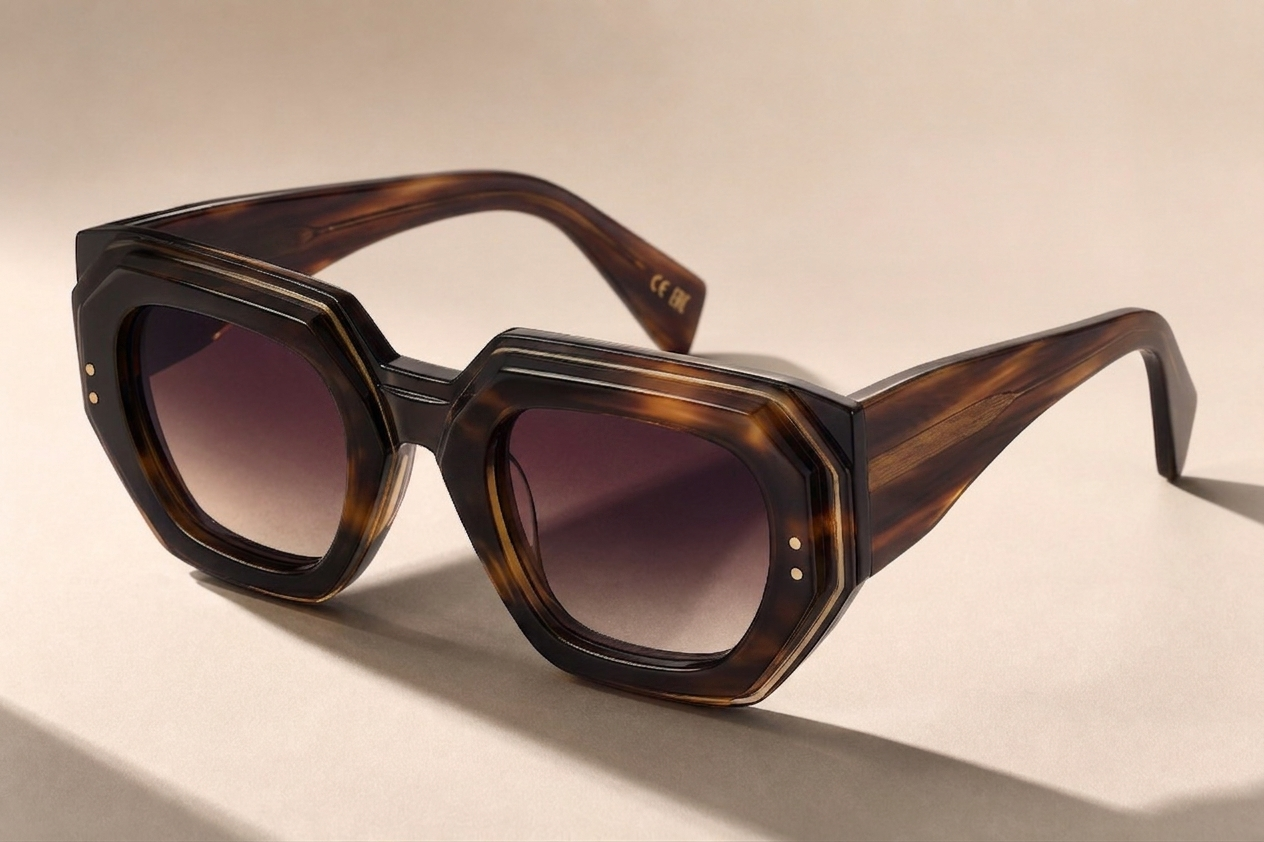
Sculptural acetate sunglasses sit at the intersection of fashion, technology and performance. Instead of flat fronts and restrained profiles, frames are carved, layered and thickened to use volume as a design statement. This makes sculptural acetate sunglasses instantly recognizable at retail and in e-commerce photography, where form, shadows and edge highlights create a premium visual story.
The trend also responds to the broader move toward personal expression and quiet luxury. Strong silhouettes and geometric angles signal confidence, while refined acetate finishes and carefully chosen neutrals keep the look wearable across age groups and markets. For brands, sculptural acetate sunglasses provide a clear design language that can stretch from accessible price tiers to aspirational flagship lines.
What design language shapes this sculptural trend?
At the heart of sculptural acetate sunglasses is three-dimensional thinking. Designers treat the frame as an object rather than a flat outline, working with bevels, faceting, stepped rims and pronounced end pieces. Temple thickness becomes part of the signature; sharp transitions between front and temple, or soft continuous curves, can communicate different brand attitudes within the same trend.
Geometry is key. Oversized squares and rectangles, deep ovals, butterfly-inspired shapes and bold cat-eye silhouettes all fit into the sculptural vocabulary. Many brands pair these shapes with translucent or gradient acetates so that internal contours and lamination effects are visible, reinforcing the sense of depth. For OEM/ODM projects, clearly defining these geometric rules in technical drawings is essential to repeatable production.
Which materials and lens technologies work best for sculptural acetate sunglasses?
Acetate remains the core material for sculptural sunglasses because it offers excellent machinability, color richness and structural stability. High-quality cellulose acetate allows for thicker profiles without excessive weight, especially when combined with carefully optimized core-wire design in temples. Brands increasingly specify plant-based or recycled acetate to align with sustainability narratives while retaining the sculptural look.
Lens selection is equally strategic. Tinted lens sunglasses are central to 2026, and sculptural acetate sunglasses benefit from deep, yet wearable tones such as warm browns, smoky grays, deep purples and wine-inspired gradients. Polarized and photochromic lenses add functional value, while anti-reflective back coatings and oleophobic front treatments ensure visual comfort and durability in daily use.
How should brands specify standards and testing for this trend?
Because sculptural acetate sunglasses often feature bold coverage and thicker rims, it is vital to align all designs with ISO 12312 requirements for sunglasses and, where applicable, Z87 performance criteria when a collection aims at enhanced impact resistance or industrial-adjacent use. Lens category, UV protection levels, and optical power limits must be defined in the technical specification to prevent late-stage redesigns.
Brands should work with OEM/ODM partners to build a testing workflow that integrates ISO 12312 testing, mechanical stress checks, sweat and corrosion resistance, and, for Z87-inspired SKUs, impact, retention and side-shield performance. Concept Eyewear can coordinate accredited lab testing from Vietnam and Hong Kong, ensuring sculptural acetate sunglasses move smoothly from sampling to mass production without compliance surprises.
How do EU, US and Asia markets differ for sculptural acetate sunglasses?
EU markets tend to favor sculptural acetate sunglasses with a balance of bold form and restrained color. Quiet-luxury tortoise, milky neutrals and translucent smoke are strong performers, paired with moderate eye sizes and comfortable bridge fits. Retailers focus on versatile silhouettes that work both as statement pieces and everyday wear, and they usually expect precise CE marking and documented ISO 12312 conformity.
In the US, sculptural acetate sunglasses skew slightly larger and more expressive, with stronger branding, thicker brows and bolder gradient lenses. Influencer-driven demand supports experimental shapes and limited-edition colorways, but retailers still require robust Z87 alignment for collections positioned near performance or outdoor segments. Asia, including markets like Hong Kong, Japan and Korea, often leans toward high-shine acetates, crystal finishes and compact fits, with sculptural detailing applied in a more refined, architectural way.
What price tiers and volumes make sense across regions?
In the entry to mid tier, sculptural acetate sunglasses should balance visual impact with efficient manufacturing: standardized hinges, shared lens shapes and common acetates across SKUs help keep costs in check. Here, brands can position high-volume collections for optical chains and online platforms, focusing on bestselling shapes and colors tailored to each region’s preferences.
Premium and luxury tiers invite more adventurous laminations, hand-finishing and limited-run colors, backed by detailed storytelling and upgraded packaging. Volume may be lower per SKU, but the margin and brand halo effect are higher. OEM/ODM manufacturers in Vietnam and Hong Kong can support staggered production strategies—core high-volume silhouettes combined with smaller drops of experimental sculptural acetate sunglasses in curated capsules.
How can brands position sculptural acetate sunglasses SKUs globally?
To maximize global sell-through, brands should think in terms of a sculptural acetate sunglasses family rather than isolated designs. A coherent set of shapes, lens colors and price points allows retailers to build strong merchandising stories and simplifies replenishment. The following table illustrates how three SKU concepts can be aligned with different regional and standards priorities.
| Model concept | Key features | Target region focus | Price tier | Standards emphasis |
|---|---|---|---|---|
| Urban Sculpt | Thick square acetate front, warm tortoise, polarized lenses | EU and US optical chains | Mid | ISO 12312 core compliance |
| Shielded Edge | Angular wrap-inspired shape, deep gradient lenses, reinforced temples | US outdoor and travel retailers | Upper mid | ISO 12312 with Z87-influenced impact focus |
| Neo Crystal | Compact oval sculpted front, crystal acetate, lightly tinted lenses | Asia fashion boutiques | Premium | ISO 12312 with enhanced comfort and fit testing |
Why do sculptural acetate sunglasses help brands grow strategically?
Sculptural acetate sunglasses give brands a ready-made design platform that can be refreshed season after season without losing identity. The interplay of thickness, contour and lens color creates distinctive visual codes that are easy to recognize in-store and on-screen. This strengthens brand recall and supports a clear positioning narrative, whether the focus is bold retro, modern architectural, or quiet-luxury minimalism.
The trend also supports strategic assortment building. Because sculptural acetate sunglasses can be scaled from entry price points to luxury, brands can design tiered collections that share a common design DNA while meeting different margin targets. This enables more precise segmentation—flagship models for halo impact, volume drivers for everyday sales, and regional exclusives to satisfy local preferences.
How does this trend enhance digital and omnichannel performance?
Digital shoppers respond strongly to three-dimensional detail. Sculptural acetate sunglasses photograph well from multiple angles, delivering the depth, reflections and silhouette clarity that product pages and social media campaigns rely on. This improves conversion rates and reduces returns, because customers can better understand how the frames occupy space on the face.
For omnichannel players, the same sculptural vocabulary supports consistent storytelling from homepage banners to store windows. Hero SKUs can anchor campaigns, while close-up shots highlight bevels, lamination lines and lens colors. Strategically, this aligns design, merchandising and performance marketing, giving brands a long-lived creative platform instead of short-term novelty.
How can OEM/ODM collaboration in Vietnam and Hong Kong unlock this trend?
Vietnam and Hong Kong are uniquely positioned to industrialize sculptural acetate sunglasses at scale. Vietnam offers competitive labor and modern factory infrastructure for high-volume production, while Hong Kong provides regional coordination, design communication and trade facilitation. Together, they form an OEM/ODM ecosystem capable of delivering precise sculptural profiling, consistent polishing and reliable standards compliance.
Concept Eyewear, with manufacturing roots in Vietnam and operational expertise in Hong Kong, can translate brand mood boards and design references into robust technical packages. CNC machining, manual sculpting and advanced tumbling processes are combined to achieve sharp edges where needed and smooth transitions where desired. This combination of industrial discipline and craft sensitivity is critical for sculptural acetate sunglasses.
What does a typical OEM/ODM project workflow look like for sculptural acetate sunglasses?
A well-structured OEM/ODM workflow begins with trend and benchmark analysis, followed by concept definition and design schematics. Brands share target fits, eye sizes, bridge measurements and temple lengths for EU, US and Asia, along with lens category, tint strategy and standards targets. Concept Eyewear then develops technical drawings, acetates and lens proposals aligned with sculptural acetate sunglasses design cues.
Sampling rounds focus first on achieving the right contours and thickness balance, then on fine-tuning fit, surface finish and lens performance. Once golden samples are approved, production tooling is locked, and a standards plan is executed, including ISO 12312 testing and any Z87-relevant checks. From Vietnam, mass production runs can support staggered deliveries and multi-region allocations, coordinated through Hong Kong for logistics and documentation.
How should brands think about materials, sustainability and supply chain for this trend?
Sculptural acetate sunglasses do not have to conflict with sustainability efforts. Brands can specify bio-based and recycled acetates, low-VOC finishing processes and durable hinges designed for long product life. A consistent core-wire strategy reduces complexity while ensuring stable fit and easier repairs, which supports circularity programs and extended-wear narratives.
On the supply chain side, consolidating sculptural acetate sunglasses production with an OEM/ODM partner in Vietnam, supported by Hong Kong logistics and trade expertise, simplifies vendor management and risk control. It becomes easier to manage color continuity, standards documentation, and lead times across EU, US and Asia, especially when collections share common components and testing protocols.
How can brands integrate sculptural acetate sunglasses into merchandising and e-commerce?
In physical retail, sculptural acetate sunglasses should anchor focal displays: front tables, window mannequins and premium wall bays. Grouping by silhouette families—square, oval, butterfly, cat-eye—helps customers navigate the assortment, while color blocking by neutrals, tortoise and statement tints supports quick visual decision-making.
For e-commerce, brands can build dedicated sculptural acetate sunglasses landing pages with curated edits for EU, US and Asia, featuring fit guidance, lens color explanations and standards callouts. Detailed photography of hinges, end pieces and temple profiles reinforces the sculptural story. Cross-linking these pages from main navigation and seasonal campaign hubs helps capture search demand and guide visitors toward high-margin SKUs.
How can brands partner with Concept Eyewear for sculptural acetate sunglasses?
Concept Eyewear positions itself as a strategic OEM/ODM partner for sculptural acetate sunglasses, combining design translation, standards expertise and manufacturing execution in Vietnam and Hong Kong. Brands can start by sharing their 2026 trend roadmap, existing SKU performance data and target regional mix, then co-develop a sculptural capsule or full collection aligned with their positioning.
To explore capabilities, brands can visit the Concept Eyewear website at Concept Eyewear, where they will find information on OEM/ODM services, manufacturing footprint and compliance support. For broader industry trend context, external resources such as leading optical magazines and fashion trade publications, including platforms like 20/20 Magazine, offer ongoing coverage of sculptural acetate sunglasses and related eyewear movements.
What is the next step for brands ready to scale sculptural acetate sunglasses?
Brands that see sculptural acetate sunglasses as a strategic pillar for 2026 and beyond should move quickly to lock in design languages, standards frameworks and OEM/ODM capacity. Early engagement with Concept Eyewear enables timely prototyping, lab testing and sales sample preparation for key trade shows and buying seasons across EU, US and Asia.
Now is the moment to turn trend insight into commercial impact. By partnering with Concept Eyewear as an OEM/ODM manufacturer in Vietnam and Hong Kong, brands can build sculptural acetate sunglasses collections that deliver distinctive design, reliable ISO 12312 compliance and, where relevant, Z87 performance attributes. Whether the goal is a focused capsule or a multi-tier global assortment, Concept Eyewear can help translate sculptural vision into scalable, standards-aligned product ready for retail and e-commerce.
