

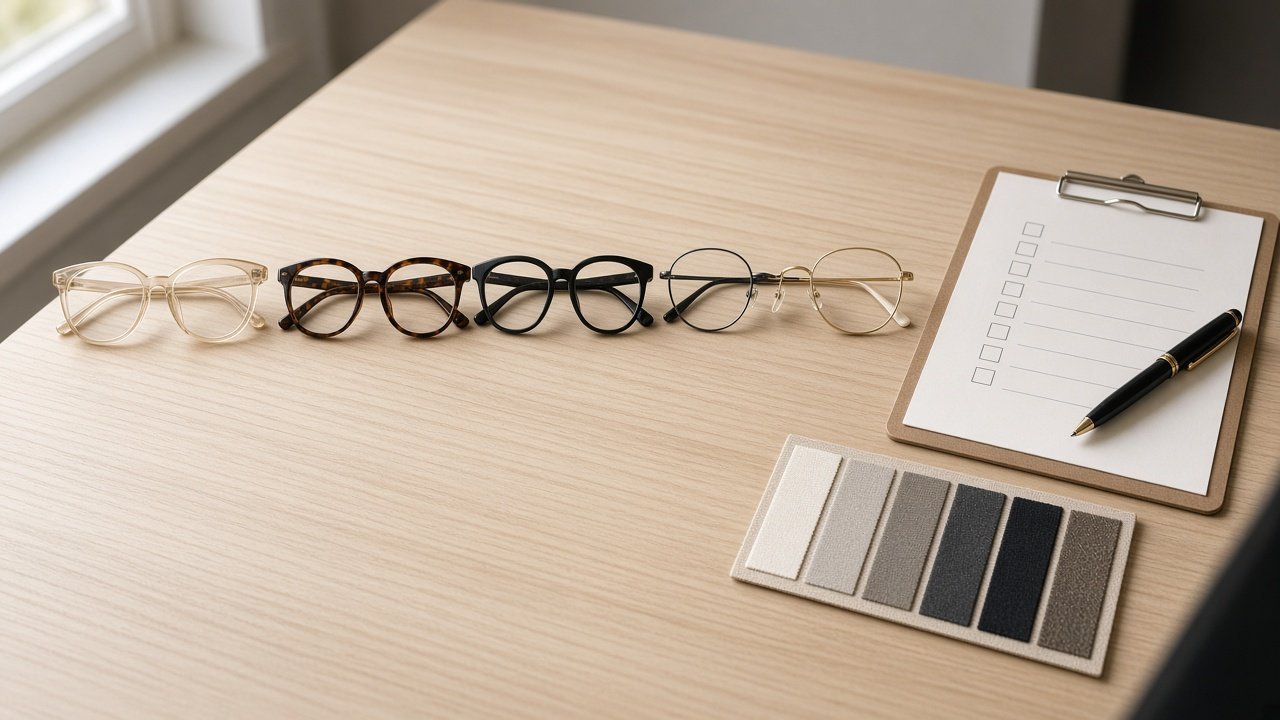
Choose eyewear OEM manufacturer decisions decide whether a fashion or apparel brand launches a clean first collection—or spends a season fixing fit, colour, and compliance gaps. A disciplined vendor checklist turns category expansion into a commercial plan. At Concept Eyewear, we see the strongest programmes treat partner selection as brand architecture, not a last-minute factory hunt.
This guide is written for United States and South America apparel and lifestyle teams that already see eyewear as a growth lever—especially after reading our eyewear AOV for apparel brands OEM playbook and our eyewear OEM sampling checklist. Here we focus on how to choose eyewear OEM manufacturer partners: capabilities, compliance, co-development versus white-label, sampling discipline, MOQ and lead time, and dual-origin footprint.
Quick answer: how do you choose an eyewear OEM manufacturer?
In short, choose an eyewear OEM manufacturer by scoring the partner on five gates. First, material and process capability that matches your silhouettes. Second, documented compliance for target markets. Third, a partnership model—co-development or white-label—that protects brand DNA. Fourth, sampling discipline with written sign-off. Fifth, honest MOQ, lead time, and FOB terms that fit your calendar.
- Map brand DNA, occasions, optical/sun mix, and target markets before you shortlist factories
- Verify acetate, metal, injection, and combination capability against your assortment plan
- Ask for compliance scope (ANSIZ80.3, CPSIA, CA PROP 65, CE, ISO12312, EN1836, REACH, and related standards) early
- Decide co-development versus white-label before you request samples
- Confirm MOQ, lead time, packaging, and dual-origin options before you announce launch
Why brands need a checklist to choose eyewear OEM manufacturer partners
Industry editors have long framed eyewear as the accessory that completes a look. Vision Monday and 20/20 Magazine’s “Ultimate Accessory” coverage notes that consumers want frames that function as well as they look—and that one shopper may want more than one look. Apparel brands entering eyewear need a manufacturer checklist so those looks stay on-brand.
Licensing and partnership activity keeps accelerating. Vision Monday’s 2025 eyewear licensing recap shows fashion, sport, and lifestyle labels treating frames as a planned portfolio extension, with multi-year manufacturing partnerships. Meanwhile, 20/20 Magazine’s “The Accessories Advantage” reminds retailers that accessories round out a sale when merchandised with intent. Choosing the right OEM is how that commercial intent becomes a shippable line.
Moreover, apparel teams already know how vendors work for garments. Eyewear has its own geometry, materials, and fit language. Therefore, a dedicated checklist to choose eyewear OEM manufacturer partners prevents garment habits from creating optical remakes.
What capabilities should you verify when you choose eyewear OEM manufacturer options?
Capability is the first screen. A partner that only offers one process or one aesthetic rarely supports a full collection story for apparel and lifestyle brands.
Capability questions that separate partners
- Material routes: acetate, metal, injection, and combination frames—plus finish intent (polish, texture, plating)
- Design depth: in-house design support versus pure build-to-print white-label
- Fit coverage: bridge options, temple lengths, and size runs that match US and South America customer mixes
- Logo and packaging craft: metal logos, print, engraving, cases, cloths, and channel-specific pack-outs
- Automation plus craft: CNC and finishing lines with craftsmen who protect fashion detail
- Export readiness: FOB China / FOB Vietnam experience and documentation for 128-country programmes
Furthermore, review process depth on our product manufacturing techniques page before you lock a shortlist. For a broader manufacturer overview, visit our China and Vietnam eyewear manufacturer hub.
How do compliance and certifications shape the partner decision?
Compliance is not a post-production checkbox. When you choose eyewear OEM manufacturer finalists, ask which standards they already support for your markets.
- Product standards commonly requested include ANSIZ80.3, CPSIA, CA PROP 65, CE, ISO12312, EN1836, REACH, ISO2870, and AS/NZS1067
- Factory systems worth confirming include ISO9001, ISO14001, SMETA 4-Pillar, CGMP, and ISCC
- US programmes often need CPSIA and CA PROP 65 clarity early; South America programmes benefit from CE/ISO12312 fluency when channels span regions
Consequently, treat compliance as a selection filter, not a scramble after PPS. Our eyewear compliance standards OEM guide walks through how brands brief market scope into the OEM relationship.
Co-development vs white-label: which partnership model fits?
Partnership model is where brand DNA either thrives or dilutes. 20/20 Magazine’s coverage of fashion-label eyewear partnerships shows designers seeking true co-development—merging apparel design philosophy with eyewear manufacturing know-how—rather than handing a logo to a generic white-label programme.
- White-label: faster when you pick from proven silhouettes and apply branding; less distinctive if competitors can buy similar shapes
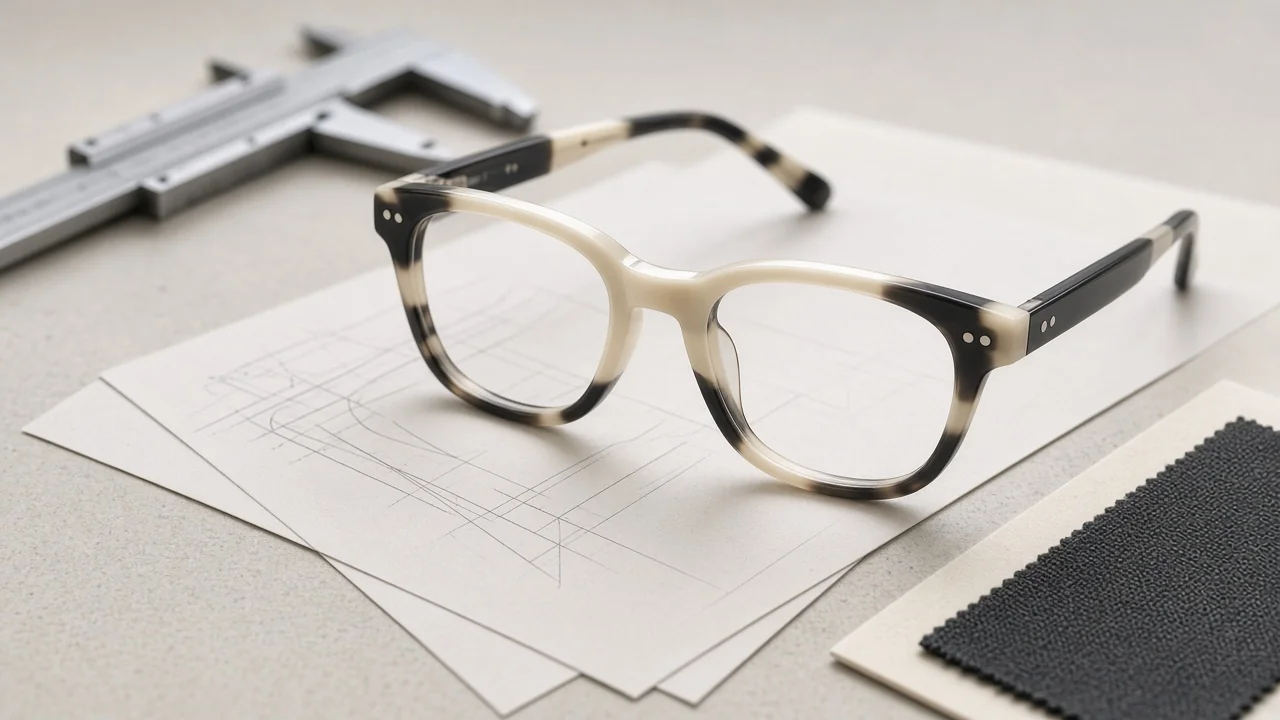
- Co-development: you brief from sketches, mood boards, or inspiration frames; the OEM refines proportion, colour, and finish so frames still feel like your apparel language
- Hybrid: start with a co-developed hero set of three or more models, then extend with selective white-label fill-ins
In addition, Concept Eyewear is built for high customization. Clients pass preferences or inspiration frames; we tweak on top. See our eyewear manufacturing partner co-development guide for how that workflow protects brand image.
How sampling discipline proves you chose the right OEM
Sampling is the stress test of the partnership. Brands that choose eyewear OEM manufacturer partners with staged samples move faster than teams that change silhouette, colour, and logo on the same piece.
- Proto / silhouette sample. Confirm shape and attitude against apparel DNA.
- Fit / wear sample. Validate bridge, temple curve, and weight balance.
- Colour and finish chips. Approve colourways against apparel cards.
- Logo and packaging sample. Lock branding and pack-out.
- Pre-production (PPS). Final sign-off before bulk—no open design questions left.
Moreover, prefer three or more models for a first collaboration so merchandising reads as a collection. Pair this gate with our eyewear OEM sampling checklist and the eyewear collection OEM get-started workflow.
What MOQ, lead time, and FOB terms should brands expect?
Commercial terms belong on every vendor scorecard so product and marketing stay aligned. Concept Eyewear is a Hong Kong-based OEM/ODM manufacturer with 26 years of experience, teams across Hong Kong, China, Vietnam, the UK, and Japan, and shipments to 128 countries.
- MOQ is 400 pcs per model for acetate and metal. Injection MOQ depends on the design.
- Each 400-piece MOQ covers three colour combinations, with at least 100 pcs per combination.
- For a first collaboration, we suggest launching with three or more models.
- Lead time is typically 90–100 days from finalized design to production completion.
- Shipping terms are FOB China or FOB Vietnam.
- Pricing depends on design complexity and materials. Therefore, please share your target range privately for a quote.
Dual-origin footprint: Hong Kong, China, and Vietnam
Dual-origin capacity is a resilience filter when you choose eyewear OEM manufacturer partners for US and South America programmes. Hong Kong coordination, China manufacturing depth, and Vietnam capacity let brands plan assortment and risk without splitting brand DNA across unrelated vendors.
Vietnam production, when your programme needs that footprint, is based at Block E5 & 6, Hoa Hiep Industrial Zone, Dong Hoa, Phu Yen, Vietnam (+842573550435). Japan demand can sit as a light secondary note in the brief when your channel already needs it—without turning a first US/South America collection into a bilingual programme.
How US and South America brands evaluate OEM partners
US DTC and wholesale programmes usually win when partner selection follows apparel drop calendars. South American distributors and multi-brand retailers often need durable sun stories, clear colour stories, and packaging that travels well. In both cases, the same checklist to choose eyewear OEM manufacturer partners keeps assortment, attach-rate merchandising, and factory reality in one plan.
Moreover, treat vendor meetings as merchandising inputs. Capability maps inform lookbooks. Compliance scopes inform channel claims. Sampling calendars inform launch dates.
How Concept Eyewear partners with apparel and lifestyle brands
We translate apparel DNA into frames, sample in stages, and protect commercial calendars. You can brief from sketches, mood boards, or inspiration frames. Our design team refines proportion, colour, and finish so the eyewear still feels like your apparel language.
- Brief intake. Mood boards, apparel colour cards, hero silhouettes, target occasions, and market scope.
- Capability and compliance match. Confirm material routes and standards for US and South America channels.
- Partnership model. Co-development, white-label, or hybrid—chosen before tooling expands.
- Staged samples. Proto, fit, colour/finish, logo/packaging, then PPS with written sign-off.
- Collection set. Prefer three or more models for the first collaboration.
- Production plan. Lock MOQ, lead time, packaging, and FOB terms before marketing calendars go live.
FAQ: choose eyewear OEM manufacturer
How do I choose an eyewear OEM manufacturer for a first apparel collection?
Score partners on capability, compliance, partnership model (co-development vs white-label), sampling discipline, and commercial terms (MOQ, lead time, FOB). Prefer a manufacturer that can protect apparel DNA across three or more first models.
What capabilities matter most when brands choose eyewear OEM manufacturer partners?
Confirm acetate, metal, injection, and combination routes; design support; fit coverage; logo and packaging craft; and export readiness for your target markets.
Should we choose co-development or white-label?
White-label is faster for proven shapes. Co-development better protects distinctive brand DNA when you brief from sketches, mood boards, or inspiration frames. Many apparel brands use a hybrid: co-developed heroes plus selective fill-ins.
What MOQ and lead time should we plan for?
MOQ is 400 pcs per model for acetate and metal, across three colour combinations of at least 100 pcs each. Injection MOQ depends on the design. Lead time is typically 90–100 days from finalized design to production completion, FOB China or FOB Vietnam.
How is pricing handled when we choose an eyewear OEM manufacturer?
Pricing depends on design complexity and materials. Please share your target range privately, and we will prepare a quote.
Can Concept Eyewear support US and South America programmes with dual-origin manufacturing?
Yes. Concept Eyewear is a Hong Kong-based OEM/ODM manufacturer with 26 years of experience and teams across Hong Kong, China, Vietnam, the UK, and Japan. Programmes ship to 128 countries, with FOB China or FOB Vietnam options and Vietnam production at Block E5 & 6, Hoa Hiep Industrial Zone, Dong Hoa, Phu Yen, Vietnam (+842573550435).
Start: choose eyewear OEM manufacturer with Concept Eyewear
Ultimately, when you choose eyewear OEM manufacturer partners with a clear checklist, apparel and lifestyle brands turn accessory ambition into a shippable line. Verify capabilities, lock compliance scope, pick the right partnership model, and sample in stages. Learn more about Concept Eyewear, then contact our team to brief your first models.
