

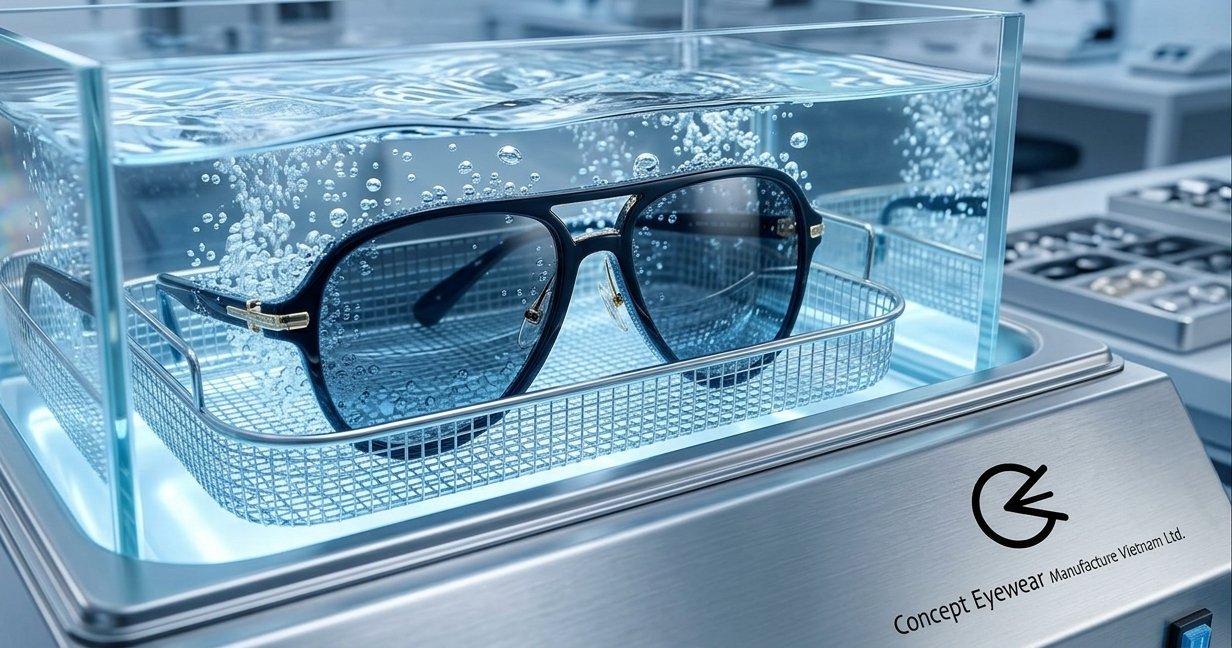
When retail chains, optical groups, and fashion labels design a new collection of private label sunglasses or optical frames, their customers expect absolute perfection, from hinge smoothness to lens clarity and surface finish. At Concept Eyewear, operating as a premier OEM/ODM manufacturer with facilities in Vietnam and China, we know that reaching this level of retail-ready quality requires not only precision engineering but also meticulous cleaning and rigorous Quality Assurance (QA).
One of the most critical steps in our manufacturing process is ultrasonic cleaning, an industrial method that uses high-frequency sound waves and cavitation bubbles to remove microscopic dirt, oils, and polishing residues from every gap and groove of the frame. By combining this technology with strict checking protocols aligned to US, European, and Australian market expectations, we ensure every piece meets the performance and aesthetic standards demanded by our customers.
The Manufacturing Challenge: Hidden Residues in Eyewear Production
Premium eyewear production involves multiple mechanical stages- cutting, milling, routing, tumbling, and hand-polishing- across acetate, injected plastic, and metal components. Each stage uses polishing compounds, micro-abrasives, and machine oils that naturally leave behind fine debris on and inside the frame.
Because modern eyewear designs are highly intricate, this residue migrates into the smallest, hardest-to-reach areas of the product. Typical problem zones include:
- Internal rim grooves where lenses will later be seated
- Hinge barrels and screw threads in the temples
- Tight gaps behind nose pad arms and along wire cores
If these contaminants are not completely removed, they can stiffen hinge movements, compromise lens fit, and create visible blemishes around the rims. For brands targeting high-end retail channels, a simple manual wipe-down cannot reach these internal cavities and is therefore insufficient as a final cleaning method.
The Science of Ultrasonic Cleaning in Eyewear Manufacturing
To achieve a consistently immaculate finish, Concept Eyewear uses industrial ultrasonic cleaning systems designed for precision components like optical frames. Ultrasonic cleaning relies on a physical phenomenon called cavitation to deliver deep, uniform cleanliness that manual washing cannot match.
Step 1 – Submersion in a Controlled Cleaning Bath
Frames are securely placed onto dedicated racks and submerged into a tank filled with a formulated, water-based cleaning solution tailored for eyewear materials. The composition of this solution is selected to dissolve oils and polishing compounds while remaining safe for acetate, metal, and coated surfaces.
Step 2 – High-Frequency Sound Waves and Cavitation
Inside the tank, ultrasonic transducers generate high-frequency sound waves, typically between 20 and 80 kilohertz, which propagate through the liquid. These waves create alternating high- and low-pressure cycles in the solution, forming millions of microscopic bubbles during the low-pressure phase.
As the pressure rises again, these bubbles collapse or implode in a process known as acoustic cavitation. Each implosion releases a localized burst of energy, producing micro-jets of liquid that act like microscopic scrubbing brushes along the surface of the eyewear frame.
Step 3 – Deep Cleaning of Hinges, Grooves, and Cavities
Because cavitation happens throughout the liquid volume, the cleaning action reaches areas that cloths and brushes cannot access. In practice, this means:
- Polishing wax is dislodged from lens rim grooves and drainage holes
- Grease and micro-dust are flushed out of hinge barrels and screw threads
- Skin oils and particles are removed from around nose pads and behind metal components
At Concept Eyewear, specialized carousel equipment systematically rotates and submerges batches of frames in multi-stage ultrasonic baths to ensure every hinge, groove, and cavity receives uniform exposure to the cavitation effect. The process is powerful enough to remove tightly packed compounds and debris, yet gentle enough not to scratch or dull the polished surface of the frame.
Integration with Quality Assurance and Final Checking
Ultrasonic cleaning is not an isolated step; it is embedded into our broader QA workflow as a prerequisite for reliable inspection. Cleanliness is essential for accurately assessing both cosmetic and mechanical attributes of each frame.
Post-Cleaning Rinse and Dry
After exiting the ultrasonic tank, frames go through controlled rinsing stages to remove loosened contaminants and any residual cleaning chemistry. They are then thoroughly dried using filtered air and, when required, temperature-controlled drying tunnels to prevent water spots or corrosion on metal components.
Final QA Checks After Ultrasonic Cleaning
Once the frames are clean and dry, they move to final checking stations where experienced inspectors verify several critical quality points:
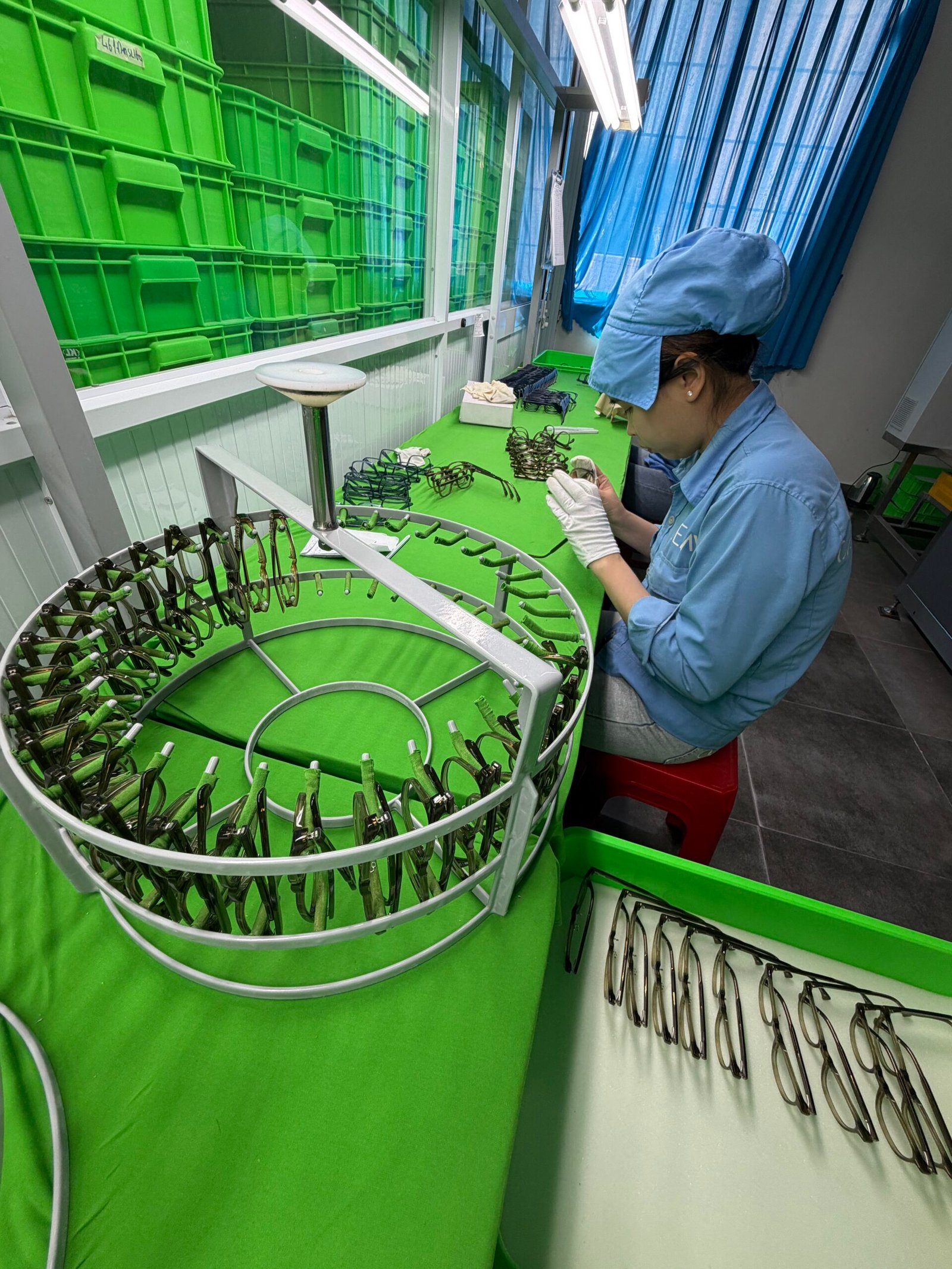
- Surface Integrity: The frames are checked under high-intensity lighting for any microscopic scratches, plating inconsistencies, or polishing defects that would have otherwise been hidden by wax or oils.
- Mechanical Function: Inspectors test the hinges to ensure they open and close with the correct tension. Because the hinge barrels are completely free of debris, the movement can be accurately evaluated for smoothness and reliability.
- Component Alignment: The alignment of the nose pads, wire cores, and rim locks is verified. Clean grooves ensure that when the lenses are finally fitted, they seat perfectly and securely without any distortion.
By performing QA only after ultrasonic cleaning has stripped away masking residues, our team can detect defects earlier and with greater precision, minimizing rework and ensuring that non-conforming units are corrected or rejected before packing.
Outcome: Delivering Retail-Ready, Deep-Cleaned Eyewear
The ultimate purpose of the ultrasonic cleaning stage is to protect your brand’s reputation at the moment of unboxing or first try-on. When a customer picks up a pair of your sunglasses from a display in Europe or receives an e-commerce order in the US, every visible and tactile detail must reflect a premium standard.
By combining deep-cleaning ultrasonic technology with unyielding QA and alignment to Western market expectations, Concept Eyewear ensures that your private label collection arrives in flawless, ready-to-wear condition- free from hidden debris, cosmetic defects, and functional issues.
Ultrasonic Cleaning – Eyewear Manufacturing FAQ
1. What is ultrasonic cleaning in eyewear manufacturing?
Ultrasonic cleaning is an industrial process that uses high-frequency sound waves to generate microscopic cavitation bubbles in a liquid cleaning solution. When these bubbles collapse against the frame surface, they produce micro-jets of liquid that safely scrub away dirt, oils, and polishing compounds from hinges, grooves, and other complex geometries.
2. Why is ultrasonic cleaning necessary for frames?
Mechanical shaping and polishing leave residues in tight spaces such as hinge barrels, screw threads, and lens grooves that cannot be fully cleaned with manual wiping or basic washing. Ultrasonic cleaning is the most reliable way to extract these embedded contaminants without damaging the frame, ensuring smooth hinge movement, accurate lens fit, and a flawless finish at retail.
3. Does ultrasonic cleaning damage eyewear materials?
When properly calibrated and paired with a compatible cleaning solution, ultrasonic cleaning is safe for standard eyewear materials such as acetate, metal alloys, and most lens-compatible components. The cavitation effect is aggressive toward contamination but non-abrasive to the polished surfaces, so it removes residue without scratching or dulling the frame.
4. How does ultrasonic cleaning connect to your QA process?
Thorough cleaning is a mandatory prerequisite for our QA checks because residues can hide scratches, plating defects, or subtle alignment issues. Once ultrasonic cleaning removes all masking contamination, our inspectors can accurately assess surface quality, verify plating integrity, and test hinge smoothness and tension before frames are approved for packing and shipment.
