

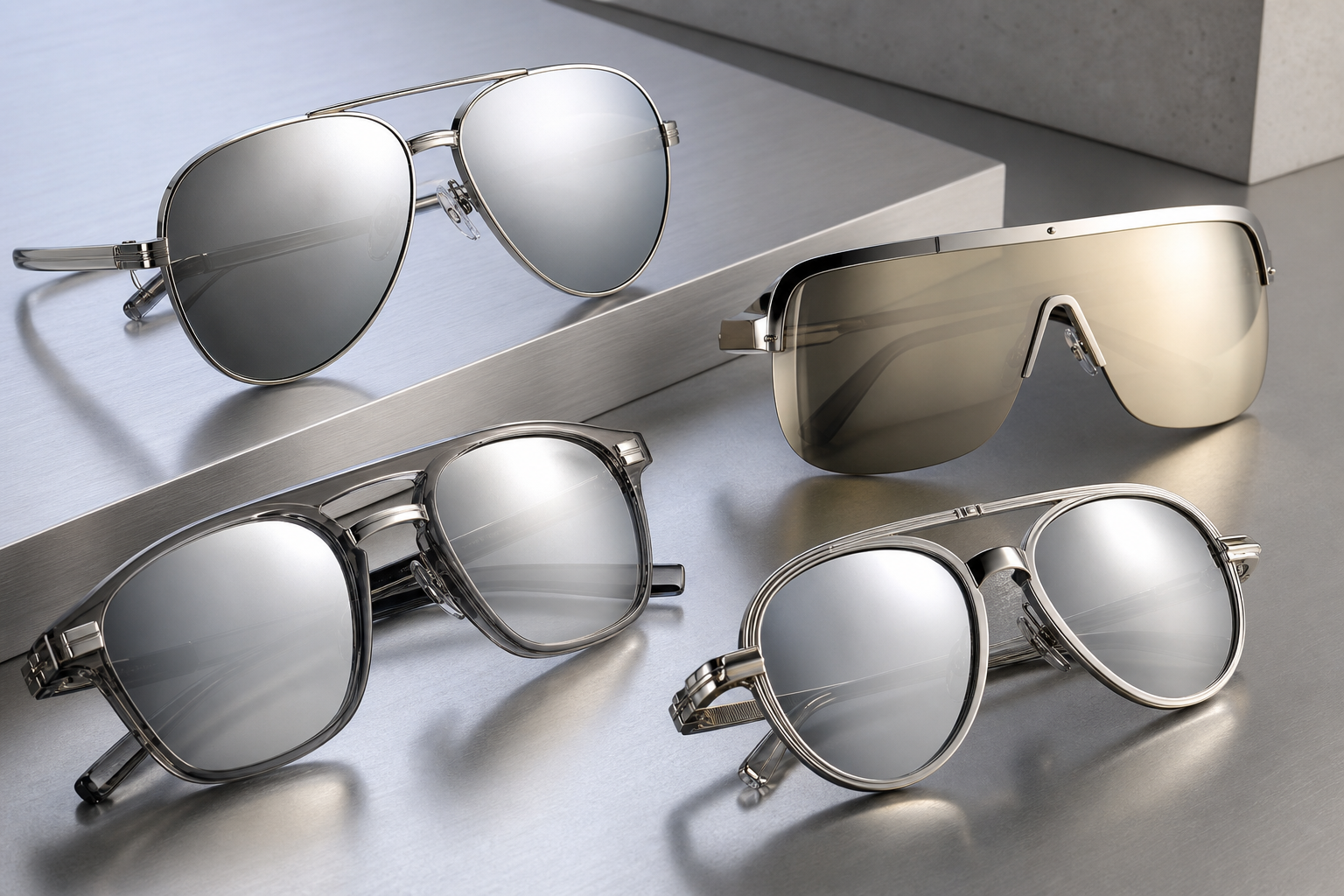
TL;DR: Chrome metallic sunglasses are one of the most commercially promising 2026 eyewear trends, combining high-shine metal frames, mirror-finish lenses and quiet-luxury detailing. For brands, they offer a clear platform to premiumize sunwear lineups, create coherent capsule stories and leverage OEM/ODM partners in Vietnam and Hong Kong to deliver regional fits and ISO 12312-compliant performance at scale.
Why are chrome metallic sunglasses defining 2026?
Chrome metallic sunglasses sit at the intersection of futuristic tech aesthetics and refined, everyday luxury. Highly polished metal frames, reflective lens coatings and tone-on-tone finishes instantly communicate value at the shelf, while still being versatile enough to work across casual, athleisure and fashion collections. This makes them attractive to both aspirational mass-market consumers and premium shoppers looking for a statement piece that still feels wearable.
Visually, chrome metallic sunglasses span a broad range: ultra-thin stainless steel wireframes with subtle mirror lenses, chunky architectural fronts with full chrome plating, and hybrid constructions where metallic bridges and temples contrast against translucent acetates. The same core design language can be tuned for gender-neutral, women’s or men’s assortments simply by tweaking proportion, lens shape and color temperature, which is ideal for retailers seeking unified displays with differentiated stories.
How should brands design chrome metallic sunglasses for 2026 collections?
Designing successful chrome metallic sunglasses for 2026 means balancing bold visual impact with long-term comfort and durability. Buyers should treat the chrome finish as a complete storytelling layer, not just an afterthought, aligning frame architecture, lens color, hardware and packaging around a consistent metallic narrative.
Which frame materials work best for chrome finishes?
For metal-forward designs, stainless steel, monel and titanium remain the core substrates for chrome metallic sunglasses. Stainless steel provides a good balance of strength, corrosion resistance and cost, while titanium offers premium lightness and hypoallergenic performance for higher price tiers. Monel and other copper-based alloys can deliver rich surface finishes at competitive costs, but require careful control of plating stacks and lacquer to maintain shine and avoid tarnish over time.
For mixed-material or acetate-led concepts, brands can use high-density acetates with embedded metallic layers or apply sputtered or PVD-style coatings on selected zones such as bridges, brows or endpieces. This allows designers to create chrome accents without the full weight of a metal frame. In all cases, OEM/ODM partners should validate nickel-release performance and surface durability according to applicable EU and US regulations, ensuring that fashionable chrome surfaces remain safe and stable during real-world wear.
How can lens choices reinforce the metallic story?
Lens selection is critical to making chrome metallic sunglasses feel coherent and modern. Full mirror coatings in silver, smoke or soft champagne create a pure metallic statement, while light flash mirrors paired with neutral grey or brown bases can deliver a more versatile, all-day tint. For quieter SKUs, a subtle flash on the upper third of the lens or a soft gradient mirror can be enough to connect with the chrome narrative without overwhelming more conservative shoppers.
From a performance standpoint, brands should specify lenses that meet ISO 12312 requirements for UV protection, luminous transmittance and category classification, while also considering polarized and AR-coated options for higher-end SKUs. For omnichannel sell-in, it is useful to build a clear good-better-best ladder: entry price frames with hard-coated mirrored lenses, mid-tier with upgraded tints and scratch resistance, and top-tier SKUs featuring polarized, oleophobic and hydrophobic stacks that justify higher RRPs.
What ergonomic details matter for all-day wear?
Because chrome metallic sunglasses often use denser materials and layered plating, ergonomics deserves special attention at the design stage. Fine-tuning bridge widths, pantoscopic angles and lens base curves helps distribute weight evenly and prevent sliding, especially for EU and US consumers who may wear sunwear for longer driving or commuting periods. Adjustable silicone nose pads on metal frames and soft, injected temple tips on hybrid designs improve comfort and accommodate a wider range of facial anatomies.
For Asia-focused fits, OEM/ODM partners can introduce higher nose bridges, reduced temple clamping force and shorter temple lengths to address regional anthropometrics. Concept Eyewear can also run iterative sampling rounds to match specific retailer fit blocks, ensuring that chrome metallic sunglasses not only look premium in photography but also perform in-store and in real life.
How do chrome metallic sunglasses fit EU, US and Asia markets?
Chrome metallic sunglasses can be localized effectively across EU, US and Asia by adjusting fit, finish, price tier and standards emphasis. Rather than treating the trend as a single global SKU, leading brands are structuring families of silhouettes that share a core design DNA but adapt to regional expectations in comfort, performance and merchandising.
| Concept SKU | Region focus | Price tier | Key specs | Standards emphasis |
|---|---|---|---|---|
| CM-01 Minimal Chrome Pilot | EU | Mid | Titanium pilot frame, soft silver flash mirror lenses, slim temples for lightweight wear | ISO 12312 sunglasses compliance, nickel-release and chemical resistance for EU directives |
| CM-02 Bold Chrome Shield | US | Upper mid | Wrap-style shield lens, strong chrome brow bar, rubberized temples, optional polarized lenses | ISO 12312 plus Z87-style impact and coverage performance messaging for active consumers |
| CM-03 Chrome Hybrid Acetate | Asia | Accessible premium | Acetate front with chrome-plated bridge and temples, Asian fit bridge geometry, light mirror gradient lenses | ISO 12312 compliance with focus on fit comfort, anti-corrosion and long-term plating adhesion |
By structuring assortments this way, brands can leverage shared tooling and components while tailoring key details such as lens category, bridge fit, temple geometry and packaging narratives. OEM/ODM partners in Vietnam can manage component harmonization and bill-of-materials optimization, while Hong Kong-based commercial teams coordinate regional approvals and sales kits for buyers in different markets.
How can OEM/ODM collaboration in Vietnam and Hong Kong support this trend?
Chrome metallic sunglasses rely heavily on precise metalworking, controlled plating environments and consistent finishing, all of which align well with the strengths of OEM/ODM manufacturing hubs in Vietnam. Concept Eyewear works with factories that can manage multi-layer plating stacks, PVD-style coatings and detailed QC for surface defects, while also delivering competitive lead times and flexible MOQs across multiple chrome variants.
Hong Kong remains a strategic coordination center, enabling rapid communication with brand design teams, merchandising leads and sourcing departments across Europe and North America. From Hong Kong, Concept Eyewear can translate design briefs into technical drawings, 3D files and bill-of-materials structures tailored for Vietnamese production lines, ensuring that chrome metallic sunglasses move from moodboard to approved golden sample with minimal friction.
For example, a European optical chain might brief a mid-priced chrome capsule with three pilots and two rounded rectangles, all within a specific retail price window. Concept Eyewear can propose a tiered material strategy (stainless steel for volume SKUs, titanium for hero frames), align plating and lens suppliers in Vietnam, and structure testing and documentation to meet EU market requirements. At the same time, the same core tooling can be used to serve a US direct-to-consumer brand with more aggressive chrome detailing, alternative lens colors and enhanced packaging that speaks to performance and lifestyle positioning.
Brands interested in building these kinds of coordinated programs can explore case studies and capabilities directly on Concept Eyewear, and then work with Hong Kong-based project managers to define timelines, specification sheets and rollout plans.
What standards and testing are critical for chrome metallic sunglasses?
Even the most visually compelling chrome metallic sunglasses must first be safe and compliant. ISO 12312 sets core requirements for sunwear, covering ultraviolet protection, luminous transmittance, traffic signal recognition, impact resistance and a range of mechanical and chemical tests. For chrome-rich designs, particular attention should be given to surface adhesion, corrosion resistance and sweat simulation tests, ensuring that mirror coatings and plating layers remain intact under realistic wear conditions.
In segments where brands position chrome metallic sunglasses as crossover performance or protective products, it becomes relevant to aim for Z87-level performance characteristics. While full ANSI Z87.1 certification may not be required for fashion-led lines, designing lenses and frames that approach those impact and coverage benchmarks can provide a compelling marketing story for US consumers who associate mirrored, wrap-style sunglasses with sports and outdoor activities. Clear labeling that differentiates fashion sunwear from certified protective eyewear remains essential to avoid regulatory confusion.
Operationally, brands should work with OEM/ODM partners to define standard test plans that cover at least the following: UV and transmittance testing under ISO 12312, lens and frame impact tests, plating and mirror adhesion tests, salt-spray and sweat resistance, and hinge cycle durability. Third-party laboratories can provide formal reports, while in-house QC in Vietnam can manage routine inspection plans, sample retention and traceability to production lots.
To stay aligned with evolving industry expectations and best practices, buyers and product managers can regularly review resources from leading trade and professional platforms such as 20/20 Magazine, and then translate those insights into concrete test protocols and specification updates for chrome metallic programs.
Why do chrome metallic sunglasses help brands grow strategically?
Chrome metallic sunglasses are not just another seasonal embellishment; they give brands a strategic toolkit for portfolio differentiation and value creation. Because the chrome language can be executed from entry-level to premium price tiers, it is possible to architect clear line structures where metal intensity, lens technology and detailing map directly to price points and margin targets. This makes it easier for sales teams to tell coherent stories to buying offices and for retailers to build eye-catching, yet logically organized, merchandising walls.
From a brand equity perspective, chrome metallic sunglasses photograph extremely well, whether in studio shoots, user-generated content or e-commerce thumbnails. High-shine frames and reflective lenses help collections stand out in digital marketplaces, where shoppers scroll quickly and respond to strong visual cues. By anchoring campaigns around a focused chrome capsule, brands can drive more efficient marketing spend, leveraging a consistent visual motif across banners, social media and in-store POS while still offering enough SKU diversity to meet different face shapes, genders and price sensitivities.
Operationally, chrome metallic programs also align with the strengths of Concept Eyewear as an OEM/ODM partner in Vietnam and Hong Kong. Once tooling, plating sequences and test plans are established, brands can spin off regional exclusives, limited editions and retailer-specific variants with relatively low incremental cost. This supports growth strategies based on targeted collaborations, co-branded launches and omnichannel drops, all built on a stable technical platform that meets ISO 12312 requirements and, where relevant, approaches Z87 performance benchmarks.
For brands looking to capitalize on this 2026 trend, the next step is to brief a focused chrome metallic sunglasses capsule with clear regional roles, price tiers and standards expectations. By partnering with Concept Eyewear as an OEM/ODM specialist in Vietnam and Hong Kong, buyers can turn that brief into robust, tested and visually distinctive collections that strengthen their positioning in both brick-and-mortar and digital channels.
