

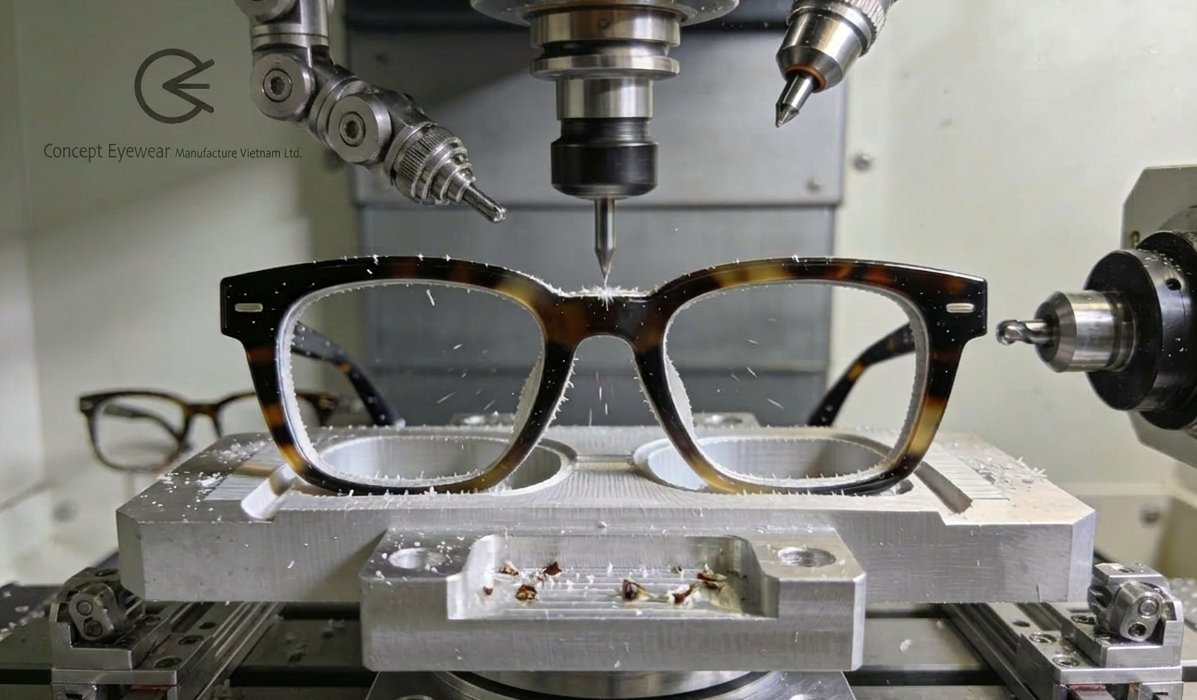
Acetate CNC finishing OEM work is where premium frame detail either reads as fashion architecture—or collapses into generic plastic. Multi-axis machining shapes rim edges, hinge pockets, and temple geometry before craftsmen polish the surface brands photograph. At Concept Eyewear, we treat acetate CNC finishing as brand DNA in toolpaths, not a back-of-house afterthought.
This guide is for United States and South America apparel and lifestyle teams building acetate collections with an OEM partner. It pairs with our multi-axis CNC manufacturing guide for OEM eyewear in Vietnam and our product manufacturing techniques overview. Here we focus on finishing intent: what CNC should lock, what polish should protect, and how brands brief the process before sampling.
Quick answer: what is acetate CNC finishing OEM for brands?
In short, acetate CNC finishing OEM means programming multi-axis toolpaths that cut solid acetate sheet into precise fronts and temples, then refining those surfaces through staged polishing so silhouette, edge radius, and hinge fit match the brand brief. CNC owns geometry; finishing owns tactile luxury.
- Lock silhouette, bevel, and hinge pocket geometry in CAD before CNC programmes run
- Specify edge radius, polish grade, and texture intent in the tech pack—not only colour
- Separate CNC proto from polish sign-off so remakes stay scoped
- Prefer Mazzucchelli or approved premium acetate when the brief needs depth and colour stability
- Plan MOQ, lead time, and FOB terms after finishing standards are written—not before
Why does acetate CNC finishing matter for premium OEM collections?
Industry editors keep framing eyewear as the accessory that completes a look. Vision Monday and 20/20 Magazine’s “Ultimate Accessory” coverage notes that consumers want frames that function as well as they look. Acetate CNC finishing is how those looks survive close-up photography and all-day wear.
Meanwhile, 20/20 Magazine’s “The Accessories Advantage” reminds retailers that accessories round out a sale when merchandised with intent. Soft edges, crisp bevels, and hinge pockets that seat correctly are the finishing details shoppers feel before they read a brand story.
Moreover, apparel teams often brief colour first. Acetate CNC finishing OEM partners also need geometry language: rim thickness maps, bevel profiles, and temple taper. Without that language, colour chips alone cannot save an unfocused silhouette.
How does multi-axis CNC shape acetate frame detail?
Multi-axis CNC mills cut acetate from sheet stock into fronts and temples with controlled toolpaths. The machine owns consistency across sizes; craftsmen own the final hand that brands associate with premium.
CNC gates brands should brief early
- Front silhouette and depth: outer contour, lens aperture, and rim thickness that match optical or sun intent
- Edge architecture: bevel angle, facet count, and whether the rim reads soft, sharp, or sculptural
- Hinge pockets: machining that seats metal hinges without rocking or crush marks
- Temple geometry: taper, tip pocket, and flex zones that survive wear testing
- Material orientation: sheet grain and colour pattern alignment for mottled or striped acetates
Furthermore, review process depth on our Vietnam multi-axis CNC OEM article and the manufacturing techniques page before you lock a finishing brief. For a broader manufacturer overview, visit our China and Vietnam eyewear manufacturer hub.
What finishing steps follow CNC before brands sign off?
CNC leaves a precise blank. Finishing turns that blank into a wearable, photographable frame. Brands that skip staged polish approvals often discover edge haze or uneven gloss after packaging photos are already shot.
- Deburr and edge refine. Remove machining marks without collapsing the bevel CNC created.
- Staged polish. Move from coarse to fine so colour depth and translucency open without rounding away design edges.
- Hinge and hardware fit. Confirm metal seats cleanly after polish thickness is final.
- Clean and inspect. Check for swirl, burnish, or pattern smear on premium sheets.
- Pre-production (PPS) finish standard. Lock the polish grade brands will photograph and ship.

How should brands brief acetate CNC finishing OEM partners?
A finishing brief is part of co-development, not a note on a mood board. Pass preferences or inspiration frames; the OEM tweaks geometry and polish on top so brand DNA survives the machine.
- Reference silhouettes: photos or sketches with callouts for rim thickness and edge attitude
- Material call: Mazzucchelli or approved premium / regional acetates, with colour chips tied to apparel cards
- Finish intent: high gloss, soft satin, or mixed—written as acceptance criteria
- Size run: bridge and temple lengths for US and South America mixes
- Logo zones: temple real estate reserved before CNC programmes harden
In addition, pair this brief with our eyewear OEM sampling checklist and choose eyewear OEM manufacturer guide so process and partner selection stay aligned.
What MOQ, lead time, and materials should brands plan for?
Commercial terms belong beside finishing standards so product and marketing calendars match. Concept Eyewear is a Hong Kong-based OEM/ODM manufacturer with 26 years of experience, teams across Hong Kong, China, Vietnam, the UK, and Japan, and shipments to 128 countries.
- MOQ is 400 pcs per model for acetate and metal. Injection MOQ depends on the design.
- Each 400-piece MOQ covers three colour combinations, with at least 100 pcs per combination.
- For a first collaboration, we suggest launching with three or more models.
- Lead time is typically 90–100 days from finalized design to production completion.
- Shipping terms are FOB China or FOB Vietnam.
- Pricing depends on design complexity and materials. Therefore, please share your target range privately for a quote.
- Acetate options include Mazzucchelli and approved premium Chinese sheets (including well-known mills such as Jinyu and Jimei) when the brief allows.
Dual-origin footprint for acetate CNC programmes
Dual-origin capacity keeps acetate CNC finishing OEM programmes resilient for US and South America launches. Hong Kong coordination, China manufacturing depth, and Vietnam capacity let brands plan assortment without splitting brand DNA across unrelated vendors.
Vietnam production, when your programme needs that footprint, is based at Block E5 & 6, Hoa Hiep Industrial Zone, Dong Hoa, Phu Yen, Vietnam (+842573550435). Japan demand can sit as a light secondary note when your channel already needs it.
How US and South America brands evaluate CNC finishing quality
US DTC and wholesale programmes usually win when finishing standards match lookbook photography. South American distributors often need durable sun stories and polish that survives transit handling. In both cases, acetate CNC finishing OEM partners should show toolpath discipline and craftsman polish side by side.
Vision Monday’s 2025 eyewear licensing recap shows fashion and lifestyle labels treating frames as planned portfolio extensions. Finishing consistency is how those extensions stay on-brand across seasons.
How Concept Eyewear runs acetate CNC finishing with brands
We translate apparel DNA into acetate geometry, programme CNC with written finish intent, and sample in stages. You can brief from sketches, mood boards, or inspiration frames. Our design and process teams refine proportion, colour, and polish so frames still feel like your brand language.
- Brief intake. Silhouette, edge attitude, acetate grade, colour cards, and market scope.
- CAD and CNC programme. Lock geometry before polish standards expand.
- Staged samples. CNC proto, polish sign-off, hinge/fit, colourways, then PPS.
- Collection set. Prefer three or more models so merchandising reads as a collection.
- Production plan. Lock MOQ, lead time, packaging, and FOB terms before marketing calendars go live.
FAQ: acetate CNC finishing OEM
What does acetate CNC finishing OEM include?
It covers multi-axis machining of acetate fronts and temples plus staged polishing, hinge fit, inspection, and pre-production finish standards so brand silhouette and tactile quality match the brief.
How is CNC different from hand-cut acetate finishing?
CNC locks repeatable geometry across sizes. Hand finishing still refines edges and gloss, but starts from a precise blank instead of varying hand-cut stock.
Which acetate materials work best for CNC finishing?
Premium sheets such as Mazzucchelli and approved regional mills support colour depth and polish clarity. Material choice should be written into the tech pack with colour chips.
What MOQ and lead time should we plan for acetate CNC programmes?
MOQ is 400 pcs per model for acetate, across three colour combinations of at least 100 pcs each. Lead time is typically 90–100 days from finalized design to production completion, FOB China or FOB Vietnam.
How is pricing handled for acetate CNC finishing OEM?
Pricing depends on design complexity and materials. Please share your target range privately, and we will prepare a quote.
Can Concept Eyewear support dual-origin acetate CNC manufacturing?
Yes. Concept Eyewear is a Hong Kong-based OEM/ODM manufacturer with 26 years of experience and teams across Hong Kong, China, Vietnam, the UK, and Japan. Programmes ship to 128 countries, with FOB China or FOB Vietnam options and Vietnam production at Block E5 & 6, Hoa Hiep Industrial Zone, Dong Hoa, Phu Yen, Vietnam (+842573550435).
Start acetate CNC finishing OEM with Concept Eyewear
Ultimately, acetate CNC finishing OEM programmes succeed when brands brief geometry and polish as carefully as colour. Lock toolpaths, stage finish approvals, and sample before bulk. Learn more about Concept Eyewear, then contact our team to brief your first acetate models.
