

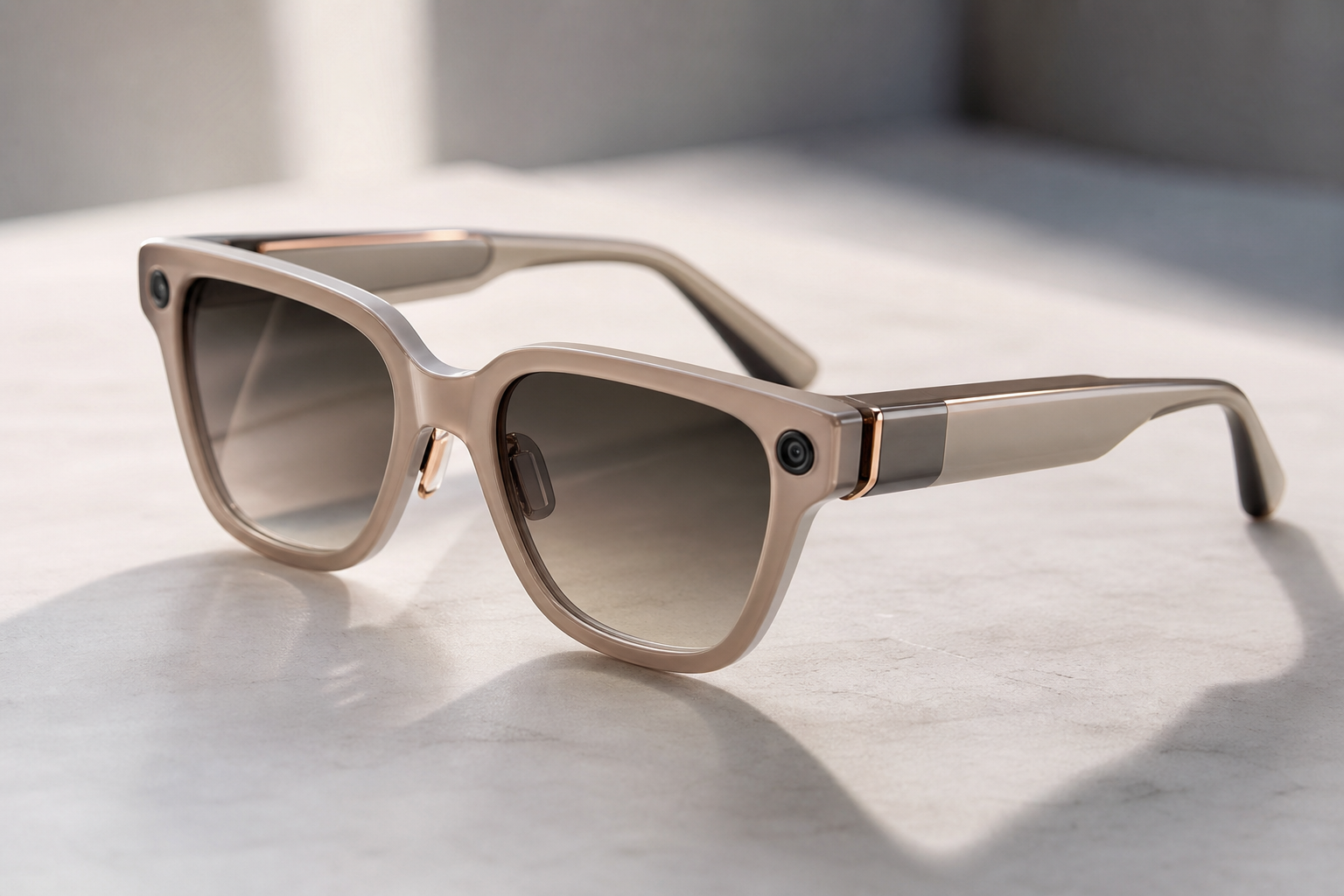
TL;DR: AI smart sunglasses are shifting from niche gadgets to mainstream fashion eyewear in 2026, combining hands-free connectivity, certified sun protection and sculptural designs. For brands, this creates new OEM/ODM growth opportunities with agile partners in Vietnam and Hong Kong.
What makes AI smart sunglasses the key 2026 trend?
In 2026, AI smart sunglasses are evolving from tech curiosities into fashion-first eyewear that delivers practical everyday utility. Consumers now expect audio, voice assistance functions and notifications to blend seamlessly with flattering frame silhouettes, comfortable fit and dependable UV protection.
Instead of bulky, gadget-looking devices, the latest AI smart sunglasses follow the same aesthetic direction as premium sunwear: oversized but controlled proportions, sculptural acetate, thin metals, and soft neutral palettes that complement skin tones. When brands treat AI components as an invisible layer inside well-designed sunglasses, adoption accelerates and collections stay relevant across seasons.
For OEM/ODM buyers, this convergence of fashion and function opens a new product category that can be merchandised both as statement sunglasses and as connected wearables. The result is higher perceived value, stronger storytelling and a clear reason for customers to upgrade beyond conventional sunwear.
How should brands design AI smart sunglasses for 2026?
Which frame architectures work best for AI integration?
The most successful AI smart sunglasses in 2026 use architectures that hide electronics in clean, balanced silhouettes. Thick temples in acetate or hybrid construction provide space for batteries, PCBs and speakers, while front profiles remain elegant and wearable. Soft rectangles, shield-inspired fronts and modern cat-eye silhouettes give enough coverage for lenses and sensors without feeling heavy on the face.
For OEM/ODM projects, Concept Eyewear can co-engineer temple cores to accommodate audio modules, touch controls and connectivity components while keeping hinge systems robust. In Vietnam and Hong Kong, our tooling and assembly lines are optimized for repeatable precision in embedded channels, screw bosses and cable routing, reducing rework and improving yield.
What materials and lens options suit AI smart sunglasses?
Material choice must balance comfort, aesthetics and thermal management. High-quality plant-based acetate remains the primary material for fashion-forward AI smart sunglasses, offering rich color, sculptural geometry and enough volume for embedded electronics. Stainless steel and titanium can be used for bridges or front rims to reduce weight while maintaining strength.
On the lens side, brands increasingly specify polarized or high-performance lenses that meet ISO 12312 requirements for UV protection and optical clarity. Gradient and lightly tinted lenses give AI smart sunglasses a lifestyle feel for urban use, while mirrored or high-contrast tints suit outdoor sports and driving. For industrial or mixed-use collections, impact-resistant lenses and reinforced frames can be engineered to align with Z87-level performance expectations while still presenting as stylish sunglasses.
How can comfort and user experience be optimized?
AI smart sunglasses must feel like good eyewear before they feel like good devices. Weight distribution across the bridge and temples, tuned nose pad geometry, and stable temple curvature are critical to prevent hotspots during long wear. Subtle tactile markers on touch surfaces, intuitive button placement and clear audio pathways also help users learn interactions without visual prompts.
Through OEM/ODM collaboration, Concept Eyewear can run iterative fitting samples, adjusting temple thickness, core wire stiffness and pad arm positions to align with regional fit expectations in the EU, US and Asia. By coupling ergonomic data with electronics layouts, brands can avoid common complaints such as front-heavy frames, pinching at the ears or unstable fit during movement.
Why do AI smart sunglasses help brands grow strategically?
How do AI smart sunglasses extend brand ecosystems?
AI smart sunglasses move eyewear from a purely physical accessory into a gateway for services, apps and content. Once a brand owns a connected eyewear platform, every wearer interaction can reinforce loyalty: guided audio tours, fitness prompts, voice-controlled playlists, or contextual information layered into daily routines.
This ecosystem effect makes AI smart sunglasses strategically valuable. Collections can be paired with subscription services, premium lenses or exclusive digital features, creating recurring revenue instead of a single replacement cycle. OEM/ODM partners like Concept Eyewear can support multi-SKU hardware families that keep the same design language while offering different feature tiers, making it easier to plan assortments for wholesale, e-commerce and specialty retail.
How do AI smart sunglasses reshape price tiers and margins?
AI smart sunglasses naturally sit in higher price brackets than conventional sunglasses thanks to electronics, software and perceived innovation. This allows brands to position entry, mid and premium tiers more clearly: lifestyle audio models at accessible prices models in the mid-range, and advanced AR-integrated designs at the top end.
Because much of the electronics cost can be amortized across multiple styles using shared modules, OEM/ODM projects gain economies of scale. Concept Eyewear can help brands design chassis families where different fronts and colors share the same internal hardware, enabling differentiated merchandising without multiplying engineering cost. Strategically, this strengthens margins while giving sales teams more levers to segment accounts and regions.
How do EU, US and Asia differ in AI smart sunglasses demand?
What are the key use cases in the US, EU and Asia?
In the US, AI smart sunglasses adoption is driven primarily by lifestyle and creator use cases: hands-free social content, navigation, communication and music integrated into everyday sunwear. Consumers are comfortable with bold frames and storytelling around technology, as long as comfort and privacy are respected.
In the EU, demand leans toward discreet, design-led products with strong emphasis on safety, optical performance and regulatory compliance. Privacy, data handling and long-term comfort are key messaging pillars. Factories need to prioritize precise lens alignment, material safety documentation and robust testing workflows to support European retailers and chains.
Across Asia, especially in China and broader ASEAN markets, AI smart sunglasses benefit from rapid digital adoption and high interest in wearable tech. Consumers are keen on value-packed products that balance rich features with strong cost performance. Styles must be available in inclusive sizing and address diverse facial features, making OEM/ODM fit studies especially important.
Which AI smart sunglasses concepts fit different regions and price tiers?
By mapping concepts to clear regional roles and standards focus, brands can plan collections and launch phases more strategically. Concept Eyewear supports this process by translating trend intelligence into SKU trees that align with target markets, volumes and certification needs, then industrializing them through factories in Vietnam with coordination from Hong Kong.
How can OEM/ODM with Concept Eyewear turn AI smart sunglasses ideas into products?
What does a typical AI smart sunglasses OEM/ODM workflow look like?
For AI smart sunglasses, OEM/ODM collaboration starts with joint concept definition: target wearer, primary use cases, electronics platform and regional positioning. From there, Concept Eyewear’s design and engineering teams develop 2D and 3D proposals that balance frame aesthetics, component packaging and lens performance, followed by technical drawings and tolerance schemes suited to volume production in Vietnam.
Sampling rounds refine fit, weight and thermal behavior while validating that electronics can be assembled consistently. Materials, coatings and lens treatments are specified to meet ISO 12312 and, for more demanding environments, Z87-style impact and durability expectations. Once approved, production lines are set up with clear work instructions, QA checkpoints and data capture to keep yields and quality stable.
How can brands address compliance, testing and documentation?
Compliance is non-negotiable when electronics and sun protection meet. Concept Eyewear can coordinate third-party testing for UV transmission, optical quality, impact resistance and material safety, providing the documentation EU and US retailers require. For Asia distribution, we can adapt test plans to local standards while maintaining a global baseline derived from ISO 12312 and relevant safety frameworks.
Our teams prepare specification sheets, bill-of-materials structures, labeling guidelines and packaging claims that keep marketing aligned with technical reality. This protects brands from non-compliant messaging while giving sales teams confidence when promoting AI smart sunglasses as both fashionable and safe.
How should brands plan merchandising and e-commerce for AI smart sunglasses?
AI smart sunglasses need to be merchandised as both fashion and technology. In retail, strong visual storytelling around lens colors, frame shapes and lifestyle scenarios should sit alongside clear feature icons for audio, AI assistance functions and battery life. Online, product pages should include fit diagrams, lens performance charts and compatibility information, supported by short demo videos.
OEM/ODM planning with Concept Eyewear can incorporate merchandising needs early in the design phase, ensuring that colors, finishes and SKU naming support category navigation and upselling. Vietnam-based production offers the flexibility to run differentiated colorways and limited editions for key markets, while Hong Kong coordination ensures responsive communication with global clients and logistics partners.
How can brands start an AI smart sunglasses OEM/ODM project with Concept Eyewear?
What are the next steps for brands exploring AI smart sunglasses?
Brands that want to capture the 2026 AI smart sunglasses trend should begin by defining their strategic position: accessible lifestyle audio experiences. From there, an OEM/ODM roadmap can be created that segments markets (EU, US, Asia), sets price tiers and determines which standards each SKU must meet.
Concept Eyewear, with OEM/ODM manufacturing bases in Vietnam and operational hubs in Hong Kong, is ready to co-create these collections. Our teams blend eyewear trend expertise, frame engineering, lens technology and supply chain management so that AI smart sunglasses lines launch on time, at scale and with the right mix of fashion and performance.
To learn more about our capabilities and case studies, visit Concept Eyewear. For broader market context on AI glasses adoption, industry resources such as Optical Prism show how quickly this category is growing, especially in Asia.
If you are ready to translate AI smart sunglasses concepts into ISO 12312-compliant, Z87-aware collections, contact Concept Eyewear to discuss an OEM/ODM partnership. Together, we can build connected sunwear ranges that align with 2026 trends, support long-term brand ecosystems and give your customers a compelling reason to upgrade their sunglasses.
