

For fashion labels, retail chains, and optical groups, the biggest questions around OEM eyewear manufacturing are increasingly about consistency, lead times, and quality at scale. Brands want to know how their frames are made, and what manufacturers are doing to reduce defects and delays.
Across the global eyewear industry, leading players are turning to automation, robotics, and digitalization to meet these expectations, from fully automated lens lines in Europe to robotic fulfillment in large online retailers. An OEM/ODM partner in Vietnam that embraces these technologies can offer private-label clients more predictable quality, faster repeat orders, and a more resilient supply chain.
Why automation matters in eyewear production
Eyewear manufacturing involves many repetitive, high-precision steps: cutting and milling, bending metal components, polishing edges, attaching lugs and hinges, and assembling temples and fronts. Even small variations can create fit issues, uneven finishes, or problems at the lab stage.
Robotics and automation are now widely used in the industry to handle these repeatable tasks with consistent force, speed, and positioning, freeing human technicians to focus on complex adjustments, inspection, and finishing. This shift mirrors what has already happened in other precision sectors such as automotive glass and optical lenses, where AI-driven automation has become standard for quality control and throughput.
How Concept Eyewear applies robotic processes in Vietnam
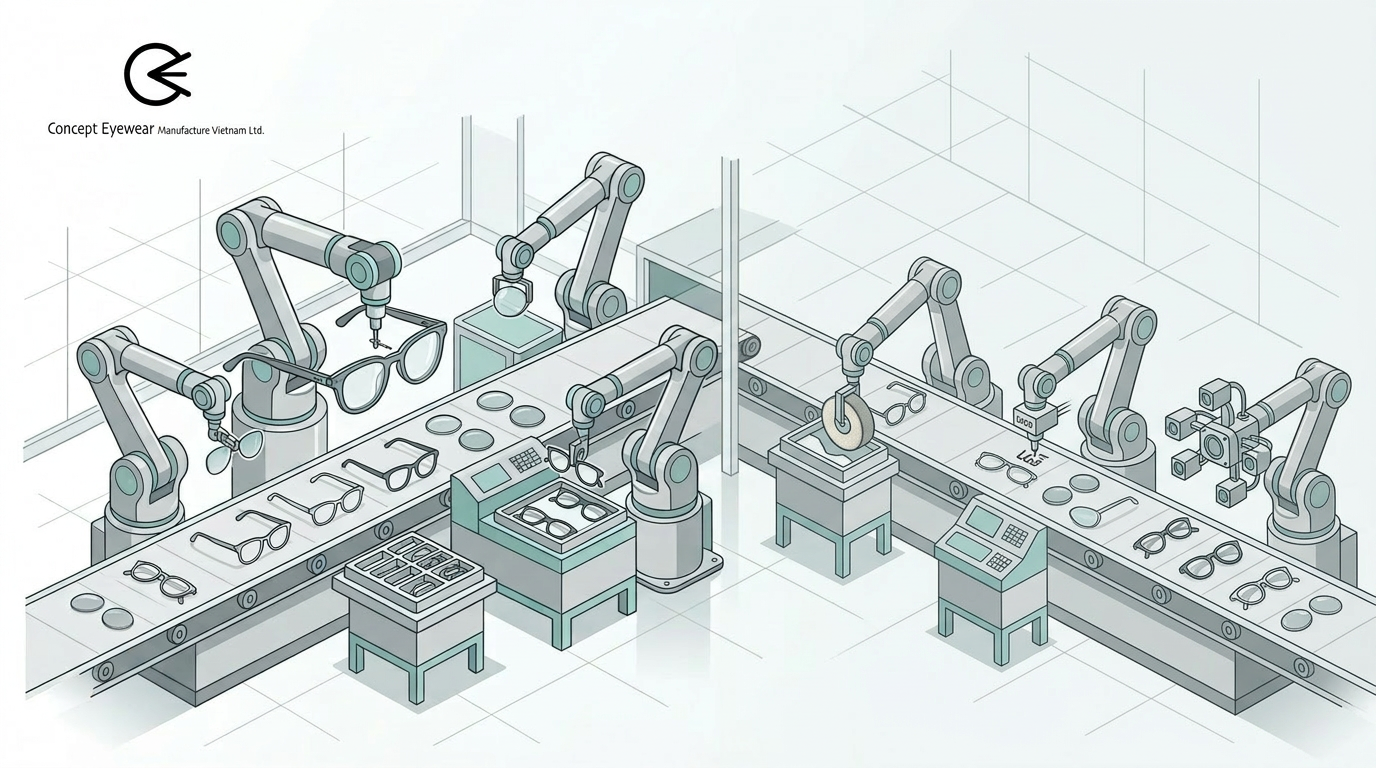
In Concept Eyewear’s Vietnam operations, automation is being expanded across key stages of the frame manufacturing process. Robotic arms are used to:
- Deliver components between workstations.
- Automate cutting of frame fronts and temples.
- Perform smoothing and polishing on contact surfaces and edges.
- Execute precise bending operations for metal components.
- Handle lug-related steps, such as positioning and processing before assembly.
By assigning these highly repeatable operations to robots, the production line can maintain consistent pressure, timing, and angles from piece to piece, which helps standardize outputs and significantly reduce operator-driven variation. This directly supports a much lower error rate and more uniform fit and finish across large orders.
Benefits for quality, consistency, and defect rates
For private-label eyewear buyers, the practical impact of this automation shows up in three main areas:
- Dimensional accuracy: Robotic cutting and bending help keep frame dimensions within tight tolerances, which reduces rejection rates at both the factory and the optical lab stage.
- Surface quality: Automated smoothing and polishing produce more consistent finishes across colors and SKUs, reducing visible defects that cause rework or returns.
- Assembly readiness: When lugs and other connection points are prepared in a standardized way, final assembly and hinge installation are more stable and repeatable, improving frame durability in daily wear.
Similar benefits have been documented elsewhere in the eyewear value chain. For example, robotic bagging and scanning solutions used by online eyewear retailers have cut manual steps and pushed order-processing errors close to zero while increasing throughput. Applying the same logic upstream in manufacturing supports the reliable supply that retail chains and optical groups now expect.
Shorter lead times and smoother reorders
Automation also helps stabilization, the pace at which each piece moves through the line. When cutting, polishing, and bending are handled by robots, daily output is less affected by shift changes, fatigue, or operator turnover.
For buyers, this can translate into:
- More predictable lead times once tooling and samples are approved.
- Easier forecasting for seasonal drops or capsule collections.
- Smoother reorders, because the same automated programs can be reused for repeat SKUs with minimal adjustment.
This trend is aligned with broader moves in the eyewear sector, where vertically integrated and “made-to-order” factories emphasize in-house control and modern equipment to keep production flexible yet reliable. Vietnam’s strong export infrastructure adds another layer of stability for shipments to the US, Europe, and Australia.
Human expertise plus automation, not a replacement
Automation in eyewear manufacturing does not remove the need for skilled people; it changes where their attention is focused. Robots handle the repetitive motions, but trained technicians still:
- Fine-tune bending and fitting characteristics for comfort on different face shapes.
- Conduct in-process checks on alignment, symmetry, and cosmetic details.
- Oversee setup and maintenance of robotic cells and fixtures.
- Manage sampling, color approvals, and final inspections before export.
This combination—robotic repeatability plus human judgment—is also how large multinational groups approach advanced lens and frame manufacturing, using automated systems for quality control while relying on specialists for exception handling and process optimization.
What automation means for your brand’s OEM projects
For fashion labels and retail chains exploring or scaling private-label eyewear, working with an OEM/ODM partner in Vietnam that has invested in automation offers several strategic advantages:
- Better size and fit consistency across stores and markets, which reduces store-level adjustments and exchanges.
- Lower risk on large commitments, because defect rates and rework are reduced at the factory level.
- More flexibility for design variety, as automated programs can be adapted to new shapes and materials without completely rebuilding the line.
- Alignment with modern manufacturing expectations, including digital files, programmable tooling, and traceable process parameters.
These capabilities complement other core OEM/ODM services such as design refinement, sampling, production, quality control, and export documentation, giving brand owners a clearer, more controlled path from sketch to shelf.
FAQ – Manufacturing Process: Automation at Concept Eyewear
Q1: Which parts of the eyewear manufacturing process are automated at Concept Eyewear in Vietnam?
Key repetitive operations such as component delivery, cutting, smoothing and polishing, bending, and certain lug-related steps are handled by robotic arms, while technicians focus on inspection, adjustments, and final quality checks.
Q2: How does automation affect defect rates and returns for private-label eyewear?
By standardizing force, timing, and positioning in critical steps like cutting and bending, automation reduces variation, which typically lowers in-factory rejects and downstream returns linked to fit or finish issues.
Q3: Does automation limit design flexibility for fashion or lifestyle brands?
In practice, it increases flexibility: once the robotic programs and fixtures are set up, they can be adapted for new shapes and materials, allowing brands to refresh collections without fully rebuilding the process each season.
Q4: How does automated manufacturing in Vietnam support global retail chains?
Stable, automated lines help keep lead times predictable, support large and repeat orders, and improve consistency across thousands of units shipped to store networks in the US, Europe, and Australia, aligning with modern retail planning needs.
Q5: What role do humans still play if much of the process is automated?
Experienced staff oversee equipment, fine-tune fit and comfort, run in-process and final inspections, and coordinate sampling and approvals, ensuring that robotics enhances, rather than replaces, craftsmanship and quality oversight.