

For fashion labels, retail chains, and optical groups, the biggest questions around OEM eyewear manufacturing are increasingly about consistency, lead times, and quality at scale. Brands want to know how their frames are made, and what manufacturers are doing to reduce defects and delays.
Across the global eyewear industry, leading players are turning to automation, robotics, and digitalization to meet these expectations, from fully automated lens lines in Europe to robotic fulfillment in large online retailers. An OEM/ODM partner in Vietnam that embraces these technologies can offer private-label clients more predictable quality, faster repeat orders, and a more resilient supply chain.
Why automation matters in eyewear production
Eyewear manufacturing involves many repetitive, high-precision steps: cutting and milling, bending metal components, polishing edges, attaching lugs and hinges, and assembling temples and fronts. Even small variations can create fit issues, uneven finishes, or problems at the lab stage.
Robotics and automation are now widely used in the industry to handle these repeatable tasks with consistent force, speed, and positioning, freeing human technicians to focus on complex adjustments, inspection, and finishing. This shift mirrors what has already happened in other precision sectors such as automotive glass and optical lenses, where AI-driven automation has become standard for quality control and throughput.
How Concept Eyewear applies robotic processes in Vietnam
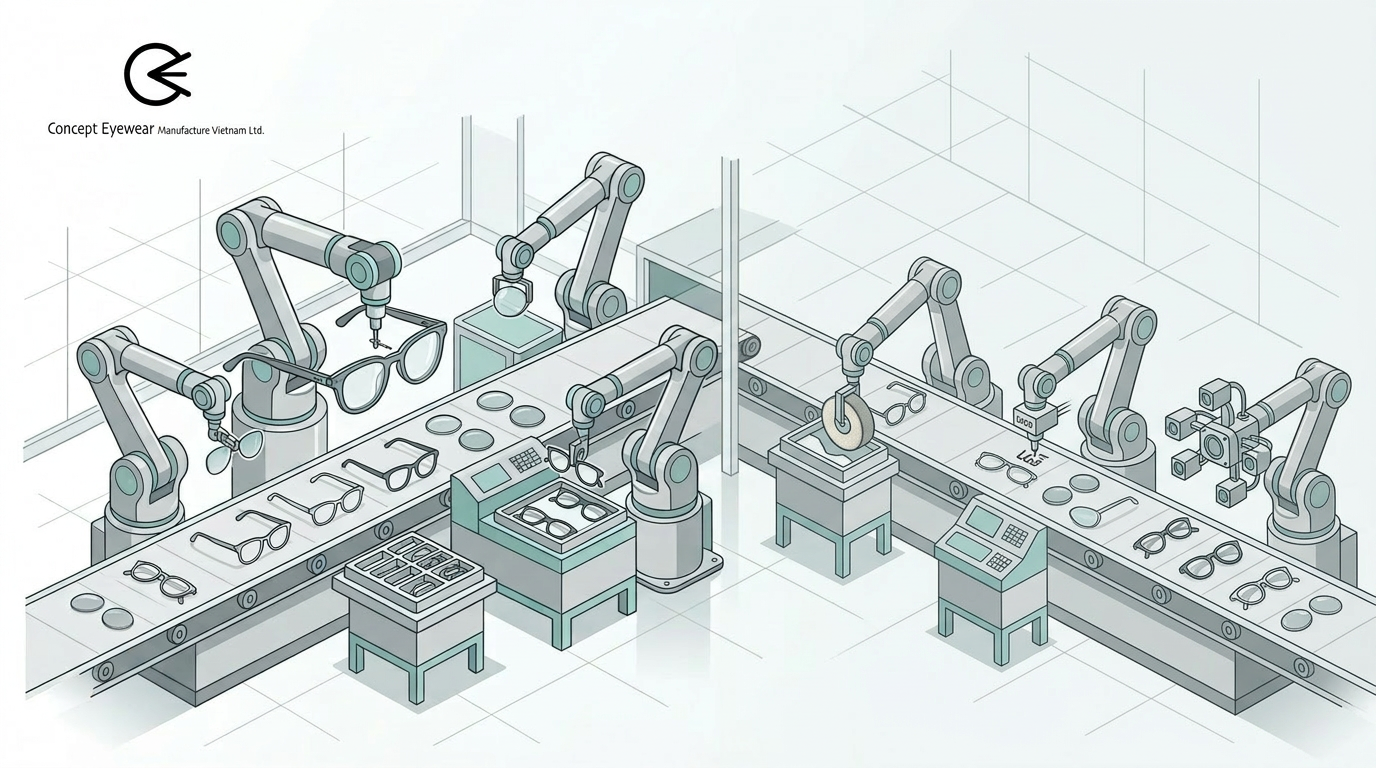
In Concept Eyewear’s Vietnam operations, automation is being expanded across key stages of the frame manufacturing process. Robotic arms are used to:
- Deliver components between workstations.
- Automate cutting of frame fronts and temples.
- Perform smoothing and polishing on contact surfaces and edges.
- Execute precise bending operations for metal components.
- Handle lug-related steps, such as positioning and processing before assembly.
By assigning these highly repeatable operations to robots, the production line can maintain consistent pressure, timing, and angles from piece to piece, which helps standardize outputs and significantly reduce operator-driven variation. This directly supports a much lower error rate and more uniform fit and finish across large orders.
Benefits for quality, consistency, and defect rates
For private-label eyewear buyers, the practical impact of this automation shows up in three main areas:
- Dimensional accuracy: Robotic cutting and bending help keep frame dimensions within tight tolerances, which reduces rejection rates at both the factory and the optical lab stage.
- Surface quality: Automated smoothing and polishing produce more consistent finishes across colors and SKUs, reducing visible defects that cause rework or returns.
- Assembly readiness: When lugs and other connection points are prepared in a standardized way, final assembly and hinge installation are more stable and repeatable, improving frame durability in daily wear.
Similar benefits have been documented elsewhere in the eyewear value chain. For example, robotic bagging and scanning solutions used by online eyewear retailers have cut manual steps and pushed order-processing errors close to zero while increasing throughput. Applying the same logic upstream in manufacturing supports the reliable supply that retail chains and optical groups now expect.
Shorter lead times and smoother reorders
Automation also helps stabilization, the pace at which each piece moves through the line. When cutting, polishing, and bending are handled by robots, daily output is less affected by shift changes, fatigue, or operator turnover.
For buyers, this can translate into:
- More predictable lead times once tooling and samples are approved.
- Easier forecasting for seasonal drops or capsule collections.
- Smoother reorders, because the same automated programs can be reused for repeat SKUs with minimal adjustment.
This trend is aligned with broader moves in the eyewear sector, where vertically integrated and “made-to-order” factories emphasize in-house control and modern equipment to keep production flexible yet reliable. Vietnam’s strong export infrastructure adds another layer of stability for shipments to the US, Europe, and Australia.
Human expertise plus automation, not a replacement
Automation in eyewear manufacturing does not remove the need for skilled people; it changes where their attention is focused. Robots handle the repetitive motions, but trained technicians still:
- Fine-tune bending and fitting characteristics for comfort on different face shapes.
- Conduct in-process checks on alignment, symmetry, and cosmetic details.
- Oversee setup and maintenance of robotic cells and fixtures.
- Manage sampling, color approvals, and final inspections before export.
This combination—robotic repeatability plus human judgment—is also how large multinational groups approach advanced lens and frame manufacturing, using automated systems for quality control while relying on specialists for exception handling and process optimization.
What automation means for your brand’s OEM projects
For fashion labels and retail chains exploring or scaling private-label eyewear, working with an OEM/ODM partner in Vietnam that has invested in automation offers several strategic advantages:
- Better size and fit consistency across stores and markets, which reduces store-level adjustments and exchanges.
- Lower risk on large commitments, because defect rates and rework are reduced at the factory level.
- More flexibility for design variety, as automated programs can be adapted to new shapes and materials without completely rebuilding the line.
- Alignment with modern manufacturing expectations, including digital files, programmable tooling, and traceable process parameters.
These capabilities complement other core OEM/ODM services such as design refinement, sampling, production, quality control, and export documentation, giving brand owners a clearer, more controlled path from sketch to shelf.
FAQ – Manufacturing Process: Automation at Concept Eyewear
Q1: Which parts of the eyewear manufacturing process are automated at Concept Eyewear in Vietnam?
Key repetitive operations such as component delivery, cutting, smoothing and polishing, bending, and certain lug-related steps are handled by robotic arms, while technicians focus on inspection, adjustments, and final quality checks.
Q2: How does automation affect defect rates and returns for private-label eyewear?
By standardizing force, timing, and positioning in critical steps like cutting and bending, automation reduces variation, which typically lowers in-factory rejects and downstream returns linked to fit or finish issues.
Q3: Does automation limit design flexibility for fashion or lifestyle brands?
In practice, it increases flexibility: once the robotic programs and fixtures are set up, they can be adapted for new shapes and materials, allowing brands to refresh collections without fully rebuilding the process each season.
Q4: How does automated manufacturing in Vietnam support global retail chains?
Stable, automated lines help keep lead times predictable, support large and repeat orders, and improve consistency across thousands of units shipped to store networks in the US, Europe, and Australia, aligning with modern retail planning needs.
Q5: What role do humans still play if much of the process is automated?
Experienced staff oversee equipment, fine-tune fit and comfort, run in-process and final inspections, and coordinate sampling and approvals, ensuring that robotics enhances, rather than replaces, craftsmanship and quality oversight.
Here is your Japanese version optimized for WordPress (clean HTML, proper heading hierarchy, and SEO/GEO-friendly phrasing with natural keyword placement like ベトナム 眼鏡 OEM, 自動化, 品質管理, リードタイム):ロボティクスと自動化は現在、アイウェア製造業において広く活用されており、一定の力・速度・位置精度で反復作業を処理しています。これにより、技術者は複雑な調整、検査、仕上げといった高付加価値業務に集中できるようになります。この流れは、自動車用ガラスや光学レンズなどの精密産業でもすでに進んでおり、AI主導の自動化は品質管理と生産効率の標準となっています。
ベトナムにおけるConcept Eyewearのロボット工程
Concept Eyewearのベトナム工場では、フレーム製造の主要工程に自動化技術を導入しています。ロボットアームは以下の工程で活用されています:
- 工程間の部品搬送
- フロントおよびテンプルの精密切断
- 接触面・エッジの研磨および平滑化
- 金属部品の高精度な曲げ加工
- ラグ(ヒンジ接合部)関連の位置決めおよび前加工
これらの工程を自動化することで、圧力・角度・加工時間のばらつきを抑え、製品ごとの品質を標準化できます。その結果、不良率の低減と均一なフィット・外観品質の実現が可能になります。
品質・一貫性・不良率へのメリット
プライベートラベル(OEM/ODM)で眼鏡製造を行うブランドにとって、自動化の導入は以下の点で大きなメリットがあります:
- 寸法精度の向上: 切断・曲げ工程の精度が安定し、公差内管理が容易になり、不良削減につながります。
- 表面品質の安定: 研磨工程の均一化により、色やSKU間での仕上がり差を最小化し、外観不良を削減します。
- 組立精度の向上: ラグや接合部の加工精度が高まり、ヒンジ取り付けの安定性と耐久性が向上します。
同様の自動化メリットは、オンライン眼鏡販売における自動梱包・スキャン工程でも確認されており、ヒューマンエラーの削減と処理速度の向上に貢献しています。これを製造工程に適用することで、より安定した供給体制が構築されます。
リードタイム短縮と安定供給
自動化は生産スピードの安定化にも大きく寄与します。ロボットによる加工は、作業者の熟練度やシフト変更の影響を受けにくく、日々の生産量を一定に保ちます。
- サンプル承認後のリードタイムが予測しやすい
- シーズン商品やカプセルコレクションの計画が立てやすい
- 同一SKUの再注文時にスムーズな再生産が可能
ベトナムの眼鏡OEM工場は、近年、設備投資と内製化を進めており、柔軟性と安定性を両立した生産体制を構築しています。また、輸出インフラの強さにより、米国・欧州・オーストラリア向けの安定した出荷にも対応可能です。
自動化と職人技の融合
自動化は人材を不要にするものではなく、役割を高度化させるものです。ロボットが反復作業を担う一方で、熟練技術者は以下を担当します:
- 顔型に合わせたフィッティング調整
- アライメント・対称性・外観の工程内検査
- ロボット設備の管理・保守
- サンプル確認、カラー承認、最終検査
この「自動化+人の判断」の組み合わせは、グローバル大手メーカーでも採用されており、品質の再現性と柔軟な対応力を両立します。
ベトナムOEMにおける自動化の価値
ファッションブランドや小売企業がベトナムで眼鏡OEM/ODMを行う際、自動化対応工場を選ぶことで以下のメリットがあります:
- 市場・店舗間でのサイズとフィットの一貫性向上
- 大量発注時の不良リスク低減
- 新デザインへの柔軟な対応(プログラム調整で対応可能)
- デジタル管理・トレーサビリティへの対応
これにより、デザインから量産、品質管理、輸出までのプロセスがより透明かつ効率的になり、ブランドの成長を支える製造基盤となります。
FAQ – Concept Eyewearの自動化製造
Q1:どの工程が自動化されていますか?
部品搬送、切断、研磨、曲げ加工、ラグ関連工程などの反復作業はロボットが担当し、技術者は検査や調整を行います。
Q2:不良率や返品率への影響は?
加工条件の標準化によりばらつきが減少し、工場内不良および市場での返品リスクが低減します。
Q3:デザインの自由度は下がりますか?
いいえ。プログラム調整により新しい形状や素材にも対応でき、むしろ柔軟性は向上します。
Q4:グローバル展開にどう役立ちますか?
安定した品質とリードタイムにより、大量出荷やリピート注文に対応しやすくなります。
Q5:人の役割は残りますか?
はい。品質判断、フィッティング調整、最終検査などは依然として人が担い、品質を支えています。
