

Eyewear premiumisation US is no longer a fashion slogan — it is the growth math. The Vision Council put the US optical industry at about USD 69.5B in 2025, with value rising even as units and exams softened. H1 2026 data still shows pricing carrying the market while visit volume lags. For brands and OEM partners, that means fewer pairs must earn more trust: better materials, tighter finish QC, leaner SKUs, and dual-origin resilience.
Quick answer: what does eyewear premiumisation US mean for brands?
In short, eyewear premiumisation US means shoppers and providers buy fewer frames at higher average selling prices, so assortment quality, finish consistency, and origin planning matter more than flooding doors with SKUs. H1 2026 still shows prices doing the work while exam volume stays soft — so OEM briefs should favour higher-ASP heroes, disciplined colourways, and supply options that survive tariff noise.
- Anchor plans on Vision Council FY 2025 ~USD 69.5B value growth, not unit growth
- Treat H1 2026 pricing-led results as the operating assumption for H2 assortment
- Cut weak SKUs; invest finish QC on fewer, higher-ASP frames
- Build dual-origin (Vietnam + China) options without overclaiming capacity numbers
- Keep smart/clinical adjacent as frame engineering — not lens IP claims
What the Vision Council numbers say about eyewear premiumisation US
According to The Vision Council’s Market inSights 2025 press release, US optical industry revenue reached about USD 69.5B in 2025 — value up despite fewer units and exams. Roughly 94% of US adults use some form of eyewear, and more than 80% of frames and lenses are still purchased in physical locations. Plano sunglasses were a rare FY 2025 volume gainer (~+2% units), while the broader story was premiumisation.
Then H1 2026 reinforced the same pattern. The Vision Council’s H1 2026 Market/Provider inSights reported market value around USD 18.39B in Q1 and USD 19.06B in Q2, with exam volume down roughly 2.5 million visits versus H1 2025. Trade coverage summarised it plainly: pricing is doing all the work. Providers also signalled a barbell assortment — 92% stock frames at USD 350+, 49% offer smart eyewear (up from 39% YoY), and 61% say tariffs already hit their practice.
Therefore, eyewear premiumisation US is not “make everything luxury.” It is “make every remaining SKU defend its ASP.”
How should brands redesign assortments under eyewear premiumisation US?
When consumers buy fewer pairs, weak colourways become expensive orphans. Brands scaling into optical should tighten the brief before the first sample round:
- Fewer SKUs, clearer roles. Protect carryover heroes; limit capsule guests; kill lookalikes early.
- Materials that read premium up close. HD acetate, titanium hybrids, and consistent polish matter when independent ECPs stock USD 350+ boards.
- Finish QC as a sales feature. Temple fit, hinge torque, plating uniformity, and logo-free cleanliness decide whether a higher ticket survives the first fitting.
- Channel barbell. Value DTC and independent optical can share an OEM calendar — but not the same MOQ psychology or packaging story.
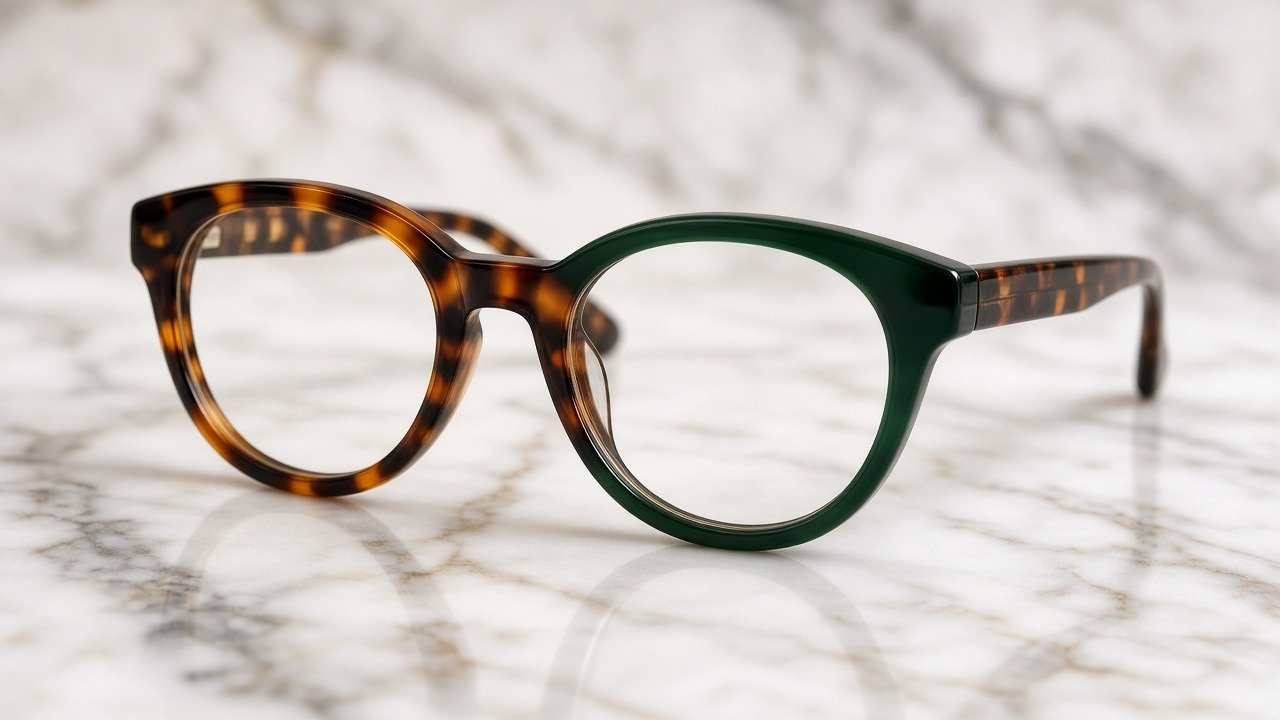
Moreover, style signals on 2025 floors (chunky acetate, green, oval, geometric, optical aviators) still reward depth in a few silhouettes over shallow breadth across twenty.
What OEM partners must deliver when pricing does the work
Eyewear premiumisation US changes the factory conversation. Concept Eyewear — a 26-year OEM/ODM partner with Hong Kong commercial leadership and manufacturing in Vietnam and China — typically helps brands with:
- Materials and finish QC gates written into the tech pack so ASP claims survive inspection, not only lookbooks
- Assortment discipline — sample fewer SKUs, lock colourways that ECP boards can sell repeatedly
- Dual-origin resilience — Vietnam and China production options so US-bound programmes can plan origin without inventing duty maths in public content
- Smart-adjacent chassis care — weight balance and hinge space for fashion-led open-ear Bluetooth concepts when the brief asks; never camera AI glasses storytelling, and never claiming CEM builds Meta, Stellest, or Transitions lenses
Furthermore, spare-parts thinking (temples, nose pads, screws) protects independent optical relationships when fewer pairs must last longer between repurchase cycles.
Tariffs, origin, and dual-factory planning — without overclaiming
H1 2026 provider surveys show tariff pressure is already shaping practice economics. Brands do not need public duty tables to act: ask OEM partners for dual-origin quotes, transformation documentation, and certificate-of-origin readiness before locking a US launch calendar. Concept Eyewear’s Vietnam site (Block E5 & 6, Hoa Hiep Industrial Zone, Dong Hoa, Phu Yen; +842573550435) and China capacity exist so origin strategy is an engineering choice — not a last-minute scramble.
Do not invent CEM capacity figures, customer names, or numeric price ranges. Share your target channel mix privately when you request a quote.
Practical checklist for US-bound private label
- Write the ASP role of each SKU before colourway expansion
- Require finish QC photos and measurement gates on approved samples
- Separate DTC value lanes from USD 350+ ECP heroes in the OEM brief
- Ask for Vietnam + China origin options early — paperwork decides resilience
- If smart or photochromic-adjacent frames are in scope, brief chassis/fit only; leave lens IP to licensed partners
Bottom line on eyewear premiumisation US
US optical grew on value, not volume, in 2025 — and H1 2026 says pricing is still doing the work. Brands that win eyewear premiumisation US will ship fewer, better frames with OEM partners who can prove finish quality and dual-origin options. For an OEM consultation on US assortment, materials QC, or dual-factory planning, visit concepteyewear.com.
