

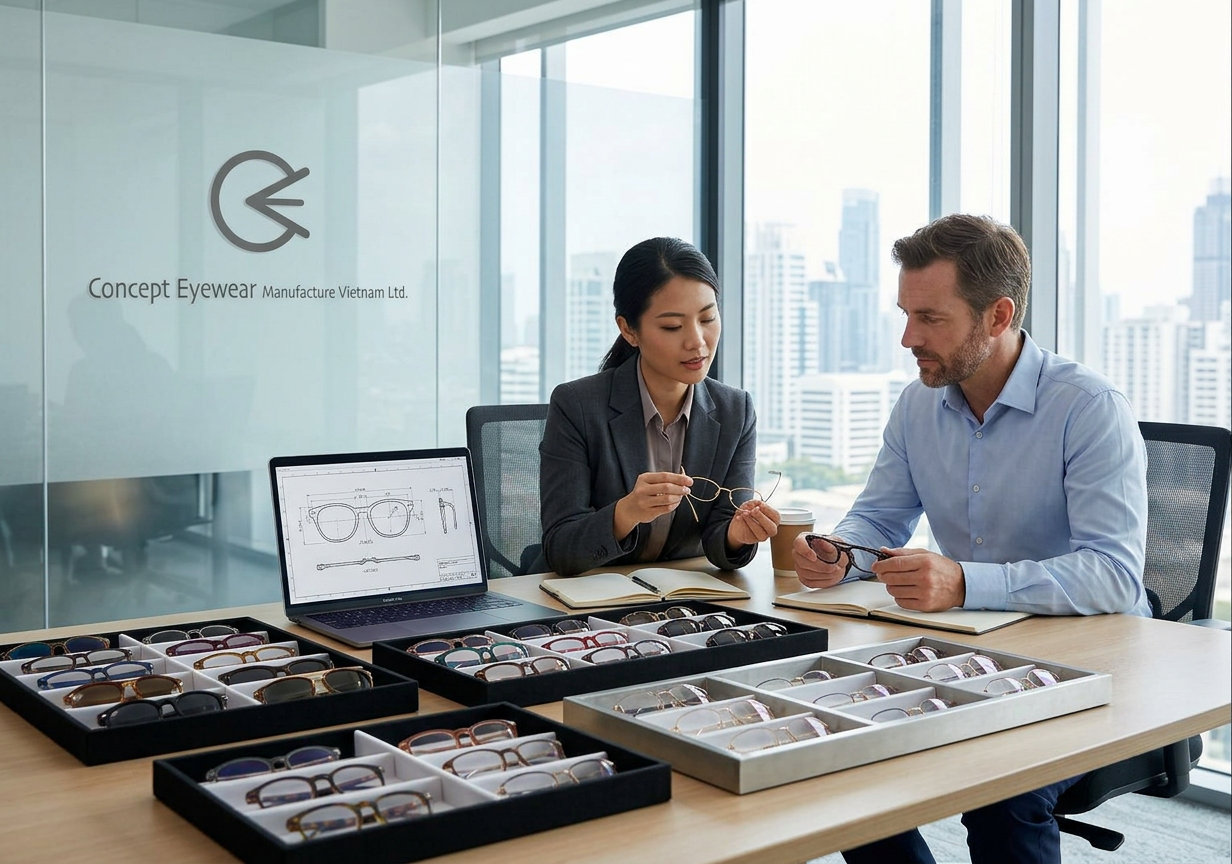
Fashion labels, lifestyle brands, and optical chains in the US, Europe, and Australia increasingly seek reliable OEM partners to launch or expand private-label eyewear programs. Vietnam has emerged as a strategic production base, offering cost-competitive manufacturing, skilled labor, and strong export capabilities to Western markets.
Concept Eyewear, with operations in Vietnam and China, supports international clients by translating brand guidelines into scalable eyewear collections that meet retail timelines, quality standards, and margin targets.
Why Vietnam Attracts Eyewear Buyers
Vietnam’s eyewear manufacturing sector has grown rapidly, drawing investments from global groups establishing large-scale facilities for frames and components. This shift supports supply-chain diversification away from single-country reliance.
Buyers benefit from lower labor and overhead costs compared to traditional hubs, alongside improving logistics infrastructure linking to North America, Europe, and Australia. Local market growth also fosters a robust ecosystem of materials suppliers and skilled workers familiar with international styles.
Key advantages include:
- Competitive production economics without sacrificing scale.
- Proven export experience to regulated markets.
- Proximity within ASEAN for efficient regional sourcing.
Current Trends Driving OEM Demand
Trade publications highlight bold frame shapes, jewelry-like detailing, and lightweight technical materials as dominant 2025–2026 styles across optical and fashion channels. Retailers prioritize collections that balance statement designs with everyday wearability.
Customization remains critical, with brands requesting differentiated color palettes, ergonomic fits, and advanced lens integrations like polarized or photochromic options. OEM partners must handle complex constructions, from titanium temples to injection-molded fronts, while maintaining consistency across styles.
Elements of a Strategic OEM Partnership
Effective OEM relationships extend beyond basic production, functioning as collaborative extensions of your design and merchandising teams. With Concept Eyewear, partnerships typically follow a structured process tailored to retail chains and fashion brands.
Collection Planning and Design Support
Define your target price architecture (good/better/best), channel strategy (optical stores, fashion retail, DTC), and consumer profile. The OEM provides feasibility input on frame constructions, hinges, and material combinations that align with your mood boards and 2D sketches.
Sampling and Iteration
Progress through initial prototypes for design confirmation, followed by fit and color approval samples, then pre-production units. This phased approach minimizes risks when introducing trend-driven elements like oversized profiles or mixed-material temples. Most of the time, the cost of sampling is refundable if you proceed into mass production with the OEM/ODM.
Production and Quality Assurance
Bulk runs incorporate in-line inspections and final QC checks against your specifications. For US, EU, and Australian shipments, if required, customer can request OEM partners to coordinate certification with accredited labs as needed, ensuring compliance without shifting regulatory burden, which would involve additional costs.
Communication and Timeline Management
English-speaking account teams deliver regular updates via shared platforms, with clear milestones from design lock to ex-factory delivery. This supports seasonal timing around key trade shows and retail windows.
MOQs and Scalability for Retail Programs
Retail chains often start with test quantities before scaling successful styles. Vietnam OEMs like Concept Eyewear offer minimum order quantities (MOQs) per style and color, balancing production efficiency with launch needs.
Typical structures:
- 400-600 units per style/color for initial drops.
- Collection-based totals that scale with store counts or performance.
- Adjustments for seasonal capsules or one-off collaborations.
Discuss your rollout plan- store network size, e-commerce testing, or chain-wide adoption- early to align capacity and pricing.
Development Timelines for Western Markets
From brief alignment to delivery, expect 16–24 weeks depending on complexity:
- Weeks 1–2: Design review and material sourcing.
- Weeks 3–9: First prototypes and revisions.
- Weeks 9–11: Pre-production approvals.
- Weeks 11+: Bulk production and QC.
Buffer for peak seasons or custom tooling ensures on-time arrival for Spring/Summer or Fall/Winter assortments.
Evaluating Vietnam OEM Partners
Ask these questions to gauge fit:
- How do you translate brand guidelines into differentiated collections?
- What is your experience with trend-driven designs like bold shapes or technical materials?
- How flexible are MOQs for retail testing versus full-scale programs?
- Describe your QC process for Western exports.
- Provide examples of English communication workflows with international clients.
Concept Eyewear’s Partnership Approach
Concept Eyewear structures client engagements for predictability and collaboration:
- Initial Alignment: Review brand positioning, pricing, and channel needs.
- Design Development: Recommend constructions and materials matching your inspirations.
- Prototyping Rounds: Iterate on fit, finish, and details per feedback.
- Production Execution: Scale with rigorous inspections and compliance support.
- Post-Launch Review: Analyze sell-through to refine future seasons.
This model suits optical groups launching house brands, fashion labels entering eyewear, and chains refreshing private-label lines.
FAQ: OEM Eyewear Partnerships in Vietnam
Q: Why choose a Vietnam OEM for private-label eyewear?
Vietnam offers cost advantages, skilled production, and export expertise, enabling reliable supply to US, Europe, and Australian retailers while diversifying from traditional sources.
Q: What MOQs apply to eyewear collections?
Flexible per-style/color minimums (often 400+ units) support testing, with scalable totals for chain-wide rollouts based on your volume strategy.
Q: How long from design to delivery?
11–15 weeks covers sampling, approvals, and production, timed for retail seasons with clear milestone updates.
Q: Can Vietnam OEMs handle trend-led designs?
Yes, experienced partners manage bold shapes, mixed materials, and custom details while meeting quality and margin requirements.
Q: How does Concept Eyewear ensure Western market compliance?
Structured QC, in-line checks, and lab coordination align with international standards, streamlining your import process.