

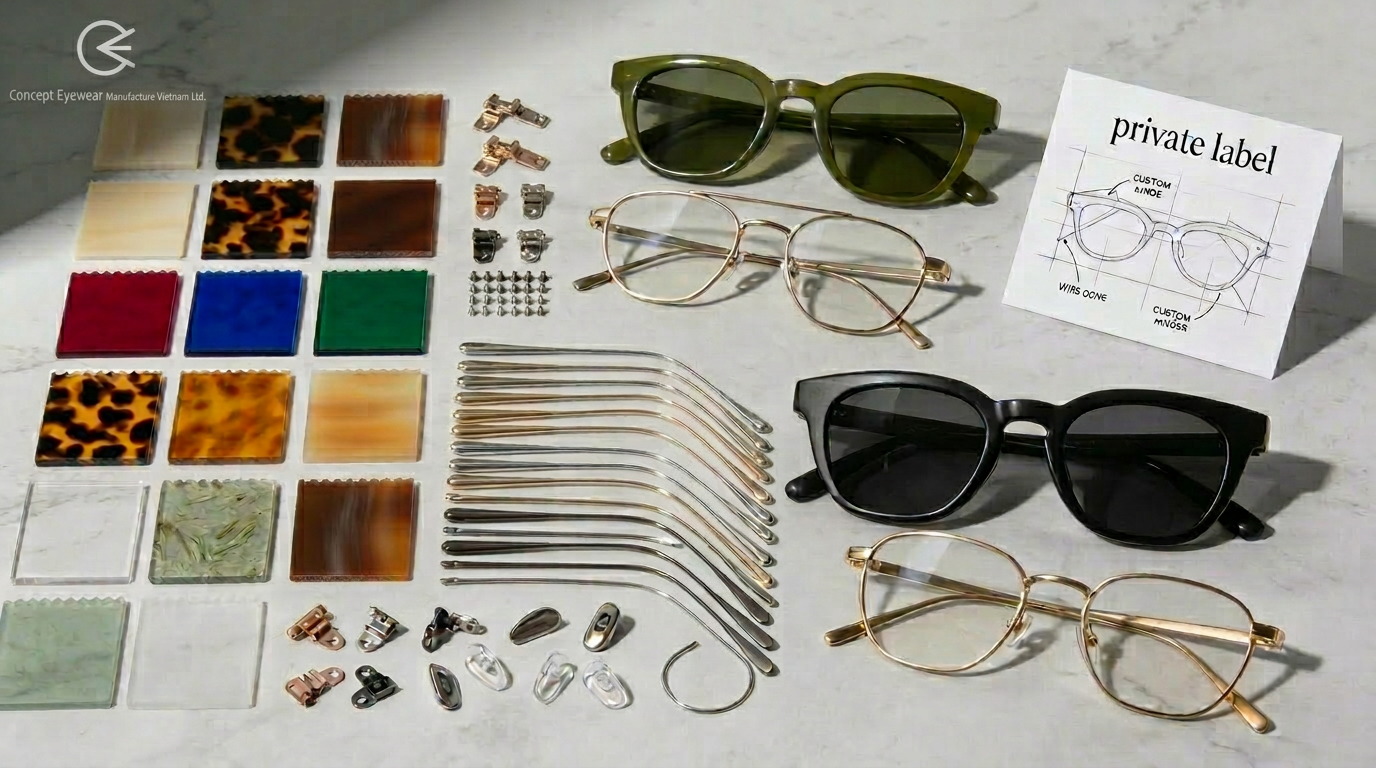
Brand owners today are asking a clear question: how far can we customize private label eyewear with an OEM/ODM partner, and what does that process really look like in practice?
As global eyewear shifts toward personalization, sustainable materials, and premium private label collections, OEM partners like Concept Eyewear (with operations in Vietnam and China) are increasingly expected to deliver tailored designs, consistent quality, and smooth execution from brief to shipment for US, European, and Australian markets.
This article explains how brand customization works with an OEM/ODM eyewear partner in Vietnam, from design and materials to compliance and timelines, so you can assess if this model fits your strategy.
Why Customization Is Now a Must-Have
Global trend reports for 2025 highlight customization and private label as major growth levers in eyewear, especially for fashion-led and multi-channel retailers. Consumers increasingly want frames that reflect their personal style, face shape, and lifestyle, and retailers are using exclusive designs to differentiate from pure-play e‑commerce and global license brands.
Industry analyses also show that optical groups are moving their private labels “up the value chain”, investing in better materials, finishes, and storytelling so that in-house brands can sit credibly alongside licensed labels on the board. For many of these players, OEM/ODM partners are the engine behind that shift, providing the design and production backbone needed to scale custom collections.
Why Vietnam for Customized Private Label Eyewear
Over the last decade, Vietnam has become a serious eyewear manufacturing base, with many international groups installing OEM/ODM factories for sunglasses and basic optical frames aimed at export markets. Reports note that production is concentrated in the middle and south, benefiting from export-friendly infrastructure, competitive labor costs, and policies that favor light industry and overseas buyers.
For US and EU importers in particular, Vietnam is often used to diversify away from China-origin tariffs and to build a more resilient, multi-country supply chain for mid-range sunglasses and TR90/plastic optical frames. Concept Eyewear fits into this landscape as an OEM/ODM partner that can develop and sample with close engineering support in Asia, then mass-produce in Vietnam for cost-optimized, “Made in Vietnam” programs where that origin is advantageous.
What Brand Owners Really Want from an OEM Customization Partner
Recent trade coverage shows a consistent pattern in what brands, chains, and optical groups expect from their eyewear manufacturing partners when it comes to customization:
- Clear translation of brand DNA into shapes, colors, and hardware (not just catalog reorders).
- Flexible but realistic MOQs that allow testing of new concepts without overstock.
- Strong quality systems and repeatability across reorders.
- Support on sustainability claims and material choices.
- Compliance-ready product for US/EU/AU standards, with access to recognized labs when needed.
Concept Eyewear’s OEM/ODM model is built around these needs: we start from your brand positioning and target retail price, then define the right construction (acetate, metal, injection), finishing level, and packaging to deliver a coherent collection instead of a set of disconnected SKUs.
How Concept Eyewear Supports Your Customization Project
In parallel with wider industry trends, more brands are moving beyond simple logo stamping and are asking for distinctive silhouettes, temple details, and color stories. Concept Eyewear typically supports this through a structured design and development process.
Design Translation and Technical Engineering
You supply a moodboard, existing bestsellers, or a brand deck. Our team proposes shapes, dimensions, and detailing aligned to your audience (fashion, sport, optical, kids). We then convert chosen designs into production-ready drawings, including measurements, hinges, and bridge fits appropriate for US, European, or Australian consumers. Where necessary, we can adapt eye sizes and temple lengths for better fit in specific regions, reflecting the broader industry trend toward fit-focused eyewear.
Color, Finish Development, and Sampling
We help you choose acetates, injections, or metal finishes that match your brand palette while staying feasible at scale. We can build signature color stories into your line within realistic MOQ constraints, inspired by premium brands using custom acetates and exclusive colors.
The sampling process is staged: virtual drawing approval to confirm shapes, dimensions, logo positions, and colors at line-planning stage; first physical samples (pilot set) typically requiring 1–2 rounds to refine fit, weight, and finishing; then sales samples for key accounts, tradeshows, or internal buying aligned with the final production specification.
Production and Quality Control
Concept Eyewear follows standard OEM/ODM flows used by international brands: pre-production (PP) sample signed off before mass production begins; inline QC checks at key stages (cutting, polishing, assembly, lens mounting); and final random inspection based on agreed AQL or buyer-specific standards, before shipment.
For private label to compete with licensed brands, consistency and spare-part availability are essential. Our approach emphasizes stable components and specifications so that reorders and rolling programs maintain the same feel, fit, and finish across seasons.
Customization Options: From Logos to Limited Editions
Most private-label and collaboration programs today go beyond a simple logo on the temple. With Concept Eyewear, typical brand identity options include laser-etched or pad-printed logos on temples, end-tips, or lenses; metal logo plaques inset into acetate or fixed to metal temples; and signature hardware details such as a unique hinge plate shape or a subtle pattern on metal components that can carry through collections.
These “ownable” design touches echo what many successful brands are doing – from subtle engravings to custom hinge plates – to make their frames instantly recognizable without shouting.
Based on current global trends, many brands are combining lightweight, minimal optical shapes for everyday wear; bolder, oversized sunglasses and geometric silhouettes for fashion and social media impact; and sport-inspired or performance silhouettes where polarized or photochromic lenses add functional value.
Concept Eyewear can develop coordinated families of shapes – for example, a slim optical, a bolder sunglass, and a clip-on version – that share a common design language while targeting different use cases and price points.
Sustainable Materials and Eco-Focused Customization
Sustainability is now a central purchase driver in eyewear. Trade articles highlight examples such as bio-acetate frames made from plant-based cellulose with lower carbon footprints, recycled metal frames and sun clips using reclaimed metal content, and acetate programs that reclaim production scrap and reprocess it into new material, reducing landfill waste and fossil-based inputs.
Within this context, Concept Eyewear can help you specify more responsible acetates (including bio-based or partially recycled options from mainstream suppliers, where available at your price level), explore recycled metal options (particularly for stainless-steel optical or sunglasses in higher-margin programs), and design for durability and timelessness – slimmer, lighter frames that still use robust hinges and classic silhouettes, reflecting the industry shift toward “buy better, buy longer” in everyday eyewear.
We do not claim specific environmental certifications, but we work with material suppliers who are actively investing in lower-impact options, and we can discuss trade-offs clearly (cost, lead time, color range) so you can make informed decisions.
Compliance for US, EU, and Australian Markets
For chain retailers and optical groups in the US, Europe, and Australia, regulatory and quality compliance is non-negotiable. Industry sources emphasize the importance of aligning private-label frames with relevant standards (for example CE marking in Europe, REACH-related chemical limits, and FDA registration for certain medical device categories in the US), typically supported by independent testing where required.
Concept Eyewear designs and specifies products with mainstream export markets in mind, including appropriate materials, metal compositions, and lens categories. We can work with recognized third-party testing labs (as directed by the client) for tests such as UV protection categories for sunglasses, nickel-release tests on metal components, and other client-defined protocols. We also document bill of materials and production processes so that retailers have a clear traceability trail to support their internal quality and compliance teams.
We do not offer legal or regulatory advice, but we align our production with international norms and collaborate with your compliance teams to ensure required testing and documentation are in place before launch.
Typical MOQs, Lead Times, and Project Timing
Exact figures vary by design and material, but based on common OEM practice in Vietnam and China, you can plan around the following reference ranges. For MOQs: injection sunglasses and TR90 frames typically carry lower MOQs per color (suited to high-volume programs), while acetate or complex metal frames have higher MOQs per color due to material sheets, tooling, and hardware minimums.
For lead times: concept-to-sample often takes 4–8 weeks, depending on how clear your brief is and how many sample rounds you require. Sample-to-mass-production is typically 60–90 days from PP sample approval, in line with broader eyewear manufacturing norms.
For seasonal launches aligned with fashion calendars (SS/AW), many brands now start 9–12 months ahead of in-store dates, especially when sustainability or new materials are involved. Concept Eyewear can help you backward-plan from your target in-store month, factoring in design, sampling, lab testing (if required), production, and shipping.
Current Trends Driving Customized Private Label Demand
Putting it all together, several macro trends are pushing more brands to explore customized OEM/ODM eyewear: private label premiumization (optical groups and big retailers using higher-spec private label frames to improve margins and strengthen their own brands); hyper-personalization (AI face-scanning, digital twins, and 3D printing enabling more individualized fits, raising expectations even for ready-to-wear collections); sustainability as a default expectation (bio-acetates, recycled metals, and circular material streams moving from niche to mainstream, particularly in Europe); and diversified sourcing (Vietnam’s growing eyewear production base giving brands another lever to manage tariffs, costs, and supply-chain risk while still hitting Western quality expectations).
An OEM/ODM partner like Concept Eyewear sits at the intersection of these trends, helping you translate them into commercially viable product rather than one-off experiments.
How to Get Started with Concept Eyewear
To move from idea to a concrete customization project, the most efficient starting point is a structured brief. Share your brand deck or seasonal moodboard, your target markets (US, EU, AU), channels (optical, fashion retail, DTC), and competitors you benchmark against.
Define your product and pricing targets: target retail price bands and margin expectations, and your product mix (optical vs sunglasses, unisex vs gendered, youth vs adult, sport vs fashion). Clarify customization priorities: how important are unique shapes versus faster development from existing base models, your must-have brand signatures (logos, colors, hardware), and any sustainability requirements.
Align on volumes and timelines: expected launch window and key milestones (sell-in meetings, trade shows, marketing campaigns), and volume expectations by style and color so we can propose suitable constructions and material options.
Once we have this information, Concept Eyewear can propose a tailored range architecture (number of SKUs, families, and colorways), recommended materials and construction levels that fit both your pricing and brand positioning, and an indicative project calendar covering design, sampling, testing (if applicable), production, and shipping.
Quick FAQ: Brand Customization with a Vietnam OEM/ODM Partner
Q1: How customized can my private label eyewear really be?
You can typically customize shapes, dimensions, colors, materials, logos, hardware details, and packaging. The main constraints are tooling cost, MOQs per color, and timelines – not the creativity itself.
Q2: Is Vietnam suitable only for low-cost, basic styles?
While Vietnam is strong in cost-efficient injection sunglasses and simpler optical frames, ongoing investment and international OEM/ODM projects are gradually expanding its capabilities, especially for export-oriented programs.
Q3: Can I build a sustainable or eco-focused eyewear line with an OEM partner?
Yes, as long as you are clear about your priorities and price points. Many brands now use bio-acetates, recycled metals, and scrap-recovery acetate programs, and these materials can often be integrated into private-label collections with the right planning.
Q4: Who handles testing and compliance?
Your internal quality and compliance team typically defines the required tests and standards per market. The OEM partner produces to those specifications and coordinates with recognized third-party labs as needed, providing samples and documentation for certification or conformity files.
Q5: What information should I prepare before contacting Concept Eyewear?
Have clarity on target markets, price architecture, estimated volumes, desired launch timing, and examples of shapes and colors you like. A clear brief shortens development time and helps us propose realistic customization and material options from the outset.