

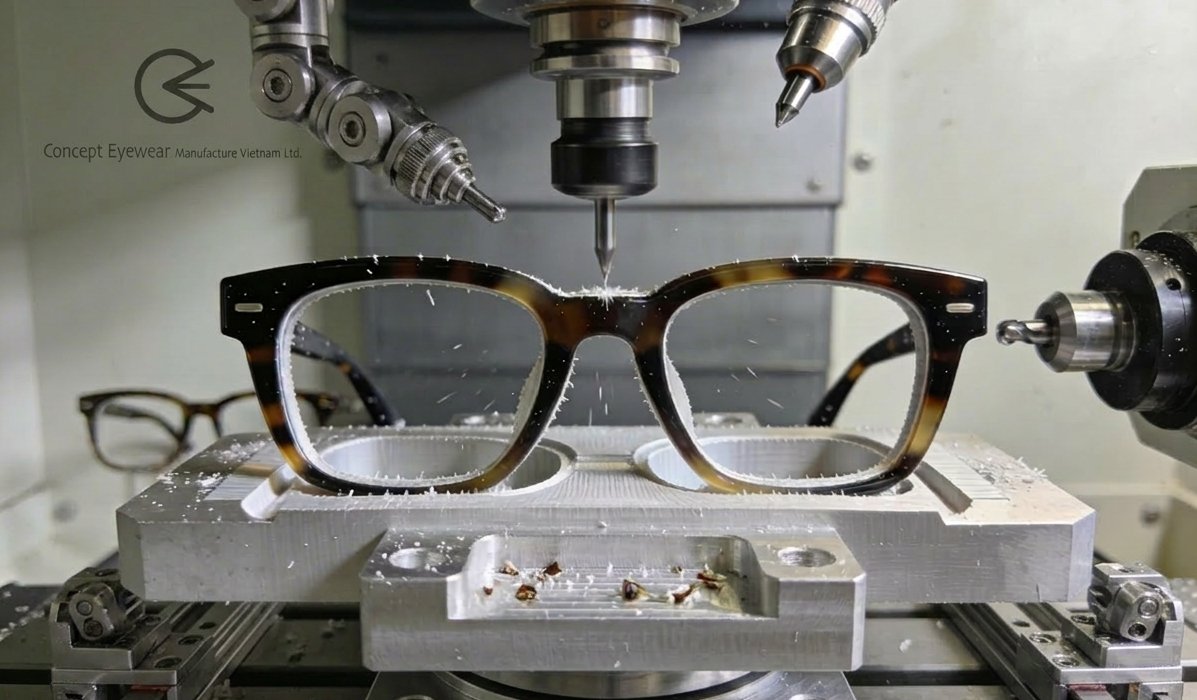
Multi‑axis CNC machining is transforming how OEM eyewear is manufactured in Vietnam, especially for fashion labels, lifestyle brands, and optical groups that demand tight tolerances and distinctive frame geometries. Instead of asking whether to use CNC, the real question for modern brands is how deeply this technology should be integrated into their eyewear supply chain.
Concept Eyewear leverages advanced multi‑axis CNC equipment in its Vietnam‑based factories to translate detailed CAD concepts into production‑ready eyewear components, while still combining this with skilled hand‑finishing and traditional frame‑making techniques.
What Multi‑Axis CNC Machining Means for Eyewear
CNC (Computer Numerical Control) machining uses programmed tool paths to cut, mill, and shape materials into precise eyewear parts. In eyewear, this technology is particularly critical for frame fronts and temples, where even small deviations can affect fit, ergonomics, and aesthetics.
Modern eyewear CNC machines often go beyond basic 3‑axis systems to include rotary and tilting axes that allow the cutting head or the part itself to move in multiple directions. In practice, a “8‑axis” robotic bending or machining system can coordinate several servo‑driven movements simultaneously, for example, rotating, tilting, feeding, and bending the material in different planes at the same time.
For brand owners, the benefit is straightforward: multi‑axis CNC can shape the frame from many angles in a single setup, producing complex curves and transitions that would be time‑consuming or inconsistent with purely manual methods.
Why Multi‑Axis CNC Matters for Brand Identity
Global eyewear trends highlight sculpted acetate fronts, beveled edges, layered details, and mixed‑material constructions as key design differentiators. Achieving these shapes repeatedly across thousands of pieces requires tight control of depth, angle, and curvature.
Multi‑axis CNC equipment allows Concept Eyewear to:
- Cut lens openings with customized shapes and tilt that match the exact CAD drawings supplied by your designers.
- Mill complex front profiles, such as step‑downs, 3D reliefs, and bold chamfers, that give a frame its signature look.
- Shape temples with controlled thickness transitions and ergonomic curves that echo your brand’s design language.
- Create precise grooves, holes, and pockets for hinges, metal cores, logos, and decorative parts so that components align cleanly in assembly.
Because every movement is programmed from CAD data, the machine reproduces the same geometry across production batches, helping protect the visual consistency of your brand at retail.
Inside the CNC‑Driven Manufacturing Process
While each factory has its own workflow, industry practice follows a similar sequence for CNC‑based acetate or metal eyewear production. Concept Eyewear’s process aligns with this general structure and can be understood in three main stages.
1. Digital Design and Toolpath Programming
Your internal team or design partner creates detailed 2D/3D models of frame fronts and temples using CAD software. These files define all key geometries: lens opening, bridge width, pantoscopic angle, bevels, and decorative cuts.
CNC programmers then convert the CAD model into machine instructions by:
- Selecting cutting tools and spindle speeds suited to acetate or metal.
- Defining multi‑axis tool paths that machine each surface and angle without unnecessary repositioning.
- Running simulations to verify that there are no collisions or gouges before any material is cut.
This digital preparation is where your brand’s concept is translated into a precise manufacturing recipe.
2. Multi‑Angle Machining of Fronts and Temples
Prepared acetate sheets or metal blanks are mounted in the CNC machine’s vice or robotic fixture. With a multi‑axis setup, the system can tilt, rotate, and feed the part while the cutting head moves along several axes.
Typical operations include:
- Rough cutting the outer frame shape and lens openings.
- Milling the inner and outer bevels that define how lenses sit and how light hits the front.
- Sculpting 3D contours—brow lines, nose area transitions, and edge profiles—from multiple angles without removing the part from the fixture.
- Drilling hinge holes, pad arm positions, or slots for metal cores with tight positional tolerances.
In the case of robotic bending equipment for metal frames, multiple coordinated axes control feed length, bend radius, and twist, allowing complex temple and bridge geometries to be formed in one automated cycle.
3. Finishing, Assembly, and Quality Checks
After CNC machining, frames are still in a “raw” state and move through traditional processes such as tumbling, hand‑polishing, surface finishing, and assembly.
For Concept Eyewear’s OEM clients, the key link to CNC at this stage is consistency:
- Because the CNC work is repeatable, polishing teams work from parts with uniform thickness and geometry, improving final fit.
- Assembly technicians receive components where hinges, cores, and lens grooves are already aligned to spec, reducing rework and rejects.
- QC teams can measure parts against the original digital models, catching deviations early in the process.
Benefits for Fashion Brands and Optical Chains
Investing in CNC‑heavy manufacturing capacity allows OEM partners in Vietnam to offer a level of precision and flexibility that aligns with current expectations for private‑label and licensed eyewear programs.
For buyers, this translates into:
- Design freedom – Complex shapes, layered acetates, and bold structures are achievable at scale without sacrificing repeatability.
- Faster development – Once tool paths are validated, design tweaks (for example, adjusting bridge fit or lens height) can be implemented digitally without re‑building manual tooling.
- Stable quality across regions – When the same CNC recipe is used for all markets, fit and aesthetics remain consistent whether frames ship to the US, Europe, or Australia.
- Efficient scaling – Programs can move from prototype runs to bulk orders using the same digital files, supporting both niche collaborations and chain‑wide rollouts.
In a competitive retail environment, this helps ensure that the frames on your shelves accurately reflect the concept your design and marketing teams approved.
FAQ – CNC‑Driven Manufacturing at an OEM Eyewear Partner
Q1. What is the advantage of a multi‑axis CNC machine versus standard equipment?
Multi‑axis machines can cut and shape the frame from many directions in a single setup, enabling more complex geometries, cleaner transitions, and better repeatability, especially for sculpted fronts and twisted or contoured temples.
Q2. Does CNC replace hand craftsmanship in eyewear?
No. CNC handles the precision cutting and shaping, while polishing, surface finishing, and many assembly steps still rely on skilled manual work to achieve the final look and comfort level.
Q3. How does CNC help protect our brand identity?
Because the tool paths are driven directly from your CAD files, the final frames closely match your approved design language, down to bevel depth, contour lines, and logo placements, across every production batch.
Q4. Can we use CNC for both acetate and metal frames?
Yes. CNC machining is widely used for acetate fronts and temples, as well as for metal components, where precise bending, milling, and drilling are required for fit and durability.
Q5. How early should we share CAD files with Concept Eyewear?
Ideally at the start of development, so programmers can evaluate feasibility, suggest small adjustments for better machinability, and build tool paths that balance design intent with efficient production.