

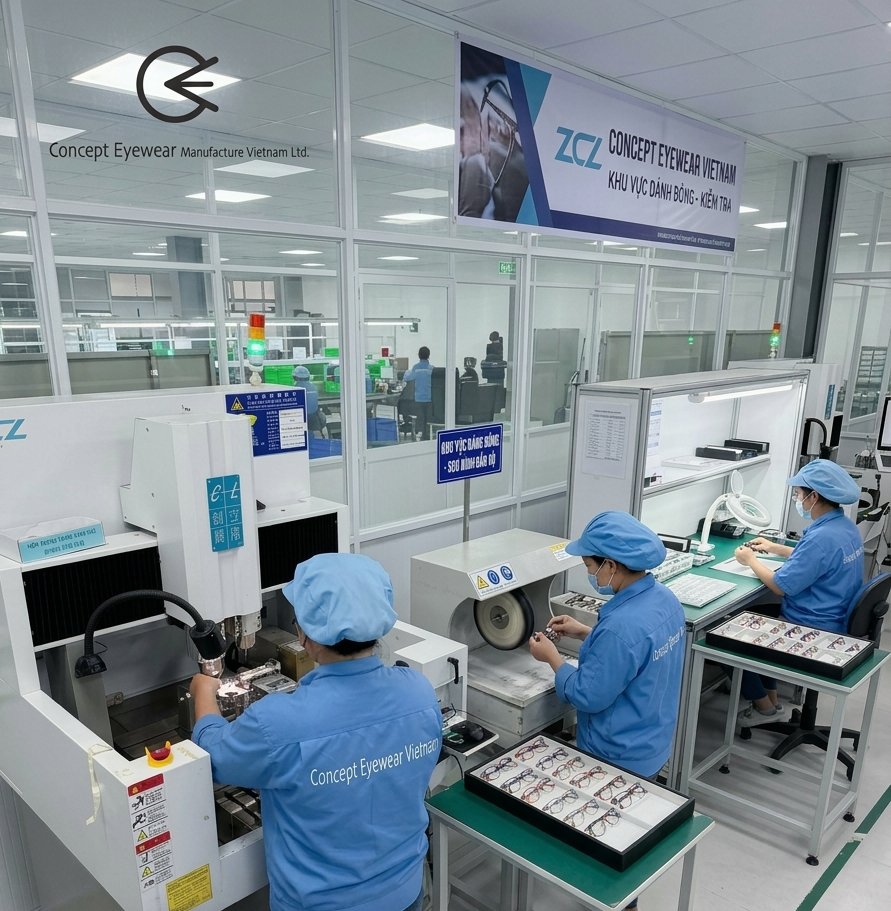
Even with advanced CNC and automation, high‑quality OEM eyewear is not a “press‑button” product. Every frame that reaches your stores has passed through dozens of human decisions: how it feels in the hand, how it sits on the face, how the finish reads under retail lighting. For Concept Eyewear, technology provides precision and repeatability, but skilled craftsmanship and rigorous quality assurance determine whether a collection truly meets the expectations of fashion brands and optical chains in the US, Europe, and Australia.
From Raw Material to Frame Blank: Setting the Foundation
The craft starts well before any polishing wheel. Selecting the right acetate blocks, metal sheets, or titanium profiles affects color depth, edge definition, and long‑term stability. Experienced technicians review batches for pattern balance, transparency, and compatibility with the intended design, rejecting materials that will not finish cleanly.
Once materials are approved, CNC and cutting operations shape fronts and temples according to the CAD files. Machines deliver tight tolerances on lens grooves, bridge dimensions, and thickness, but operators still decide feed rates, tool changes, and how to adapt the program for tricky laminations or special effects. If the operator’s judgment is off, even the best program can cause chipping, burning, or micro‑cracks.
Hand Shaping and Polishing: Where Frames Become Wearable
Trade articles regularly highlight that premium acetate and metal frames can involve 100–200 manual steps, especially around shaping and finishing. After CNC, edges are still sharp, surfaces show tool marks, and contact points are not yet comfortable enough for all‑day wear.
Key craftsmanship stages include:
- Edge tuning by hand file or belt to soften contact points without losing the design lines.
- Multi‑stage tumbling to gradually smooth surfaces before final polishing, often over several days for higher‑end collections.
- Hand polishing on wheels with different compounds to achieve either deep gloss or refined matte effects that feel “jewelry‑grade” at retail.
These steps rely on touch and experience. Too much pressure or heat can deform acetate or thin out critical areas, while rushed polishing leaves micro‑scratches that are obvious under store lighting. Machines support the work, but skilled hands decide when a frame is truly finished.
Precision Assembly: Micromillimeters That Change the Fit
Assembly is another stage where craftsmanship directly affects quality. Hinges, screws, and cores can all be installed by process, yet subtle differences in torque and alignment determine whether a frame feels refined or cheap.
Experienced assemblers:
- Align fronts and temples so the frame sits level and balanced on the face.
- Adjust temple curvature and pressure to match average fit requirements for different markets.
- Integrate logos, metal inlays, and decorative parts cleanly, avoiding gaps or visible adhesive.
High‑end brands frequently emphasize that perceived quality comes from these details—the invisible work that makes a frame open smoothly, close symmetrically, and feel substantial without being heavy.
Why Quality Assurance Must Be Present at Every Stage
Industry guides consistently stress that quality control is not a single final check but an integrated system that touches raw materials, semi‑finished parts, and finished frames. Concept Eyewear follows this principle by embedding QA checkpoints throughout the manufacturing process rather than only at the end.
Typical QA involvement includes:
- Incoming material checks – Color consistency, pattern matching, and dimensional accuracy before cutting.
- In‑process inspections – Verifying CNC dimensions, groove depths, and component positions after machining and before polishing.
- Surface and finish checks – Inspecting for scratches, pits, polishing burns, and color irregularities after tumbling and hand polishing.
- Functional tests – Opening and closing temples, flexing bridges, and assessing overall symmetry and fit.
Rather than relying on one inspector at the end, Concept Eyewear uses a dedicated QA presence at each major step to catch issues early and minimize human error, particularly where manual work is involved.
How a QA‑Backed Craft Process Protects Your Brand
For retailers and brands, the value of this combined craftsmanship and QA system shows up in three practical ways:
- Consistent shelf appearance
Frames from different batches look and feel the same – color, gloss, and shaping match the approved samples, supporting coherent merchandising. - Reduced returns and complaints
Systematic checks on alignment, comfort, and finish help avoid common problems like loose hinges, uneven temples, or rough contact points, which often drive returns. - Stronger brand perception
When customers pick up a frame and notice smooth edges, solid hinge feel, and refined surfaces, they perceive the collection as premium – even at accessible price points.
In a market where technology and automation are widely available, what differentiates one OEM partner from another is how they combine those tools with human skill and disciplined QA.
FAQ – Craftsmanship and QA in OEM Eyewear Manufacturing
Q1. If CNC is so precise, why do we still need hand work?
CNC defines geometry, but human hands refine comfort and aesthetics, polishing, edge softening, and adjustments are still required to achieve the feel customers expect from quality eyewear.
Q2. Does CNC replace hand craftsmanship in eyewear?
No. CNC handles precision cutting and shaping, while polishing, surface finishing, alignment, and many assembly steps rely on skilled manual work to deliver the final look and comfort level your customers notice immediately.
Q3. How does Concept Eyewear minimize human error during manual steps?
By placing QA checks at each stage- materials, machining, finishing, and final assembly and by comparing output to golden samples and defined tolerances, rather than leaving all decisions to one person at the end.
Q4. What does this mean for global retail chains?
You gain confidence that every frame across stores in the US, Europe, and Australia matches the approved standard, reducing surprises at delivery and reinforcing a consistent brand experience for customers.