

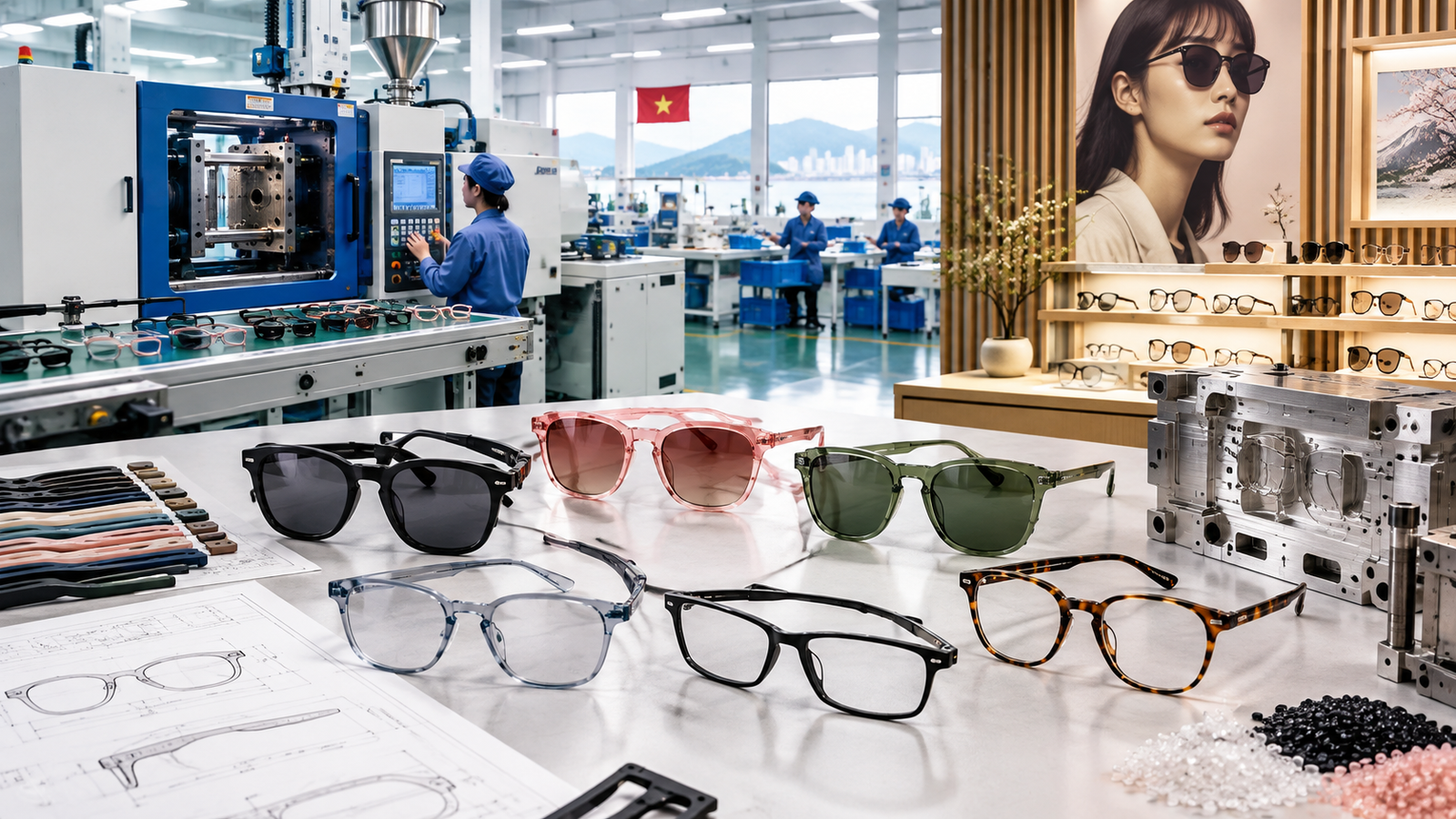
TL;DR: Vietnam injection frames give Japanese fast-fashion brands a practical route to lightweight, consistent and affordable Asian-fit eyewear. With carefully tuned bridge geometry, lens proportions, flexible polymers and disciplined OEM/ODM quality control, scaling brands can serve Japanese eye shapes while preserving speed, margin and multi-market potential.
Why are Vietnam injection frames gaining attention in Japanese fast fashion?
Vietnam injection frames are becoming a strategic option for brands that need fashionable eyewear at repeatable volume. Injection molding creates consistent frame geometry across large runs, supports efficient color changes and enables lightweight silhouettes that work well with fast-fashion merchandising. For Japanese consumer collections, the opportunity is not simply lower production cost. It is the ability to combine Asian-fit comfort, rapid SKU testing and dependable replenishment from an organized OEM/ODM supply chain.
Japanese shoppers often expect eyewear to sit securely without excessive sliding, pressure at the temples or a frame that looks oversized relative to the face. That makes eye-shape and facial-proportion research central to product development. A narrow-to-medium eye opening, controlled endpiece width, moderate bridge height and carefully selected nose-pad architecture can produce a more stable fit than copying a Western base pattern.
Concept Eyewear helps international brands translate these requirements into manufacturable products through OEM/ODM development in Vietnam and Hong Kong. A typical program can begin with a Japanese-fit design brief, move through 3D engineering and tooling, then proceed to pilot production, wear testing and volume manufacturing.
How should brands engineer injection frames for Japanese eye shapes?
The best Vietnam injection frames begin with fit data rather than decoration. A Japanese fast-fashion SKU should balance a compact lens shape with enough horizontal coverage for modern styling. The frame must also control pantoscopic angle, temple spread, bridge contact and the relationship between the optical center and the wearer’s pupils.
Which geometry decisions matter most?
- Bridge and nose fit: Use a bridge height and curvature that reduce downward movement, while avoiding excessive pressure on the nasal area.
- Eye shape: Consider softer rectangular, rounded-square and subtle cat-eye profiles with proportions that suit smaller or medium facial widths.
- Endpieces: Keep hinge placement and endpiece thickness visually light but structurally strong enough for repeated daily opening and closing.
- Temple design: Use a controlled taper, reliable flex and appropriate length options to improve retention without creating pressure behind the ear.
- Lens position: Validate vertex distance, optical center placement and usable field of view before approving the final mold.
Injection frames can use TR-90 or other nylon-based materials for low weight and resilience, while bio-based or recycled-content polymers may support a stronger sustainability story when their performance and traceability are verified. For premium fast-fashion capsules, a two-material construction can combine a rigid front with a softer temple tip. However, each additional material, insert or color process should be assessed against the target price and production volume.
What does a Vietnam injection-frame production workflow include?
A reliable Vietnam factory program separates creative speed from engineering discipline. The process should protect the brand’s launch calendar while creating measurable approval gates.
- Market and fit brief: Define Japanese consumer profile, target eye shape, face-width range, lens category, retail price and planned color count.
- Design engineering: Convert sketches into production-ready 3D data, draft analysis, wall-thickness checks, hinge specifications and material selection.
- Prototype validation: Review 3D prints or soft tools for balance, comfort, visual proportion and lens seating before committing to hard tooling.
- Mold development: Confirm cavity count, steel selection, gate location, cooling, texture and expected cycle time. Tooling decisions affect both unit economics and replenishment speed.
- Injection trials: Inspect first shots for sink marks, short shots, weld lines, warpage, color consistency and dimensional stability.
- Assembly and finishing: Verify hinge installation, temple alignment, surface texture, logo application, lens fitting and packaging presentation.
- Compliance release: Complete documented inspection and applicable optical, mechanical and chemical testing before shipment.
For a concrete OEM/ODM example, a Japanese fast-fashion brand could launch three Vietnam injection frames: a rounded-square everyday optical frame, a slim rectangular blue-light frame and a sun frame with UV-protective lenses. Concept Eyewear can coordinate the fit block, color standards, tooling review, pilot run and production allocation between Vietnam manufacturing and Hong Kong-based commercial coordination.
Which Vietnam injection frames fit Japan, EU, US and Asia markets?
One base design can travel internationally, but the fit, lens performance and merchandising message should be localized. Japanese buyers may prioritize compact proportions, stable nose contact and understated colors. EU buyers may respond to stronger sustainability documentation and fashion-led color stories. US buyers may require broader fit options, larger lens coverage and more explicit performance communication.
| Concept or SKU | Target price and production logic | Regional positioning | Standards and performance focus |
|---|---|---|---|
| Rounded-square Asian-fit optical frame | Value to mid-tier; efficient single-material injection and four core colors | Japan first, then selected Asian e-commerce channels | Dimensional consistency, hinge durability, optical lens retention and ISO 12312 where applicable |
| Slim rectangular blue-light frame | Mid-tier; lightweight nylon-based front with controlled color and logo options | Japan, Korea, Hong Kong and digital-first EU testing | Lens transmission claims, abrasion resistance, chemical testing and documented batch control |
| UV fashion sun frame | Mid to premium; larger volume potential with seasonal color drops | Japan, EU and US lifestyle retail | UV performance, impact requirements, ISO 12312 applicability and Z87 evaluation for protective variants |
For sunglasses, brands should confirm the applicable market requirements and product claims before finalizing the lens specification. ISO 12312-1 is a useful reference point for general-use sunglasses, while Z87-related testing becomes relevant when a product is positioned as occupational or protective eyewear rather than ordinary fashion eyewear. An authoritative starting point for standards research is the ISO 12312-1 standard page.
How can fast-fashion brands control cost and speed?
The commercial advantage of Vietnam injection frames appears when design, tooling and demand planning are considered together. A low unit price alone does not guarantee a profitable program. Brands should model tooling amortization, minimum order quantities, color complexity, lens purchasing, packaging, testing, freight and the cost of slow-moving variants.
What should sourcing teams measure?
- Tooling return: Compare cavity count and mold investment with the expected lifetime volume, not only the first order.
- SKU discipline: Start with a small number of proven shapes and use color drops to create freshness without multiplying molds.
- Yield: Track rejects from molding, trimming, assembly, lens fitting and final inspection separately.
- Replenishment: Reserve capacity for best sellers and establish a repeat-order process before launch.
- Quality cost: Include corrective-action time, sorting, returns and marketplace reviews in the total cost model.
Japanese fast fashion is particularly compatible with a test-and-repeat strategy. A brand can launch a controlled assortment online and in selected stores, measure conversion and return reasons, then replenish the strongest eye shapes. This approach reduces the risk of committing to too many colors before the fit and silhouette are commercially proven.
Why does this research help brands grow strategically?
Research into Vietnam injection frames helps brands grow strategically because it connects consumer fit insight with a scalable manufacturing system. Instead of treating eyewear as a seasonal accessory purchase, brands can build a repeatable platform: a validated Japanese-fit block, a family of compatible lens shapes, standardized hinge and temple components, and a production partner capable of controlled variation.
That platform creates three advantages. First, it shortens development because new designs begin from tested geometry. Second, it protects margin because the factory can reuse engineering knowledge, packaging formats and inspection procedures. Third, it improves channel expansion because a Japan-developed fit can be adapted for Asian markets while selected shapes are re-engineered for EU or US requirements.
Concept Eyewear’s Vietnam and Hong Kong OEM/ODM model supports this strategic workflow. The brand retains control of creative direction and commercial positioning, while the manufacturing team translates the brief into moldable geometry, repeatable materials and documented quality gates. For scaling brands, that collaboration is more valuable than a one-off low-price quote.
How should brands launch a Japan-ready Vietnam eyewear collection?
- Define two or three target face-width and eye-shape profiles using wear-test feedback and retailer data.
- Create one core fit block and develop multiple front shapes around it.
- Choose a polymer based on weight, flexibility, surface finish, color stability and verified sustainability claims.
- Approve prototypes on real users before hard tooling and record fit comments in a technical specification.
- Build a pilot order with limited colors, then reserve capacity for the best-selling silhouettes.
- Align product claims, test reports, labeling and packaging with each destination market.
Brands can review Concept Eyewear’s OEM/ODM manufacturing approach when evaluating Vietnam injection frames for a Japanese consumer launch. The right partner should be able to discuss mold flow, material certificates, inspection plans, forecast flexibility and the practical difference between fashion eyewear and protective products.
Ready to build a Japanese-fit collection that can scale beyond the first drop? Partner with Concept Eyewear for Vietnam and Hong Kong OEM/ODM development of Vietnam injection frames, with fit engineering, production planning and testing aligned with ISO 12312 and, where relevant, Z87 performance requirements.
日本のファストファッション向けベトナム製インジェクションフレームとは?
要約:ベトナム製インジェクションフレームは、日本のファストファッションブランドにとって、軽量性、安定した品質、手頃な価格、そしてアジアンフィットを同時に実現しやすい選択肢です。ブリッジ、レンズ形状、テンプル、素材、品質管理を日本の目元や顔幅に合わせて設計することで、ブランドは商品開発のスピード、利益率、補充生産の柔軟性を高められます。
射出成形は、フレーム形状を安定して再現しやすく、複数カラーの展開や大量生産にも適しています。日本市場では、フレームがずれにくく、鼻やこめかみに過度な圧力がかからず、顔に対して大きすぎないことが重要です。そのため、欧米向けの基本形状をそのまま流用するのではなく、日本人の顔幅、目の位置、鼻の高さ、まぶたの形状を考慮した設計が必要です。
Concept Eyewearは、ベトナムと香港を拠点とするOEM/ODM開発を通じて、海外ブランドの企画を量産可能な製品へ変換します。日本向けフィットの設計、3Dエンジニアリング、金型、試作、装用テスト、量産までを一貫して検討できます。
日本人の目元に合うインジェクションフレームはどう設計する?
日本向けフレームは、装飾だけでなくフィットデータから設計することが重要です。コンパクトなレンズ形状でありながら視界を確保し、ブリッジの接触、テンプルの開き、レンズの光学中心、前傾角を確認します。
どの設計要素を確認すべき?
- ブリッジと鼻あたり:ずれ落ちを抑えながら、鼻への局所的な圧迫を避けます。
- レンズ形状:ソフトなスクエア、ラウンドスクエア、控えめなキャットアイは、複数の顔幅に展開しやすい形状です。
- ヨロイ:ヒンジ周辺を軽く見せながら、開閉を繰り返しても強度を保てる構造にします。
- テンプル:テーパー、柔軟性、長さを調整し、耳の後ろに過度な圧力をかけずに保持します。
- レンズ位置:頂点間距離、光学中心、視野、レンズ保持を試作品で確認します。
素材にはTR-90などのナイロン系樹脂を使うことで、軽量性と耐久性を両立しやすくなります。バイオベース樹脂や再生材を使う場合は、性能、トレーサビリティ、表示根拠を確認する必要があります。高付加価値のカプセルコレクションでは、硬質なフロントと柔らかなテンプル先端を組み合わせる方法もありますが、部品数や工程が増えるため、目標価格と数量を先に確認すべきです。
ベトナム工場のOEM/ODM生産工程には何が含まれる?
信頼できるベトナム工場のプログラムでは、デザインの速さとエンジニアリングの精度を分けて管理します。市場仕様、金型、材料、試作、量産、検査に明確な承認段階を設けることで、発売スケジュールを守りやすくなります。
- 日本の消費者像、顔幅、目元、希望小売価格、レンズカテゴリー、カラー数を定義します。
- スケッチを量産用3Dデータへ変換し、抜き勾配、肉厚、ヒンジ、材料を確認します。
- ハード金型の前に3Dプリントまたはソフトツールで重量、装用感、外観、レンズ嵌合を確認します。
- 金型のキャビティ数、鋼材、ゲート、冷却、表面テクスチャ、サイクルタイムを決定します。
- 初回成形品でショートショット、ヒケ、ウェルドライン、反り、色差、寸法を検査します。
- ヒンジ、テンプル、ロゴ、レンズ、表面仕上げ、包装を確認します。
- 対象市場に必要な性能、化学、表示、機械試験を完了し、量産出荷を承認します。
例えば、日本のファストファッションブランドは、ラウンドスクエアのオプティカルフレーム、細身の長方形ブルーライトフレーム、UVカットレンズを使用したサングラスの3型から開始できます。Concept Eyewearは、フィットブロック、カラー基準、金型確認、試作、量産配分を、ベトナムの製造拠点と香港の商務・開発体制の間で調整できます。
日本、EU、米国、アジア市場でどう展開できる?
1つの基本設計を国際展開することは可能ですが、フィット、レンズ性能、商品説明は市場ごとに調整します。日本ではコンパクトな比率、安定した鼻あたり、落ち着いたカラーが評価されやすく、EUではサステナビリティ資料や色のストーリーが重要になります。米国では、より広いフィット選択肢、大きめのレンズカバレッジ、性能表示が求められる場合があります。
| 商品コンセプト | 価格・生産設計 | 地域ポジション | 規格・性能確認 |
|---|---|---|---|
| アジアンフィットのラウンドスクエア | バリューからミドル。単一素材成形と4色の定番展開 | 日本を中心にアジアのECへ展開 | 寸法安定性、ヒンジ耐久性、レンズ保持、該当時のISO 12312 |
| 細身の長方形ブルーライトフレーム | ミドル。軽量ナイロン系素材と管理しやすいカラー展開 | 日本、韓国、香港、EUのデジタル販売テスト | 透過率表示、耐摩耗性、化学試験、ロット管理 |
| UVファッションサングラス | ミドルからプレミアム。季節カラーで数量を拡大 | 日本、EU、米国のライフスタイル小売 | UV性能、耐衝撃性、ISO 12312、保護用途ならZ87評価 |
サングラスの場合、最終的なレンズ仕様と表示を決める前に、販売国の規制と商品カテゴリーを確認してください。一般用途サングラスではISO 12312-1が重要な参照となり、作業用・保護用として販売する場合はZ87関連の評価が必要になることがあります。規格確認の出発点として、ISO 12312-1の公式ページを参照できます。
ファストファッションブランドはコストとスピードをどう管理する?
ベトナム製インジェクションフレームの商業的な強みは、デザイン、金型、需要予測を一体で考えたときに現れます。単価だけでは、金型費、最低発注数量、カラー数、レンズ、包装、試験、輸送、在庫リスクを判断できません。
- 金型費は初回数量ではなく、想定する累計数量で回収性を確認します。
- 最初は少数の形状に絞り、カラー追加で新鮮さをつくります。
- 成形、トリミング、組立、レンズ、最終検査の不良を工程別に管理します。
- 販売前から売れ筋補充の生産枠と再注文プロセスを確保します。
- 返品、選別、クレーム、ECレビューへの影響も品質コストに含めます。
日本のファストファッションでは、テスト販売とリピート生産の組み合わせが有効です。ECや限定店舗で少量展開し、購入率、返品理由、サイズ評価を分析した後、最も評価された目元形状を補充します。これにより、フィットが検証される前に多色展開へ投資するリスクを抑えられます。
なぜこの調査がブランドの戦略的成長に役立つ?
ベトナム製インジェクションフレームに関する調査は、消費者のフィットニーズと量産可能な製造システムを結びつけます。ブランドは単発のアクセサリーではなく、検証済みの日本向けフィットブロック、互換性のある複数レンズ形状、共通部品、標準化された検査手順を持つ商品プラットフォームを構築できます。
この仕組みは、開発期間の短縮、利益率の保護、海外展開の柔軟性につながります。日本向けに検証した設計をアジア市場へ展開し、一部の形状はEUや米国向けにブリッジ、レンズ幅、性能表示を調整できます。
Concept Eyewearのベトナム・香港OEM/ODMモデルは、この戦略を支援します。ブランドはクリエイティブと販売戦略を管理し、製造チームはそれを成形可能な形状、安定した材料、記録された品質ゲートへ変換します。成長を目指すブランドにとって、単純な低価格見積もりよりも、この継続的な開発能力が重要です。
日本向けコレクションはどのように立ち上げる?
- 装用テストと小売データから、顔幅と目元のターゲットを2〜3種類に定義します。
- 1つの基本フィットブロックから複数のフロント形状を設計します。
- 重量、柔軟性、表面、色安定性、検証済みの環境性能を基準に樹脂を選びます。
- ハード金型の前に実ユーザーで試作を確認し、装用コメントを仕様書に記録します。
- 限定カラーで試験販売し、売れ筋形状の補充生産枠を確保します。
- 各販売国の性能、表示、包装、試験資料を出荷前に整えます。
日本向けコレクションの生産パートナーを探すブランドは、Concept EyewearのOEM/ODM製造体制を確認できます。金型流動、材料証明、検査計画、需要変動への対応、ファッション用と保護用の違いを説明できるパートナーを選ぶことが重要です。
日本人の目元に合うコレクションを、最初の販売だけでなく継続的な補充と海外展開へつなげませんか。Concept Eyewearは、ベトナムと香港のOEM/ODM体制で、ベトナム製インジェクションフレームのフィット設計、生産計画、ISO 12312、必要に応じたZ87性能評価に対応するコレクション開発を支援します。
