

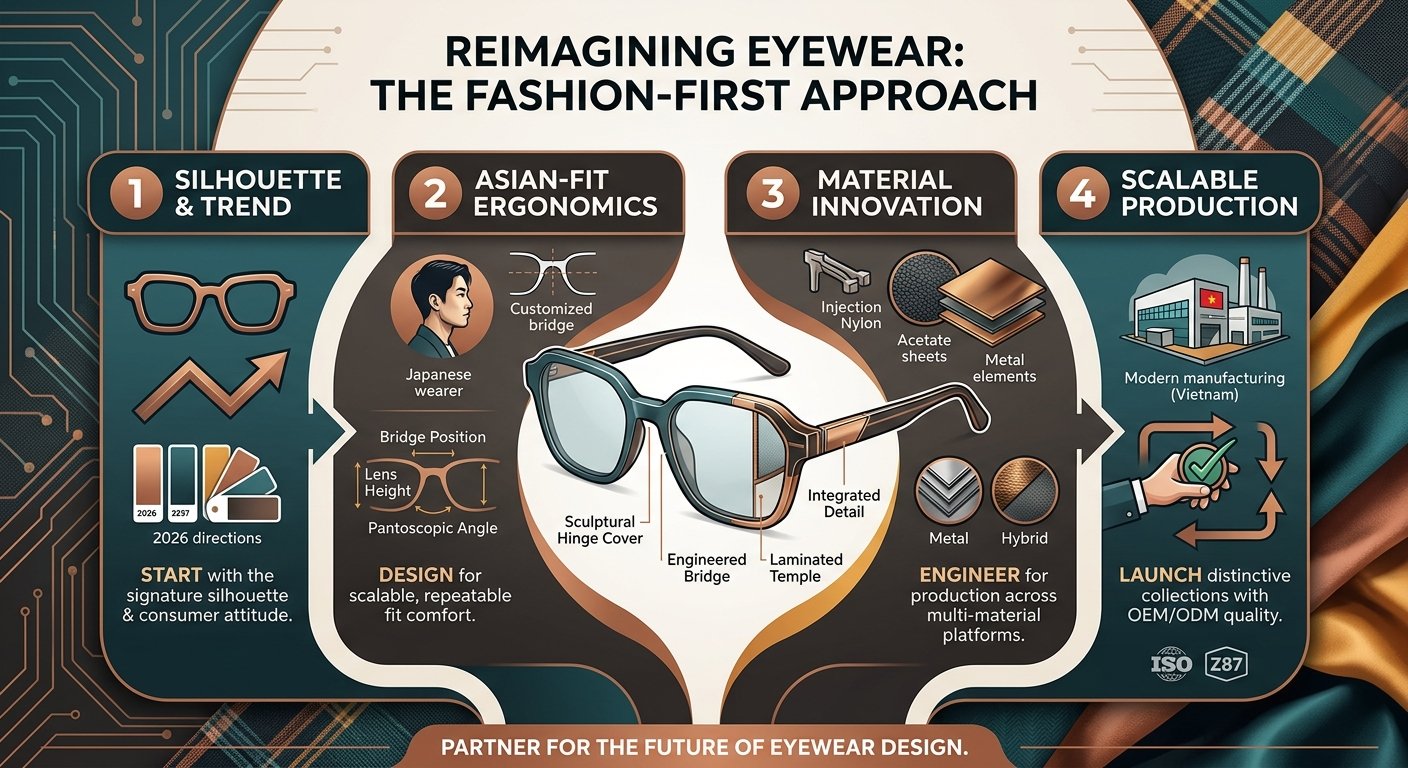
TL;DR: Fashion-first eyewear manufacturing starts with the silhouette, color story and consumer attitude before production engineering. Concept Eyewear combines fashion direction with Vietnam injection molding, acetate, metal and hybrid construction to help Japanese fast-fashion brands launch distinctive Asian-fit collections with scalable OEM/ODM quality.
Why does fashion-first manufacturing matter for eyewear brands?
Fashion-first manufacturing means the factory is involved before the design becomes a fixed production file. Instead of treating manufacturing as a final step that only controls cost, a fashion-first partner helps shape the frame architecture, material expression, color strategy and commercial range from the beginning. This approach is especially valuable for Japanese fast-fashion brands, where product freshness, reliable fit and fast replenishment must work together.
Current 2026 eyewear direction balances expressive silhouettes with wearable proportions. Sculptural geometry, softened hexagons, compact cat-eyes, refined ovals, translucent neutrals and selective bold color are commercially relevant because they create visual identity without making every SKU difficult to produce. Public trend coverage also points to a balance between statement shapes, vintage references, minimalist metals and transparent materials. The opportunity for a scaling brand is to convert those signals into a coherent design system rather than chase isolated trends.
Concept Eyewear is a fashion-first OEM/ODM manufacturer with production and development capability in Vietnam and commercial coordination in Hong Kong. Our role is not simply to reproduce a drawing. We help brands decide which details should be signature, which components should be standardized and which options can generate newness without multiplying tooling risk.
How should designers build a fashion-first frame architecture?
A strong fashion frame has a recognizable visual grammar. That grammar may come from a distinctive brow line, an engineered endpiece, a controlled lens-to-face ratio, a signature temple treatment or an unexpected color contrast. The best designs remain identifiable when reduced to a line drawing and still feel comfortable when worn.
Which design layers create commercial distinction?
- Silhouette: Start with the outline visible from a distance. Soft geometric rectangles, compact ovals, lifted cat-eyes and rounded pilots can be developed into a repeatable family.
- Proportion: Control front width, lens height, bridge span and endpiece projection for the intended face-width range rather than enlarging a generic global block.
- Surface: Decide whether the design should be high-polish, satin, micro-textured, translucent or layered. Surface is a major part of perceived value.
- Detail: Use one or two signature details, such as a sculpted hinge cover, stepped brow, metal pin, layered temple or color-blocked inner rim.
- Wear experience: Check nose stability, temple pressure, lens clearance, weight balance and visual comfort before the design is approved for tooling.
For Japanese consumers, a fashion-first process should begin with an Asian-fit base. This does not mean every wearer has identical facial features. It means the design team deliberately tests bridge position, nose contact, lens height, pantoscopic angle, temple spread and face-width coverage on relevant users. A compact front can remain expressive if the eye shape, brow lift and color story deliver enough fashion impact.
How can injection molding support fashion-led eyewear design?
Injection molding is often associated with value products, but advanced tooling and finishing can support highly contemporary fashion collections. Nylon-based materials such as TR-90 can create lightweight fronts, resilient temples and repeatable curved surfaces. The process also supports efficient color changes, integrated details and consistent geometry across high-volume runs.
The design brief must account for draft angles, wall thickness, gate position, shrinkage, ejection marks and post-molding finishing. A sculptural shape that looks excellent on screen may require a different radius, thicker transition or hidden parting line to mold cleanly. Fashion-first manufacturing brings the engineer into the conversation early enough to protect the visual intention while avoiding late-stage compromises.
When should brands choose acetate, metal or a hybrid?
| Construction | Fashion expression | Best commercial use | Key development control |
|---|---|---|---|
| Injection nylon or TR-90 | Lightweight sculptural curves, translucent color and repeatable integrated details | Fast-fashion volume, seasonal drops and e-commerce testing | Mold flow, wall thickness, color stability, warpage and hinge durability |
| Cellulose acetate or bio-acetate | Depth, layered laminations, polished edges and premium color richness | Mid-tier and elevated capsule collections | Sheet thickness, lamination alignment, polishing standard and verified material claims |
| Stainless steel or titanium | Fine lines, engineered bridges, minimal ovals and lightweight luxury | Premium optical and refined fashion ranges | Weld quality, plating, flex, corrosion resistance and dimensional tolerance |
| Acetate-metal hybrid | Contrasting textures, browline architecture and modular color stories | Cross-tier collections using shared core components | Component fit, finish compatibility, assembly sequence and serviceability |
The most scalable design strategy is often a platform rather than a single material. A brand can use one validated Japanese-fit block across an injection optical frame, an acetate premium version and a sunwear adaptation. The visual family remains consistent while the price ladder expands.
How should brands design collections instead of isolated SKUs?
Fashion-first manufacturers help brands build a collection architecture with clear roles. A commercial launch might include a core frame, a fashion hero, a color-led seasonal option and a premium upgrade. Each item should share enough DNA to look like one brand, but each should create a reason to buy.
- Core volume frame: A soft rectangle or compact oval with stable fit, efficient tooling and neutral colors.
- Fashion hero: A sculptural cat-eye, softened hexagon or architectural brow that generates campaign attention.
- Color drop: A proven silhouette refreshed through translucent smoke, soft honey, cherry red, cobalt, olive or dusty rose.
- Premium upgrade: Acetate, titanium, layered construction or refined finishing that raises average selling price.
This structure supports Japanese fast-fashion merchandising because the brand can test the hero design while protecting the launch with dependable core products. It also improves e-commerce presentation: the hero frame attracts clicks, the core frame supports conversion and the color drop creates urgency without requiring a completely new product concept.
What advanced fit decisions improve Japanese market performance?
Fit should be treated as a design language, not a technical correction. Designers can make a Japanese-fit frame fashionable by tuning the visible relationship between brow line, pupil position and cheek clearance. A slightly higher bridge, controlled lens height and a carefully placed endpiece can make a frame appear intentional rather than merely smaller.
During prototype review, measure more than total frame width. Record bridge comfort, frame-to-face distance, temple spread, pantoscopic angle, lens retention, weight distribution and cheek contact during smiling. Test both optical and sun versions because lens thickness, curvature and tint can change the visual balance of the frame.
For fast-fashion programs, fit data should be converted into reusable blocks and rules. Once a brand validates a Japanese-fit rectangle, the same bridge logic can inform an oval, cat-eye or sunglass shape. This reduces development time and makes repeat production more predictable.
How do color and finish turn engineering into fashion?
Color is one of the fastest ways to create a new commercial story without changing the entire structure. A disciplined palette can combine black, brown and tortoise as volume anchors with translucent champagne, smoke, soft honey, olive, dusty rose, cobalt or cherry red as seasonal accents. Inner laminations, temple tips and discreet metal details can deliver fashion impact while keeping the front wearable.
Injection color requires control of resin grade, pigment dispersion, UV stability, surface texture and batch approval. Acetate requires attention to sheet consistency, lamination alignment, cutting direction and polishing. Metallic finishes require plating, coating or PVD specifications, along with sweat, corrosion and adhesion testing suited to the target market.
A fashion-first supplier should provide physical color standards, approved master samples and tolerance definitions rather than relying only on digital swatches. This is particularly important for Japanese retail and e-commerce, where small differences in translucent tones can change how a product appears under store lighting or in product photography.
How does Concept Eyewear scale fashion-first OEM/ODM production?
Concept Eyewear connects fashion direction with a controlled development workflow in Vietnam and Hong Kong. The process can include trend interpretation, silhouette editing, Asian-fit engineering, material selection, 3D development, prototype review, tooling, color approval, pilot production and volume manufacturing.
- Define the fashion thesis: State the consumer attitude, reference wardrobe, target price, channel and hero detail before drawing every SKU.
- Create the fit platform: Establish bridge, eye shape, face-width range, temple length and lens rules for Japanese consumers.
- Build a design family: Translate one visual language into core, hero, color-drop and premium styles.
- Engineer for the selected material: Adapt radii, wall thickness, draft and assembly to injection, acetate, metal or hybrid construction.
- Approve physical evidence: Review prototypes, color chips, wear tests, mold trials and inspection standards before mass production.
- Plan replenishment: Separate forecast colors from evergreen colors and reserve capacity for proven winners.
A practical OEM/ODM example is a Japanese fast-fashion launch with four silhouettes built on one fit platform: a translucent injection oval, a soft rectangular acetate frame, a compact cat-eye sun frame and a thin metal pilot. The first three can share design details such as a stepped brow or signature temple tip, while the metal pilot raises the collection into a premium tier. Vietnam production can support the injection and acetate volume, while Hong Kong coordination manages development communication, approvals and international brand requirements.
Why does a fashion-first manufacturer help brands grow strategically?
A fashion-first manufacturer helps brands grow strategically because it reduces the distance between consumer insight, creative identity and production reality. When the factory understands why a shape matters, it can protect the essential design feature while improving yield, assembly and repeatability.
This model creates a stronger asset than a single successful frame. The brand develops reusable fit blocks, signature details, color standards, component libraries and tested supplier processes. New collections can move faster because the team is extending a proven design language rather than beginning from zero.
It also supports better price architecture. A brand can offer an accessible injection style, a richer acetate version and a premium metal or hybrid edition without losing visual coherence. Retailers receive a clear merchandising story, while e-commerce teams gain recognizable shapes and color variations that are easier to photograph, compare and retarget.
Which standards and testing workflow should fashion brands use?
Fashion-first does not mean performance is secondary. For sunglasses, brands should verify the applicable destination-market requirements and product claims before production release. ISO 12312-1 is an important reference for general-use sunglasses. If a product is marketed as occupational or protective eyewear, Z87-related performance evaluation may become relevant. The exact testing program should match the product category, lens claims and sales markets.
Quality control should cover incoming materials, first-shot approval, dimensional inspection, hinge and temple durability, lens retention, surface finish, color consistency, UV performance where applicable, chemical requirements and final random inspection. An authoritative starting point for general-use sunglasses standards is the ISO 12312-1 page from ISO.
For brands evaluating a manufacturing partner, Concept Eyewear’s Vietnam and Hong Kong OEM/ODM approach is designed to connect fashion development with documented production control. The goal is a collection that looks distinctive on launch day and remains consistent during replenishment.
Ready to move beyond generic private-label frames? Partner with Concept Eyewear as your fashion-first OEM/ODM manufacturer in Vietnam and Hong Kong for Japanese-fit injection, acetate, metal and hybrid eyewear collections aligned with commercial design goals, ISO 12312 and, where relevant, Z87 performance requirements.
