

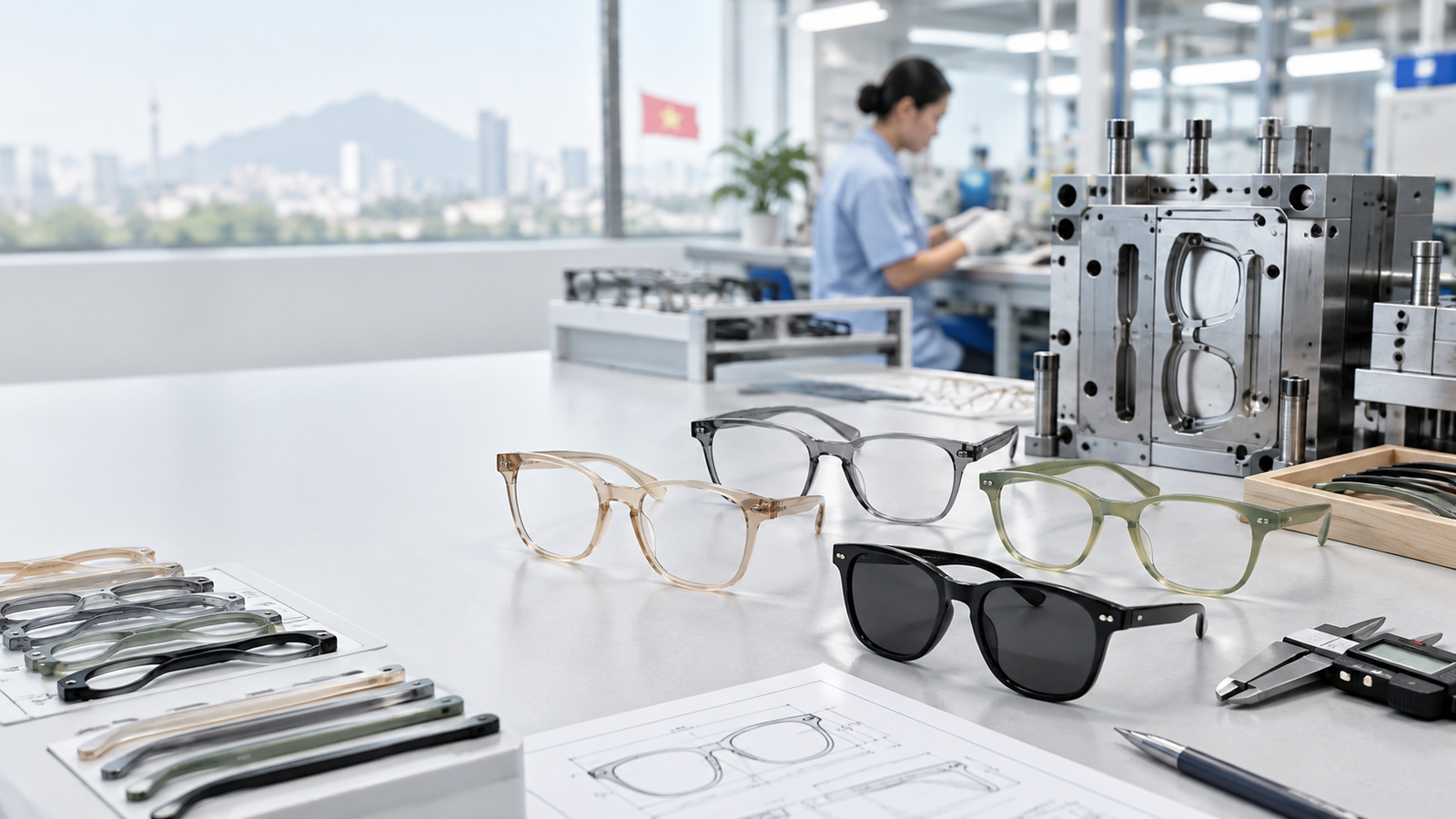
TL;DR: Vietnam injection frames are the 2026 go-to for Japanese fast-fashion eyewear — combining lightweight Asian-fit designs, rapid color drops, and compliant OEM/ODM manufacturing in Vietnam and Hong Kong to help brands scale collections while protecting margins.
What is the 2026 trend for Vietnam injection frames in Japanese fast fashion?
In 2026, Japanese fast-fashion eyewear buyers are leaning into lightweight injection frames that deliver everyday comfort, clean silhouettes and quick-turn color stories at accessible price points. This Vietnam injection frames trend focuses on slim, sculpted profiles aligned with current “quiet luxury” and minimalist aesthetics, while still allowing playful color drops and seasonal graphics that fast-fashion consumers expect.
For Japanese consumers accustomed to apparel collections rotating weekly, eyewear must now follow the same rhythm: reusable tooling for core shapes, plus fast color, finish and logo updates that refresh the shelf without restarting engineering from zero. Vietnam injection frames answer this need by pairing efficient mold programs with flexible OEM/ODM production in Vietnam and Hong Kong so brands can test and scale successful SKUs faster than ever.
Beyond fashion appeal, the trend also reflects a practical shift: injection frames are lighter, more impact-resistant and easier to fit across a wide range of face shapes than many heavy acetate silhouettes — making them ideal for busy urban consumers who wear frames all day in the office, on public transport and outdoors.
How do Vietnam injection frames fit Japanese eye shapes and Asian-fit needs?
Japanese eyewear consumers tend to prefer frames that respect Asian-fit anatomy: lower nose bridges, higher cheekbones relative to the eye line, and smaller to medium overall facial widths. Vietnam injection frames can be engineered precisely around these requirements, eliminating the slipping, pinching and lens flare issues that occur when global-fit frames are imported without adaptation.
Well-designed Asian-fit injection frames adjust three core parameters: bridge height and curvature, pantoscopic tilt and temple wrap. By shaping the injected front and temple geometry to sit slightly higher on the nose — with controlled tilt and wrap — brands can prevent lenses from touching cheeks and ensure a stable, centered visual field for daily wear.
For Japanese fast-fashion chains, the winning strategy is to standardize a small family of Asian-fit geometries, then extend them across optical and sun categories. This approach lets frames feel familiar on the face even when colorways, finishes or branding shift every season.
Which injection frame shapes work best for Japanese consumers?
For the Japanese fast-fashion market, the most commercially successful injection frame shapes balance modern styling with forgiving fit across multiple face shapes:
- Thin-profile geometrics: soft hexagons and angular rectangles that add definition without feeling aggressive — ideal for office and campus wear.
- Updated rounds and ovals: slightly flattened rounds and gentle ovals suited to smaller faces, with carefully tuned bridge heights for Asian-fit noses.
- Slim cat-eyes and elongated rectangles: subtle lifts at the outer corners create a fashionable effect without overwhelming conservative shoppers.
- Low-bridge, deep-front sunwear: deeper lens heights provide good coverage outdoors, while low bridges and refined wraps keep lenses clear of cheeks.
By combining these proven shapes with precise injection tooling, brands can build a design system that stays coherent across hundreds of SKUs — reducing returns and increasing repeat purchases in Japan’s competitive fast-fashion retail channels.
What material and engineering choices make Vietnam injection frames scalable?
Vietnam injection frames for Japanese fast fashion typically use TR-90, injected nylon and high-impact polycarbonate — materials that deliver a strong balance of flexibility, durability and cost efficiency. These polymers allow thin profiles and subtle sculpting while maintaining the mechanical strength needed for daily wear across different climates and lifestyles.
At Concept Eyewear‘s Vietnam factory, high-cavitation molds and standardized gate designs are used to control flow and shrinkage, ensuring consistent thickness around critical zones such as bridges, end pieces and temple hinges. This engineering approach reduces warpage and keeps fit stable from prototype through mass production — even when brands push for very light, minimal silhouettes.
Injection frames also support integrated design features that matter to Japanese consumers: molded nose pads tuned for Asian-fit bridges, built-in logo plaques, and subtle inner-surface texturing to improve grip without visible branding. Once tooling is stabilized, these features can be replicated at scale, supporting large retail groups and DTC brands that need high-volume, repeatable production.
How does OEM/ODM collaboration streamline fast-fashion eyewear drops?
Under OEM/ODM models, brands share trend references, target price tiers and market-fit requirements, then rely on Concept Eyewear to translate that brief into injection-friendly designs, molds and production workflows. This reduces the need for brands to manage multiple factories or technical vendors for each new collection.
For Japanese fast-fashion eyewear, typical OEM/ODM collaboration involves locking a “core” set of Asian-fit injection shapes, then planning rolling color, lens and branding updates around them. Concept Eyewear prepares color masters and lens options in advance, so that once a retailer green-lights a new drop, the Vietnam factory can move quickly from sampling to production without re-negotiating engineering details.
Because Vietnam injection frames can be produced at high daily capacities, brands gain the confidence to launch limited online campaigns, test store clusters or influencer collaborations — then scale the winning SKUs across Japan and wider Asia with short lead times and controlled unit costs.
Why does this Vietnam injection frames trend help brands grow strategically?
This trend helps brands grow strategically because Vietnam injection frames link consumer-facing creativity with repeatable industrial discipline. Instead of treating each eyewear drop as a one-off project, brands can build around reusable injection platforms that support long-term expansion, multi-channel merchandising and global compliance — all from a single OEM/ODM partnership.
Strategic growth comes from the ability to test, learn and scale. With Vietnam injection frames, brands can launch small-batch color or lens experiments in Japan, read sell-through data quickly, and then extend successful variants to other Asian markets, Europe or the US using the same molds. This preserves tooling investments while allowing constant visual refresh on the shelf season after season.
For leadership teams, the key advantage is portfolio clarity: a compact family of injection shapes organized by face-fit segment, price tier and channel — rather than a scattered assortment of unrelated designs. This structure makes it easier to manage SKU rationalization, negotiate volume commitments and maintain a coherent brand identity across optical stores, fashion retailers and e-commerce.
How can brands use data and merchandising to unlock growth?
Fast-fashion eyewear buyers in Japan increasingly monitor weekly sell-through, online click-through and return rates by frame shape, color and fit feedback. Vietnam injection frames amplify the value of this data because successful patterns can be extended quickly across the same tooling — with incremental changes to finish or lens type keeping each season feeling fresh.
For example, if a slim hexagonal injection frame with soft beige tones overperforms in Tokyo stores, the brand can rapidly roll out additional colors and lens tints from Vietnam while preparing a slightly modified version with polarized sun lenses for resort and travel channels. This continuous iteration makes eyewear assortments feel alive without overcomplicating the underlying production architecture.
Concept Eyewear supports this merchandising strategy by maintaining organized CAD libraries, mold maps and material recipes for each brand partner — so incremental updates can be processed as agile OEM/ODM changes rather than full redevelopment projects.
How do Vietnam injection frames align with EU, US and Asia market fit?
While the focus of this trend is Japanese fast fashion, Vietnam injection frames are engineered to scale globally. By adjusting bridge height, temple length and wrap angles, the same platform can be tuned for EU, US and other Asian fits — allowing brands to run a unified design language across regions while respecting local anatomy and style expectations.
Color and finish decisions also vary by region. Japanese consumers may favor soft neutrals, milky tones and discreet branding; US and EU markets may demand bolder geometrics, stronger tortoiseshells or sports-inspired details. Vietnam injection frames make it feasible to maintain region-specific palettes and coatings while still relying on shared tooling and a centralized supply chain in Vietnam and Hong Kong.
| SKU Concept | Price Tier | Regional Fit Focus | Standards & Performance |
|---|---|---|---|
| Tokyo Daily Slim | Affordable fast-fashion optical | Japanese & wider Asian-fit consumers | ISO 12312 UV-compliant, everyday impact resistance |
| Seoul Street Bold | Mid-tier fashion sunwear | Asia and EU trend-driven shoppers | ISO 12312 UV protection, enhanced scratch-resistant coating |
| California Sport Shield | Performance-focused sun & safety | US and global outdoor consumers | ISO 12312 plus Z87-inspired impact and wrap coverage targets |
By planning SKUs in this way, brands can coordinate price tiers, regional fits and standards expectations inside one Vietnam injection frames portfolio — instead of fragmenting production across multiple factories or suppliers.
What testing and standards secure performance?
For sunwear injection frames, ISO 12312 is the key reference standard, covering lens UV protection, optical quality and labeling requirements. Concept Eyewear works with certified testing partners to ensure lenses and coatings in Vietnam injection frames meet or exceed these thresholds for Japanese, EU and US markets.
Where frames must align with safety or sports expectations, brands can also target Z87-style performance — focusing on impact resistance, coverage and secure fit under movement. Designing Vietnam injection frames with these characteristics in mind helps reduce breakage, protect consumers and position products credibly for active lifestyle channels. Injection materials are highly tunable: different resin grades, wall thicknesses and reinforcement zones can be specified to strike the right balance of weight and toughness for each SKU.
How should Japanese fast-fashion brands brief Concept Eyewear for injection frames?
A strong brief is essential to turn the Vietnam injection frames trend into reliable commercial outcomes. Japanese fast-fashion brands should specify three clusters of information: consumer insights, design directions and operational constraints.
Consumer insights include target age groups, typical face shapes, bridge heights and lifestyle contexts (office, commuting, sports, leisure). Design directions cover preferred silhouettes, color palettes, branding areas and lens types (clear, tinted, polarized, photochromic). Operational constraints include target landed cost, minimum order quantities, lead time requirements and channel mix across optical, fashion retail and online.
When this information is shared early, Concept Eyewear can propose injection-friendly designs and mold strategies that preserve the brand’s identity while staying aligned with Vietnam’s manufacturing strengths and Hong Kong’s sampling and logistics capabilities.
What does a typical OEM/ODM project roadmap look like?
For Vietnam injection frames tailored to Japanese fast fashion, a typical OEM/ODM roadmap with Concept Eyewear follows a structured, agile sequence:
- Trend and brand DNA discussion: sharing Japanese and global eyewear inspiration, face-fit requirements and channel strategy.
- Concept design and CAD: translating references into injection-ready Asian-fit frames with clear mold strategies and material choices.
- Sampling and fit testing: producing first runs in Vietnam, conducting fit checks on Japanese consumer profiles and refining bridge, tilt and wrap.
- Compliance and performance verification: validating ISO 12312 lens performance and, where relevant, Z87-style impact benchmarks.
- Mass production and quality control: scaling molds and color programs with line-by-line QC in Vietnam and final inspections coordinated via Hong Kong.
- Replenishment and refresh cycles: using sales data to plan replenishment volumes, new color pushes and cross-region extensions without changing tooling.
How does Vietnam and Hong Kong manufacturing support omnichannel fast-fashion eyewear?
Vietnam injection frames manufactured in collaboration with Hong Kong-based teams give Japanese brands a resilient, omnichannel-ready supply chain. Vietnam provides cost-effective, scalable production capacity, while Hong Kong supports design translation, sampling logistics, multi-market documentation and finance coordination — creating a seamless end-to-end OEM/ODM service.
For omnichannel retailers selling eyewear in physical stores, online and via marketplaces, this combination ensures that injection frames are delivered consistently — the same fit, color and logo quality regardless of where the consumer buys. Centralized OEM/ODM management also simplifies content creation for product pages and digital campaigns, since shape families and material specs are clearly documented and version-controlled.
Concept Eyewear’s Vietnam factory operates with high daily output for injection and other frame categories, allowing Japanese fast-fashion brands to grow from pilot projects to nationwide programs without jumping between multiple suppliers or compromising compliance in the process. For brands researching the wider eyewear industry, Vision Monday provides useful market intelligence and trade coverage to complement your internal sourcing strategy.
Ready to scale Vietnam injection frames for the Japanese market?
Japanese fast-fashion brands building a structured injection frames program should start by identifying one or two core Asian-fit silhouettes that anchor their eyewear identity. From there, work with Concept Eyewear to develop molds, test fit and secure ISO 12312-compliant lenses — and where relevant, Z87-style impact performance for higher-activity SKUs.
Once the base platforms are proven, the focus shifts to strategic color planning, regional adaptations and e-commerce storytelling. Vietnam injection frames allow brands to run coordinated color and lens campaigns across Japan, wider Asia and selected EU or US markets — all without fragmenting the supply chain.
Partner with Concept Eyewear as your OEM/ODM manufacturer in Vietnam and Hong Kong. Together we design Asian-fit injection frames that match Japanese fast-fashion expectations, align with ISO 12312 and Z87 performance targets, and give your collections the industrial backbone needed to grow confidently across global channels. Contact Concept Eyewear today to start your 2026 collection brief.
