

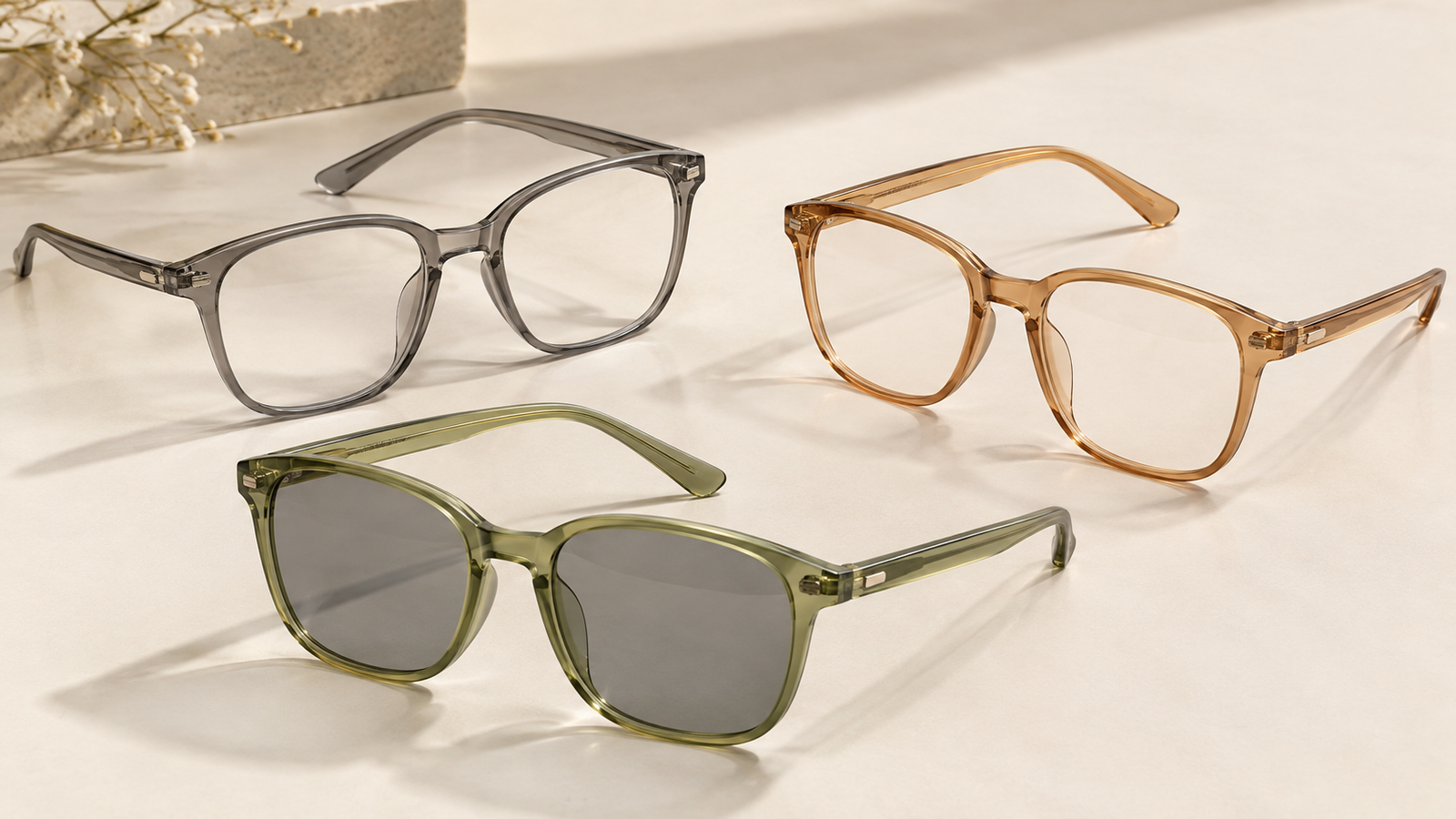
TL;DR: Translucent soft-square frames offer a focused 2026 direction for Japanese fast-fashion eyewear: a compact, gently rounded eye shape made lighter in appearance by smoke, caramel or muted olive transparency. For brands, the opportunity is to engineer fit and color consistency first, then use Vietnam injection production for repeatable seasonal drops. Concept Eyewear connects OEM/ODM development in Hong Kong with volume manufacturing in Vietnam.
Why are translucent soft-square frames relevant in 2026?
The soft square gives a customer more definition than a round frame without the sharp corners of a conventional rectangle. Translucency makes that familiar shape look current: light passes through the rim, revealing its thickness, hinge area and finish. This combination can create a recognizable product in a small e-commerce image while remaining easy to wear with everyday clothing.
Recent optical trade coverage shows translucent shades and carefully proportioned frames for narrower faces appearing together in new collections. For example, Optical Journal’s coverage of Colibris Nordic Tide describes transparent olive and caramel colorways alongside narrower frame proportions. That collection is acetate, not evidence of Japanese demand for injection frames; the useful design signal is how translucency adds depth to a wearable silhouette. Brands should validate their own color and fit choices with Japanese customers before committing to volume.
This article focuses on translucent soft-square frames rather than repeating a slim-oval story. The proposed product has a more accommodating lens height, a gently rounded upper rim and a modest endpiece. Those details provide room to develop optical-ready and sun versions, subject to separate lens and compliance briefs.
How should brands design the eye shape for Japan?
There is no single Japanese face shape. A Japan-focused range should be based on measured wearer groups, not an ethnic-fit label or a small eye size alone. Start with front width, lens width and height, bridge contact, temple opening and the position of the pupil within the lens. Then assess how the complete frame behaves when the wearer smiles, looks down or moves quickly.
For translucent soft-square frames, the design brief can begin with a compact and a regular fit block. A softer corner radius keeps the frame approachable, while a controlled lower rim avoids unnecessary cheek contact. Prototype both fit blocks before freezing tooling: a wider lens with a poor bridge can slip, and a narrow front with tight temples can still feel uncomfortable.
What makes bridge contact and eye clearance work?
Specify where the frame bears weight on the nose, how much contact area the molded pads provide and whether the front stays clear of eyelashes. An integrated injection-molded pad can be clean and economical, but its geometry is difficult to correct once a hard mold is finished. A separate pad solution may add parts and assembly cost while allowing more adjustment. Choose that trade-off at the prototype stage.
Check the pantoscopic angle, front curve, effective temple length and endpiece angle together. Raising a frame on the nose can improve cheek clearance but change lens position and visual balance. For prescription-ready SKUs, ask the lens partner to review usable lens height, groove geometry, edge thickness and fitting constraints before approving the front.
Which materials suit translucent injection production?
Transparent or translucent engineered polyamides can create a light-looking frame with a flexible feel, provided the exact grade meets the required color, molding and mechanical targets. Cellulose propionate offers another injection route with its own surface and finishing characteristics. The team should compare resin grades using finished-frame samples, not assume that all plastics sold under a familiar trade description process or wear the same way.
Translucency exposes manufacturing defects that opaque black may hide. Weld lines, bubbles, contamination, uneven wall thickness and stress marks become visible around the bridge and endpieces. Designers should position the gate thoughtfully, maintain suitable wall transitions and assess flow before cutting steel. The approved color standard should include viewing conditions and acceptable variation between molded fronts, temples and repeat batches.
Acetate is a useful premium benchmark for layered color and hand-polished depth, but it is cut and finished differently from an injection product. Stainless-steel hinges or carefully specified metal cores can add durability or a higher-tier detail; check their fit with the chosen resin and evaluate corrosion resistance. The goal is not to imitate acetate at any cost. It is to make translucent soft-square frames whose molded construction looks intentional.
Which lens choices make commercial sense?
For an optical-ready frame, sell the frame with the lens and glazing specification agreed with the retailer or dispensing partner. Do not treat a clear demonstration lens as proof of a protective claim. For a sun version, consider a neutral gray or brown lens as a core option; a polarized upgrade can create a distinct higher price tier if the target customer values glare reduction.
Lens material should follow product use and processing requirements. Polycarbonate can suit a lightweight sun brief; CR-39 or other specified lens materials may serve different optical and tint priorities. Verify lens retention after glazing and assess coating, transmittance and UV performance on the intended finished configuration. A fashionable translucent frame does not compensate for an unsuitable lens specification.
How can Vietnam production support seasonal drops?
The economic case for injection becomes stronger when a brand can use an approved mold and fit block across repeated orders. First production must absorb tooling, trials, color matching and testing; later drops may reuse that groundwork. New colors still require resin availability, signed color masters, trial pieces and quality approval. Speed should be planned, not promised without checking capacity and components.
Consider a Japanese retailer launching one soft-square front in three roles: core smoke optical, caramel fashion optical and an olive sun version. Concept Eyewear’s Hong Kong team can coordinate the OEM/ODM brief, sample feedback, costing and approvals. Its Vietnam manufacturing operation can plan molding trials, assembly, finished-frame checks and replenishment against the agreed specification. This is an illustrative project structure, not a quoted lead time or minimum order quantity.
Keep the first assortment disciplined. Agree on the front and temple bill of materials, resin grade, hinge, lens program, packaging and defect boundaries before asking the factory to price multiple colorways. Separate the steady-volume core color from smaller campaign drops so the buyer can manage stock exposure and the factory can reserve material for the proven seller.
Which SKUs fit Japan, EU and US markets?
A common design language can travel, but a common fit should not be assumed. Japan and selected Asian channels can test compact proportions and stable nose contact. EU and US teams may require different front widths, bridge choices or merchandising emphasis. The table is a proposed development matrix, not a claim about proven regional sales.
| Concept or SKU | Price tier and construction | Regional and retail role | Standards focus |
|---|---|---|---|
| Smoke Daily Soft Square | Accessible core; translucent injected polyamide with standard metal hinge | Japan and selected Asia optical retail; repeatable neutral for stores and e-commerce | ISO 12870 pathway if sold as an unglazed prescription frame; fit and hinge checks |
| Caramel Studio Soft Square | Mid tier; refined translucent resin and upgraded temple finish | Japan fashion capsule and EU boutique test; photographs well from three angles | Color stability, dimensional control and lens-retention checks |
| Olive Sun Soft Square | Mid tier; translucent injected front with specified sun lenses | Japan summer drop with a separately validated US lifestyle offering | ISO 12312-1 for general-use plano sunglasses; US sun requirements as applicable |
In retail, show all three side by side to explain the price ladder through lens specification and finishing rather than color alone. Online, publish frame width, lens measurements, weight, front and side views, and a fit note based on actual wearer trials. Show the translucent rim against both light and dark backgrounds so customers can judge the color honestly.
What testing protects a scaling brand?
Use a documented release path: approve resin and components, sign a golden sample, check first shots, conduct wearer trials, test the finished product and retain lot records. During molding, inspect moisture-sensitive resin handling where applicable, gate marks, weld lines, shrinkage, warpage and surface appearance. After assembly, verify hinge function, temple symmetry, lens seating, packing protection and color consistency across batches.
The product category determines the standards route. ISO 12870:2024 covers requirements and test methods for unglazed spectacle frames intended for prescription lenses. ISO 12312-1:2022 covers general-use plano sunglasses and clip-ons; it does not turn an optical frame into a compliant sunglass. Confirm the latest applicable destination-market labeling and testing requirements with the buyer’s compliance team before shipping.
For US fashion sunglasses, ANSI Z80.3 is a relevant sunglass standard. ANSI/ISEA Z87.1 concerns occupational and educational protective eyewear, not ordinary fashion sunwear. Do not use a Z87 claim unless a separately engineered and tested complete product supports the required impact, coverage and marking. Keeping those pathways separate protects customers and prevents an attractive lifestyle SKU from acquiring an unsupported safety message.
Why do translucent soft-square frames help brands grow strategically?
Translucent soft-square frames help brands grow when they become a managed platform rather than a one-off color experiment. An approved shape and fit block give designers a repeatable base; translucent colors offer visible seasonal change; and shared components can simplify sourcing. Brands can learn from store sell-through and online returns, then increase volume on the color and fit combination that actually performs.
The strategic value also lies in brand ownership. Specify a distinctive brow curve, corner radius, temple taper and signature transparent palette rather than buying a generic molded shape. A buyer can then recognize the family across optical and sun presentations, while the sourcing team can track yield, component availability and tooling return across the range. Fashion freshness and factory discipline should reinforce one another.
Concept Eyewear develops customized eyewear rather than relying on a standard catalogue. Its OEM/ODM approach can connect the brand’s creative brief with engineering review, samples, quality gates and Vietnam manufacturing, with commercial coordination through Hong Kong. Brands should still set their own target price, forecast and approval calendar so the program matches their margin and launch needs.
How should a brand start the development brief?
Send reference imagery, the intended Japanese customer and retail channel, target retail price, forecast by color, launch date and the markets where the product will be sold. Include wearer complaints from existing frames, preferred bridge contact, front-width range, target weight, lens use and any material or environmental claim that needs verification. The first sample should answer fit and manufacturing questions before the team debates a large palette.
Request two fit prototypes, a limited color trial and a written test matrix. Approve the golden sample only after checking real wearers and the finished lens-and-frame assembly. Then decide which color is a replenishment core and which is a limited drop. This sequence gives a scaling brand a clearer commercial decision than ordering many attractive colors before confirming comfort.
Partner with Concept Eyewear as your OEM/ODM manufacturer in Vietnam and Hong Kong to develop translucent soft-square frames for Japan’s 2026 fast-fashion market. Bring us your fit brief and price target so we can plan injection tooling, volume production and market-specific testing aligned with ISO 12312 for general-use sun collections and, only where a separate protective product genuinely requires it, Z87 performance.
【日本語版】透明感のあるソフトスクエアフレームが2026年の日本市場に適する理由は?
要約:透明感のあるソフトスクエアフレームは、角を穏やかに丸めたアイシェイプと、スモーク・キャラメル・落ち着いたオリーブなどの半透明色を組み合わせた商品提案です。フィットと色の再現性を先に検証し、承認済みの金型を使ってベトナムで継続生産することで、日本のファストファッションブランドは季節ごとの新色展開を計画しやすくなります。Concept Eyewearは香港でのOEM/ODM開発調整とベトナムでの量産を結びつけます。
ソフトスクエアは、丸型より輪郭がはっきりし、一般的な長方形ほど角が強くありません。半透明のリムには光が通るため、肉厚や表面仕上げがデザインの一部になります。ただし、海外のトレンド記事だけで日本国内の需要が証明されるわけではありません。実際の色と掛け心地は、対象となる消費者と販売店で確認すべきです。
日本市場向けのアイシェイプとフィットはどう設計しますか?
日本の消費者を単一の顔型として扱わず、対象顧客の装用データからフロント全幅、玉型の幅と高さ、鼻あたり、テンプルの開き、瞳孔とレンズの位置関係を決めます。コンパクト型と標準型の二つのフィット原型を試し、笑顔、下向き、動作時のずれも評価します。小さな玉型でも鼻あたりが合わなければずれ、大きなフロントでもテンプルがきつければ快適ではありません。
鼻あたりと目元の余裕はどう確認しますか?
一体成形のノーズパッドは部品数を抑えられますが、金型完成後の大きな修正は難しくなります。接触位置と面積、まつ毛や頬との距離を試作品で確認してください。別体パッドは調整の余地を増やせる一方、部品と組立工程が追加されます。度付き対応を想定する場合は、レンズの有効高さ、溝の形状、レンズ端厚についても先にレンズ担当者と確認します。
半透明の射出成形にはどの素材が適していますか?
透明または半透明のエンジニアリングポリアミドやセルロースプロピオネートなどを、必要な柔軟性、外観、成形性に応じて比較します。同じ通称で呼ばれる素材でもグレードによって結果は異なるため、完成フレームのサンプルで判断します。透明色ではウェルドライン、気泡、異物、応力痕、肉厚のむらが目立ちます。ゲート位置と樹脂流動を検討し、フロントとテンプルの色差を承認見本で管理することが重要です。
アセテートは積層色や磨きの深さを比較する上で有用ですが、射出成形とは製法が異なります。金属丁番や芯材を使う場合は、選定した樹脂との保持力や耐食性を確認します。オプティカル用のレンズ仕様とサングラス用のレンズ仕様も分けて決めてください。グレーやブラウンの定番レンズに加え、顧客ニーズがあれば偏光レンズを上位価格帯として検討できます。
ベトナム生産は季節ごとの新色展開をどう支えますか?
射出成形の強みは、承認された金型とフィット原型を追加発注で使えることです。ただし初回には金型製作、成形試験、色合わせ、装用評価と試験が必要です。追加色でも樹脂の調達、色見本、成形試験と品質承認を省略できません。納期や最低発注数量は、仕様と生産計画を確認してから合意します。
例えば、スモークの定番オプティカル、キャラメルの季節商品、オリーブのサングラスを一つのソフトスクエア形状から企画できます。Concept Eyewearの香港チームが仕様、見積もり、サンプル承認を調整し、ベトナムの製造拠点が成形試験、組立、完成品検査と補充生産を計画する形です。これは協業の一例であり、固定された生産日数を示すものではありません。
日本、EU、米国向けの商品はどう分けますか?
日本と一部のアジア市場では、実際の着用テストに基づくコンパクトな比率と安定した鼻あたりを優先します。EUや米国では、同じデザイン言語でもフロント幅やブリッジ選択、商品訴求を変える必要があるかもしれません。同一のフィットが世界中に適するとは想定しないことが大切です。店頭では定番色、上位仕上げ、サングラスを並べて価格差を説明し、ECには全幅、玉型寸法、重量、正面と側面の画像を掲載します。
品質と規格はどう管理しますか?
樹脂と部品の確認、承認見本、初回成形品の検査、装用評価、完成品試験、ロット記録を順に進めます。成形時にはウェルドライン、反り、収縮、ゲート痕、外観を確認し、組立後は丁番、テンプルの左右差、レンズ保持と梱包を検査します。度付きレンズ用の未装用フレームにはISO 12870:2024、一般用途の度なしサングラスにはISO 12312-1:2022の適用範囲を確認します。米国のファッションサングラスではANSI Z80.3も関連します。
ANSI/ISEA Z87.1は作業・教育環境向けの保護眼鏡規格です。一般のファッション商品を、樹脂が丈夫という理由だけでZ87対応と表示してはいけません。保護性能が必要な場合は、フレームとレンズを含む別の商品として設計し、衝撃、カバレッジ、表示を含めて検証します。
なぜ透明感のあるソフトスクエアフレームはブランドの戦略的成長に役立ちますか?
検証済みの形状とフィットを商品プラットフォームにすれば、ブランドは毎回ゼロから開発せずに季節色を試せます。共通部品は調達と品質管理を整理し、売上と返品理由のデータは補充すべき色やサイズを見極める助けになります。独自のブローライン、角の丸み、テンプルのテーパー、透明色の組み合わせを定義すれば、単なる汎用フレームではなくブランドらしいシリーズに育てられます。
Concept Eyewearへの開発相談は何から始めますか?
参考画像、対象顧客、想定上代、販売チャネル、色別の販売予測、発売時期、販売国を共有してください。既存商品の装用上の課題、希望する鼻あたり、全幅、重量、レンズ用途、根拠が必要な環境表示も合わせて伝えると、最初の試作がより有効になります。二つのフィット原型と少数の色を検証してから、定番色と限定色の生産計画を分けましょう。
日本の2026年ファストファッション市場に向けた透明感のあるソフトスクエアフレームは、ベトナムと香港のOEM/ODMパートナーであるConcept Eyewearにご相談ください。射出成形の金型、量産、地域別の試験を連携し、一般用途サングラスではISO 12312、保護眼鏡として別途必要な場合に限りZ87の性能要件に沿ったコレクション開発を進めます。
