

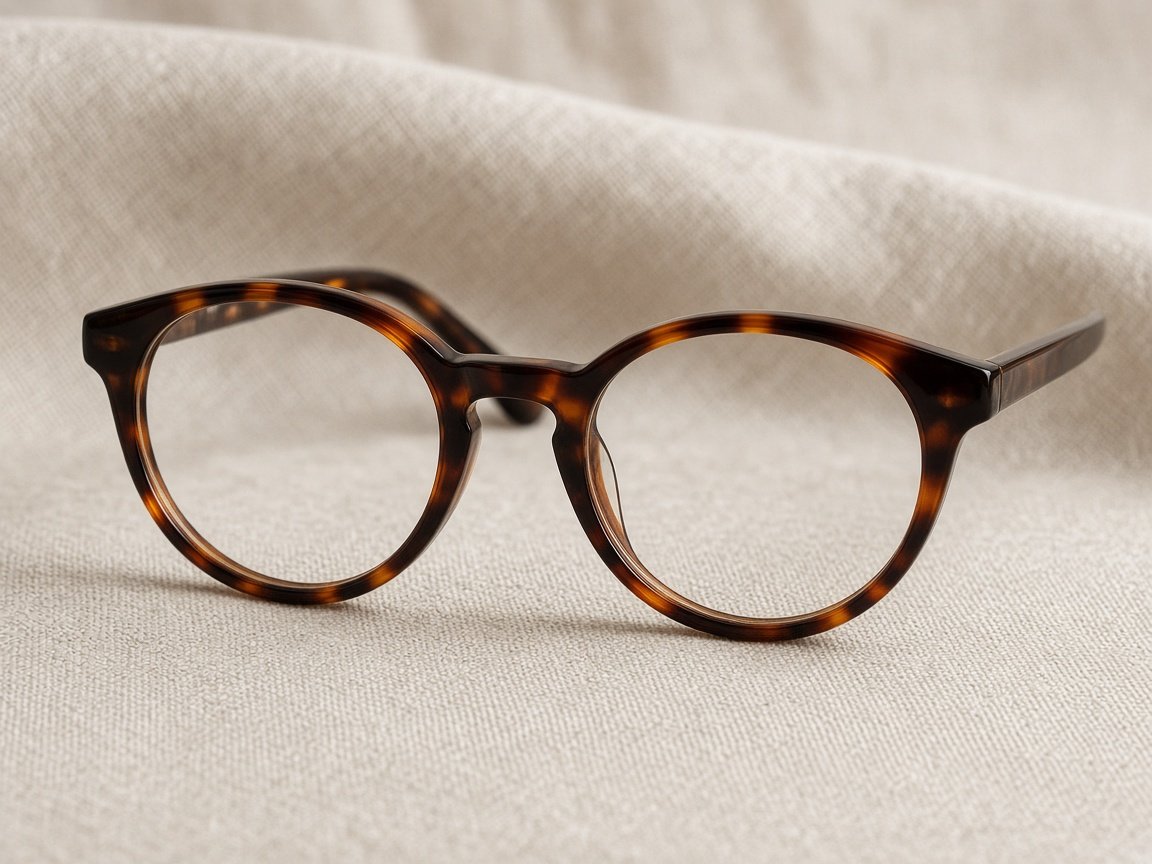
Round panto eyewear is a rounded optical shape: close to a circle, or a panto with a slightly fuller lower rim and an even outline. It is not an oval, and it is not a teardrop aviator.
This design note sits beside our chunky acetate, slim rimless, cat-eye acetate, and acetate metal combination guides. It is not a twin of oval geometric eyewear or optical aviator frames. For materials and finish stages, see our product manufacturing techniques.
Quick answer: what is round panto eyewear for brand assortments?
Round panto eyewear earns a board slot when the outline, eye size, and bridge are locked in the tech pack.
- Say whether the lens is a true round or a panto (slightly fuller at the bottom, even overall)
- Give a size ladder, not one small eye only
- Name the bridge: saddle, keyhole, or a low metal bridge
- Keep rim thickness consistent with the rest of the optical board
- Give the shape a hero, capsule, or carryover role beside squares and aviators
Why round panto eyewear still earns a board slot
For example, public 2026 collections still treat the panto as a live fashion optical. That is trade context only. Concept Eyewear does not claim to supply the brands named below.
Vision Monday’s 4 November 2026 note on MODO’s Brooklyn Made collection describes Smith as a versatile unisex panto frame with rounded lines and balanced proportions, in black, grey, olive and blonde tort. Eyecare Business, in a 23 July 2026 Kador product story, presents Premium 99 as a soft, rounded panto in cotton-derived acetate, in 47 mm and 49 mm eye sizes, with optical and sunglass versions.
Eyecare Business, on 12 August 2026, covers François Pinton’s new collection from Design Eyewear Group: Emma as an oversized round/oval acetate, Alma as a soft square/panto, and Lazare as a soft rectangle/panto. Trade writing still treats panto as its own shape word, not a catch-all for every rounded frame. US brand teams can therefore treat round panto eyewear as a current assortment tool. Japan stays light unless already on the brief.
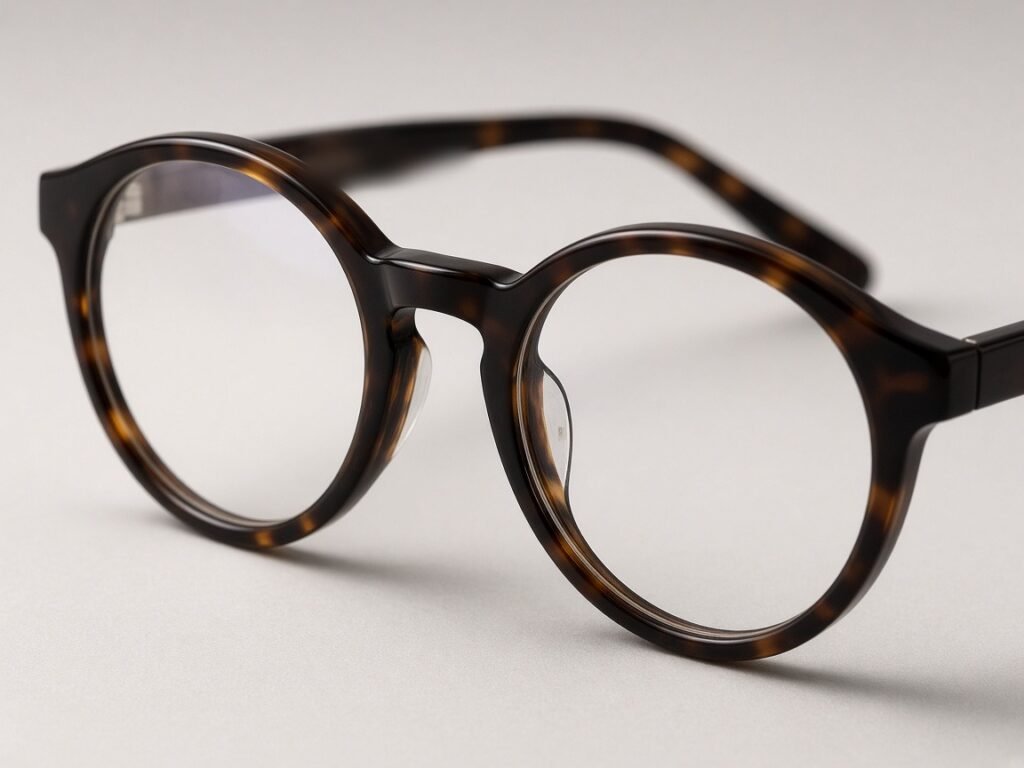
How this shape differs from oval, aviator, and other board shapes
- Oval geometric. Our oval geometric guide covers a stretched lens. A panto stays closer to a circle.
- Optical aviator. Our optical aviator frames use a teardrop pilot shape, often in metal with a double bridge. A panto does not drop in the same way.
- Chunky acetate. Our chunky acetate guide is about thickness and mass, not this outline.
- Slim rimless. Our slim rimless guide sells thin or Y2K lightness. Here the front usually keeps a visible rim.
- Cat-eye acetate. Our cat-eye acetate notes cover an upsweep at the outer corners. A panto stays rounded, without that lift.
- Acetate metal combination. Our combination notes are about the joint. A panto can use that build, but still name the outline first.
Therefore, do not brief round panto eyewear as “a small oval” or “an aviator without the drop.” Name the outline first.
What brands should brief an OEM for round panto eyewear
Lock these gates in the tech pack before sampling:
- Outline. Say true round or panto, and share a lens drawing. Do not leave “rounded” undefined.
- Eye size and bridge distance. A circular lens can look undersized if you copy a square’s measurements, because the outline sits differently. Give a size ladder.
- Bridge type. A keyhole often reads heritage. A saddle or a low metal bridge reads quieter.
- Rim and material. Mid-weight acetate, thin metal, or a mixed build each change how large the circle feels.
- Temple balance. Check length and wrap so the front does not look small or sit poorly.
- Colour and finish rotations. One core structure can carry several acetate colours or metal finishes. Limit orphan SKUs.
In addition, keep acetate and metal programmes on the usual MOQ 400 pcs/model and about a 90–100 day lead path, FOB China or Vietnam. Concept Eyewear has 26 years in fashion frames. Vietnam production sits at Block E5 & 6, Hoa Hiep Industrial Zone, Dong Hoa, Phu Yen, paired with Dongguan. See our manufacturing techniques, acetate CNC finishing notes, and OEM FAQ.
Assortment roles on a US board
Round panto eyewear often works as a heritage or soft hero optical beside squares, chunky acetates, and aviators. However, it rarely needs to replace the whole board.
- Hero. One clear round or panto that photography can own for the season.
- Capsule. One size family and a few colours or finishes, without twelve near-duplicates.
- Carryover. A quieter optical workhorse that can reorder if doors ask for more.
Common mistakes to avoid
- Calling every rounded shape a panto, or calling a panto an oval
- Locking one tiny eye size with no size ladder
- Skipping the bridge fit on a round front
- Treating the shape only as a vintage prop, not as Rx-ready optical
- Spinning too many near-duplicate colours off one structure
FAQ: round panto eyewear for brand programmes
What is round panto eyewear? A rounded optical shape that stays close to a circle, not an elongated oval and not a teardrop aviator.
How does it differ from oval or aviator frames? An oval is stretched. An aviator is a teardrop pilot, often metal with a double bridge. A panto stays rounded and even.
What should a brand send the OEM? The exact outline, eye size and bridge, rim and material, temple balance, and how many colour rotations share one core structure.
What MOQ and lead time are typical? Acetate and metal programmes commonly plan around MOQ 400 pcs/model and about 90–100 days, FOB China or Vietnam. Commercial price stays private.
Talk to Concept Eyewear
If you are planning round panto eyewear for a US assortment, contact Concept Eyewear. We are a Hong Kong–rooted OEM/ODM partner with 26 years in fashion frames, with production in Vietnam (Phu Yen) and Dongguan. Share the outline, size ladder, and bridge to discuss programme fit.
