
TL;DR: AI smart sunglasses combine advanced connectivity, voice assistance, audio, adaptive lenses and health-aware sun protection in a single fashionable product. As AI smart sunglasses become a major 2026 trend, brands that partner with experienced OEM/ODM manufacturers in Vietnam and Hong Kong can capture new margin-rich segments, align with ISO 12312 and Z87 performance requirements, and tailor collections for EU, US and Asia markets.
What Makes AI Smart Sunglasses the Defining 2026 Trend?
AI smart sunglasses sit at the intersection of fashion, function and technology, turning traditional sunglasses into connected devices that enhance daily life. Consumers now expect eyewear that does more than block UV; they want audio streaming, voice assistants, hands-free communication, activity tracking and context-aware suggestions, all wrapped in a design that feels premium and wearable all day. This makes AI smart sunglasses one of the most commercially interesting 2026 trends for both fashion and tech-forward brands.
Unlike early-generation smart glasses that felt bulky or overtly “techy,” current AI smart sunglasses emphasize comfort, subtle hardware integration and a design language aligned with quiet luxury and contemporary minimalism. Frames lean toward refined acetates, slim metals and soft rectangular silhouettes, ensuring that electronics are invisible or at least harmonious with the aesthetic. For OEM/ODM partners like Concept Eyewear, this shift opens new opportunities to integrate smart modules without sacrificing fit, weight balance or cosmetic quality.
Which Consumer Lifestyles Are Driving AI Smart Sunglasses?
Several lifestyle segments are converging around AI smart sunglasses. Urban professionals appreciate discreet audio and productivity features that allow them to join calls, listen to briefings or receive navigation prompts without wearing headphones. Outdoor enthusiasts want sport-ready silhouettes with polarized lenses, weather-resistant finishes and activity tracking. Fashion-conscious consumers focus on bold or refined color stories in acetate and metal while enjoying music, social content and AI-enhanced photography. Across these segments, the expectation is clear: sunglasses must look like eyewear first and smart hardware second.
In high-UV regions such as Hong Kong, Singapore and other Asian hubs, AI smart sunglasses are also becoming a year-round accessory that merges health and style. Users rely on high-quality UV filtration aligned with ISO 12312, yet they also appreciate features such as brightness-adaptive audio cues, environment-aware notifications and AI tools that help them optimize outdoor routines. This combination of protection, convenience and digital lifestyle integration is likely to sustain growth through and beyond 2026.
How Should Brands Design Frames for AI Smart Sunglasses?
Designing frames for AI smart sunglasses begins with balancing aesthetics, ergonomics and hardware integration. Brands must define the primary use case—urban fashion, outdoor performance or luxury lifestyle—before locking in geometry, thickness and weight targets. From there, industrial design and engineering teams work with OEM/ODM partners to ensure temples, bridges and rims can house batteries, circuit boards, microphones and speakers while maintaining comfortable pressure distribution on the ears and nose. The goal is to deliver a seamless feel: a wearer should forget about the electronics once the sunglasses are on.
Early in the design process, teams should run virtual and physical weight simulations to evaluate how the addition of smart modules affects balance points. Temple cross-sections are often subtly enlarged to accommodate PCBs and speaker channels, while hinges may shift to reinforced or custom-engineered solutions that handle additional mass and torsion. OEM/ODM manufacturers in Vietnam and Hong Kong with experience in both traditional eyewear and consumer electronics can provide practical feedback on screw sizes, flex-hinge tolerances and gasket placements to protect components from sweat, dust and humidity.
What Frame Materials Work Best for AI Smart Sunglasses?
Common AI smart sunglasses platforms use a mix of acetates, injection-molded polymers and metals. High-quality cellulose acetate remains essential for fashion-led models because it enables rich color effects such as layered tortoiseshell, translucent crystals and tonal gradients while allowing precise milling channels for electronic modules. For lighter-weight or sport-oriented concepts, TR-90 and other engineering plastics help reduce mass and increase durability. Beta-titanium and stainless steel can be used for minimal metal frames where smart functions are concentrated in interchangeable clip-on modules or slim temple housings.
When manufacturing in Vietnam, brands can leverage strong acetate finishing capabilities and precise CNC machining to create consistent internal cavities that lock PCBs and batteries in place without rattling. Hong Kong-based engineering teams often support detailed DFM (Design for Manufacturing) reviews, ensuring that frame materials, screw types, adhesives and overmolding processes are optimized for assembly line throughput. This combination of material expertise and process control is critical to achieving stable yields at volume for AI smart sunglasses.
How Do Lens Technologies Elevate AI Smart Sunglasses Performance?
AI smart sunglasses depend on lenses that deliver both visual comfort and digital synergy. At minimum, lenses should meet ISO 12312 for UV protection, but brands increasingly choose polarized lenses to reduce glare for navigation and AR-style overlays, along with photochromic options that adapt seamlessly between indoor and outdoor environments. Gradient and solid tints are used strategically to keep the upper portion of the lens darker (for sun and screen interaction) while maintaining comfortable visibility for reading and close tasks.
From a manufacturing standpoint, OEM/ODM partners must coordinate with lens suppliers to ensure coatings, tints and thicknesses match the electronics roadmap. Anti-reflective coatings help keep optical sensors reliable; oleophobic treatments make lenses easier to clean when users frequently touch them to interact with gesture controls. In performance-focused AI smart sunglasses, ANSI Z87-level impact resistance may be specified, especially for US markets and industrial or sport applications where eye safety is part of the value proposition.
How Do AI Smart Sunglasses Fit EU, US and Asia Markets?
AI smart sunglasses are global by nature, but regional expectations differ in design, pricing and compliance. In the EU, understated aesthetics, eco-conscious materials and rigorous product documentation are highly valued. US consumers gravitate toward bold silhouettes, sport-inspired shapes and clear performance claims such as polarized lenses, impact resistance and audio quality. Asia—including Hong Kong, mainland China, Japan and Korea—often leads in tech adoption, prioritizing slim, modern designs that integrate seamlessly with mobile ecosystems and e-commerce platforms.
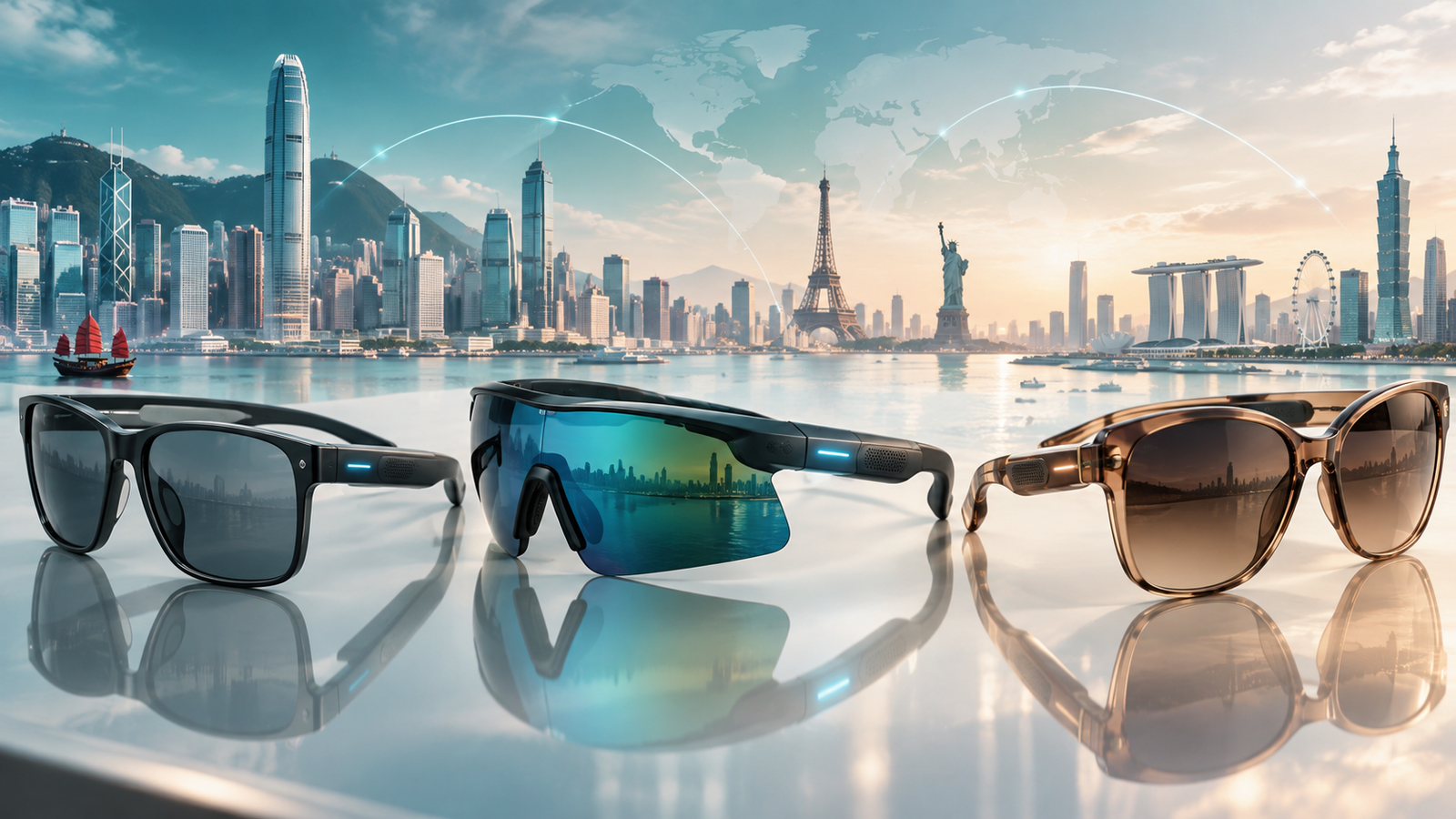
To capture these differences, brands should define region-specific SKUs while sharing a common engineering platform. Below is an example of how three AI smart sunglasses concepts can be positioned for EU, US and Asia through OEM/ODM collaboration with Concept Eyewear.
| Model Concept | Price Tier & Region Positioning | Standards Focus |
|---|---|---|
| Urban Minimalist AI Sunglass | Mid-high tier; EU & Asia focus with quiet luxury acetate, subdued colors and integrated audio for commuting. | ISO 12312 UV; CE marking; optional Z87 impact for select US/EU channels. |
| Outdoor Performance AI Sunglass | Mid tier; US & global outdoor segment with wrap-style frames, polarized lenses, sweat-resistant materials and sport audio. | ISO 12312 UV; ANSI Z87 impact; optional EN166 for specialized EU applications. |
| Lifestyle Fashion AI Sunglass | Accessible mid-tier; Asia & US focus with bold acetate colors, translucent effects and social/audio-first AI features. | ISO 12312 UV; regional UV labeling; optional blue-light and anti-reflective packages. |
By planning such a portfolio, brands can adjust lens colors, temple hardware, packaging and pricing while utilizing shared tooling and electronics. OEM/ODM partners in Vietnam can handle mainline production, while Hong Kong teams manage cross-border logistics, compliance documentation and localization for each region’s marketing and regulatory needs.
How Can OEM/ODM Partnerships in Vietnam and Hong Kong Unlock AI Smart Sunglasses Growth?
OEM/ODM partnerships are central to scaling AI smart sunglasses from concept to global launch. Vietnam offers competitive labor costs, strong plastic and acetate processing and improving electronics integration capabilities, making it ideal for volume production across multiple price tiers. Hong Kong provides proximity to component suppliers, experienced engineering talent and mature logistics infrastructures that connect EU, US and Asia distribution networks. Together, these locations enable brands to run pilot batches, refine designs and ramp up quickly once demand is validated.
Concept Eyewear positions itself as a bridge between creative brands and efficient Asian manufacturing. As an OEM/ODM partner based in Vietnam and Hong Kong, Concept Eyewear can coordinate frame tooling, component sourcing, assembly line layout and QA workflows tailored specifically to AI smart sunglasses. This includes collaborating with chipset vendors, audio specialists and lens manufacturers to ensure the final product meets both fashion expectations and technical benchmarks.
What Does a Typical AI Smart Sunglasses OEM/ODM Project Look Like?
A typical AI smart sunglasses project begins with a feasibility and cost study: brand teams share desired features, target retail prices and regional segmentation, while the OEM/ODM partner evaluates tooling requirements, electronics BOM (bill of materials) and compliance implications. After feasibility sign-off, industrial design, mechanical engineering and electronics teams co-develop a detailed CAD package, including cavity layouts, mounting points and cable routing through temples and bridges.
Once design is frozen, the project moves into prototyping, where multiple iterations are produced in small batches for fit testing, electronics reliability checks and aesthetic refinement. Field feedback from target markets (EU optical boutiques, US outdoor stores, Asian online channels) informs minor adjustments. After this phase, the OEM/ODM partner sets up the production line with well-defined work instructions, inspection checkpoints and functional test stations, ensuring that each pair of AI smart sunglasses meets agreed quality standards before shipping.
Why Do AI Smart Sunglasses Help Brands Grow Strategically?
AI smart sunglasses create new revenue streams and strengthen brand ecosystems by extending digital experiences into a high-visibility category: eyewear. Instead of treating sunglasses as stand-alone accessories, brands can position AI smart sunglasses as part of a broader subscription or service model, offering software updates, AI-enabled coaching, premium audio content or exclusive digital perks. This transforms a single product sale into a long-term relationship that builds loyalty and increases lifetime value.
Strategically, AI smart sunglasses also help brands differentiate in crowded eyewear and tech markets. As algorithms personalize audio, notifications and lens behavior, brands can express their personality through curated soundscapes, visual themes and interface design. Collections can be refreshed via both physical launches and over-the-air feature upgrades, creating ongoing marketing moments. For sourcing and product managers, this opens a path to justify higher price tiers while delivering clear functional benefits.
How Do AI Smart Sunglasses Strengthen Brand Positioning and Margins?
By blending fashion and technology, AI smart sunglasses occupy a premium zone where customers accept higher price points in exchange for added value. Brands can specify multi-layer acetates, decorative metals, custom engraving, and branded lens treatments to reinforce their identity, while AI-enabled features like adaptive sound or contextual tips make daily use more satisfying. This layering of tangible and intangible value supports robust margins even in competitive markets.
Working with OEM/ODM partners such as Concept Eyewear helps brands maintain margin discipline by optimizing material choices, assembly workflows and test processes. For example, shared electronics platforms can be paired with different frame families, reducing development costs per SKU. Strategic sourcing in Vietnam and component consolidation via Hong Kong further reduce overhead, allowing brands to reinvest savings into marketing, software development and customer experience enhancements.
How Should Brands Address Standards, Testing and Compliance for AI Smart Sunglasses?
Compliance is non-negotiable for AI smart sunglasses, particularly when products are sold across EU, US and Asia. At a minimum, lenses must comply with ISO 12312 for sunglass UV protection, and frames should be tested for durability, corrosion resistance and color fastness under regional eyewear standards. For applications that overlap with workplace safety, US markets may require ANSI Z87 impact resistance claims, while EU markets look for CE marking and relevant EN standards for optical and mechanical performance.
Electronics introduce additional layers of compliance: radio modules must pass FCC, CE and other regional RF tests; batteries require safety certifications and transport documentation; and data-handling features must respect privacy regulations. OEM/ODM partners can design integrated test plans that cover both eyewear and electronics, using environmental chambers, UV simulators and drop tests to validate performance. Collaborating with reputable labs and keeping clear technical files ensures smoother audits and retailer onboarding.
Where Can Brands Find Reliable Insight on Emerging Eyewear and Smart Glasses Trends?
Because AI smart sunglasses sit at the convergence of eyewear, consumer electronics and fashion, brands should monitor multiple information sources. Trade publications and industry platforms such as Vision Monday provide ongoing coverage of new collections, retail trends and technology-focused events. At the same time, data from online marketplaces, social media and regional distributors can reveal which silhouettes, colors and features resonate most strongly in EU, US and Asia.
OEM/ODM partners often have complementary insights based on factory-level order patterns and client briefs. Concept Eyewear, for example, can share aggregated learnings on popular frame constructions, lens combinations and hardware modules that are gaining traction across its client base, helping brands refine future AI smart sunglasses collections and avoid costly missteps.
How Can Concept Eyewear Support Your Next AI Smart Sunglasses Collection?
Concept Eyewear combines Vietnam-based manufacturing capacity with Hong Kong engineering, sourcing and logistics expertise to guide brands through every stage of AI smart sunglasses development. From material selection and tooling design to electronics integration, standards testing and multi-region packaging, Concept Eyewear’s OEM/ODM workflow is designed to deliver consistent quality at scale. Brands can start with a single hero model or launch a full collection aligned with ISO 12312 UV protection and, where relevant, Z87 impact performance.
If your team is exploring AI smart sunglasses for 2026 and beyond, consider partnering with Concept Eyewear to turn concepts into compliant, commercially viable products for EU, US and Asia. By combining strong industrial design, disciplined engineering, and efficient Vietnam-based production with Hong Kong’s global connectivity, Concept Eyewear can help you build trend-aware collections that strengthen your brand identity and unlock new sources of strategic growth.
