

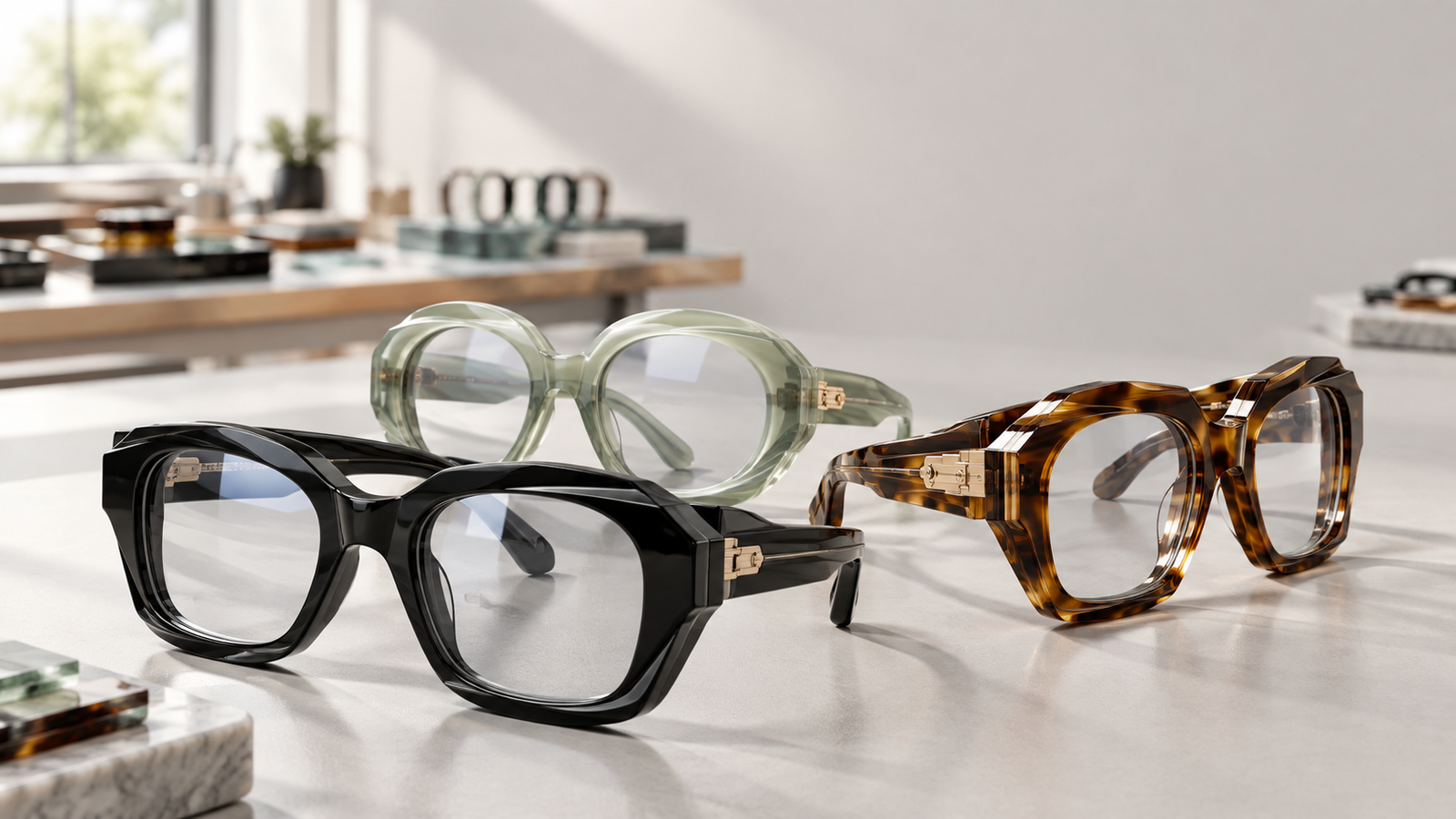
TL;DR: Sculptural acetate eyewear is a high-value 2026 opportunity for scaling brands because one engineered platform can deliver recognizable design, multiple price tiers, regional fit options, and strong digital merchandising. Concept Eyewear supports OEM/ODM development through Vietnam and Hong Kong, from acetate selection and CAD refinement to testing, pilot production, and volume control.
Why is sculptural acetate eyewear a major 2026 opportunity?
Sculptural acetate eyewear replaces flat, predictable rims with controlled volume, bevels, softened geometry, laminated color depth, and carefully shaped brow or temple transitions. The direction is visible across premium independent collections and wider 2026 reporting, where expressive frames coexist with quiet luxury and wearable restraint. Recent industry coverage from Vision Monday highlights texture, craftsmanship, milky tones, and bold sculptural shapes as important themes.
For a scaling brand, the commercial advantage is not simply a thicker frame. A well-planned sculptural acetate eyewear program creates a recognizable silhouette that can become a brand code across optical and sun products. The same front architecture can be adapted through lens shape, color, temple treatment, and finish, helping the brand expand its assortment without rebuilding every SKU from zero.
What makes the trend commercially wearable?
The strongest products balance visual mass with comfort. Designers can create presence through outward bevels, stepped rims, keyhole bridges, lifted end pieces, or layered laminations while removing hidden material from the rear. This keeps the customer-facing view bold but controls weight, bridge pressure, and temple load for all-day wear.
Commercial shapes should remain easy to understand: a softened square, rounded P3, compact oval, or modern cat-eye. Sculpture then becomes the differentiator rather than an extreme outline. This approach supports independent optical stores, fashion retailers, and direct-to-consumer brands because sales teams can explain the design quickly and e-commerce photography can show the frame depth from front, three-quarter, and side views.
How should brands engineer sculptural acetate eyewear?
Development should begin with a face-fit target, not a mood board alone. Concept Eyewear converts the creative direction into measurable parameters: eye size, bridge width, front curvature, pantoscopic angle, temple splay, hinge position, lens groove geometry, minimum wall thickness, and total target weight. A 3D CAD review identifies heavy zones and stress concentrations before acetate sheets are cut.
For premium products, cellulose acetate offers color depth, polish quality, and machinability. Bio-attributed or lower-impact acetate options can support a sustainability story, but claims should match supplier documentation and chain-of-custody evidence. Transparent and milky sheets need especially careful incoming inspection because inclusions, haze, lamination lines, or polishing variation are more visible than on opaque black material.
Which construction details matter most?
- Front thickness: Use thickness strategically around the brow and end pieces, then remove rear material to reduce weight.
- Lens groove: Maintain consistent depth and position around sculpted rims so the lens seats securely without creating local stress.
- Bridge geometry: Match bridge contact, nose opening, and front tilt to the intended EU, US, or Asia fit rather than relying on one global sample.
- Hinge reinforcement: Specify wire cores, hinge barrels, screw systems, and insertion depth for the expected front mass and temple leverage.
- Surface transition: Define polished, satin, faceted, or two-tone areas on technical drawings so finishing remains consistent at volume.
Material pairing also affects positioning. An all-acetate construction communicates warmth and craft, while stainless-steel or titanium temples can reduce visual weight and raise perceived precision. Sun lenses may use CR-39 for optical quality and premium tinting, nylon for a balance of clarity and toughness, or polycarbonate where impact performance and low weight are priorities.
Which SKU architecture supports profitable scaling?
A sculptural acetate eyewear scaling program should launch as a controlled family, not a disconnected set of statement frames. Three carefully differentiated concepts can address entry, core, and premium price tiers while sharing components, fit data, color approvals, packaging dimensions, and test planning. This reduces unnecessary tooling, simplifies replenishment, and gives buyers a clear good-better-best story.
| Concept/SKU | Construction | Price Tier | Regional Positioning | Standards Focus |
|---|---|---|---|---|
| Soft Sculpt Square | Polished acetate front, standard core wire, CR-39 or nylon sun lens | Core mid-tier | Broad EU and US retail; adjusted bridge for Asia | ISO 12312 for sun versions; dimensional and durability control |
| Milky Layered Oval | Laminated translucent acetate, stepped bevel, slim metal temple | Premium fashion | EU boutiques, US DTC launches, trend-led Asian cities | ISO 12312 plus color, coating, and transmittance verification |
| Performance Sculpt Wrap | Acetate-look front, reinforced lens retention, polycarbonate lens | Premium performance | US sport-lifestyle first, selective EU and Asia | ISO 12312; Z87 only when complete product is engineered and tested for the claim |
How can brands control color risk?
Start with one commercial neutral, one brand-signature color, and one campaign color. Black, dark tortoise, smoke, or warm crystal protects replenishment volume; a milky sage, blush, cobalt, or layered tortoise creates editorial interest. Approve master color standards under controlled lighting, define acceptable variation, and retain signed samples for both acetate sheets and finished frames.
Color should also be planned around minimum order quantities and repeatability. If multiple SKUs share the same sheet thickness and color family, material purchasing becomes more efficient and leftover stock is easier to allocate. Concept Eyewear can structure an OEM/ODM collection so fronts, temples, lenses, and metal finishes create visible variety while the underlying bill of materials remains manageable.
How does market fit differ across EU, US, and Asia?
EU buyers often respond to material authenticity, subtle architecture, independent design language, and traceable sustainability documentation. A refined bevel, nuanced lamination, and moderate logo treatment can support premium optical distribution. The sculptural acetate eyewear product file should align claims, test reports, labeling, and market-specific documentation before shipment.
US assortments can support both bold fashion statements and performance-led storytelling. Larger silhouettes, clear product benefits, and strong three-quarter imagery work well online, while polarized lenses can create a practical upgrade. If occupational or protective performance is claimed, Z87 is not a styling phrase: the complete frame-and-lens configuration must be engineered, tested, and marked according to the applicable requirement.
Asian markets require deliberate fit development. A higher or differently shaped nose contact, adjusted bridge opening, controlled front tilt, shorter effective temple geometry, and reduced cheek contact may improve wearability. Brands should not label one sample “Asian fit” without wearer trials; Concept Eyewear can develop separate fit blocks while preserving the same sculptural acetate eyewear design language across regions.
What testing workflow protects quality at volume?
Testing for sculptural acetate eyewear should be designed into the product brief. For general-use sunglasses, ISO 12312-1 applies to plano sunglasses and clip-ons intended to protect against solar radiation. The development plan should address optical quality, visible and ultraviolet transmittance, filter category, traffic-signal recognition where relevant, robustness, nickel release for applicable metal contact parts, and labeling required by the destination market.
Z87 is relevant only when a product is intended and validated as occupational or educational eye protection. Fashion sunglasses should not imply Z87 performance without the correct coverage, lens retention, impact testing, markings, and complete-device evidence. Separating fashion, sport-lifestyle, and true protective SKUs early prevents expensive redesigns and misleading retail claims.
Which factory checks should be defined?
- Approve engineering drawings, golden samples, color masters, lens specifications, and a critical-to-quality checklist.
- Inspect acetate sheets for thickness, flatness, color consistency, inclusions, and lamination defects before cutting.
- Verify CNC dimensions, lens grooves, bridge symmetry, hinge position, temple opening, and frame alignment during production.
- Control tumbling, hand polishing, bevel definition, logo application, and surface finish against signed limits.
- Test screws, hinges, lens retention, dimensional stability, coating adhesion, sweat or corrosion resistance, and applicable optical performance.
- Use pre-shipment inspection with an agreed sampling plan, packaging checks, barcode verification, and traceable lot records.
How should OEM/ODM collaboration be structured?
A practical program begins with a commercial brief covering target retail price, ex-factory target, sales channels, launch date, regions, forecast volume, and expected replenishment. The design brief should then define reference shapes, fit block, materials, colors, logos, lens claims, packaging, and standards. This sequence keeps aesthetic choices connected to margin and timing.
For example, a DTC brand can ask Concept Eyewear to develop one softened square platform in a universal Western fit and an Asia-optimized fit. Vietnam handles production engineering, acetate machining, assembly, finishing, and volume quality control, while the Hong Kong team coordinates material options, client communication, development milestones, testing, and export requirements. The brand can launch a black optical, milky neutral optical, polarized tortoise sun, and limited campaign color without treating every SKU as a separate invention.
Volume planning should use staged gates: concept approval, CAD review, prototype, wear trial, pre-production sample, laboratory testing, pilot run, and mass production. Flexible MOQ discussions are most productive when the brand consolidates colors, shares components, and supplies realistic forecasts. Lower first orders may carry higher unit costs, while repeatable platforms can improve purchasing efficiency and factory yield as demand grows.
Why does sculptural acetate eyewear help brands grow strategically?
Sculptural acetate eyewear helps growth because it creates defensible recognition without depending on a large visible logo. A consistent bevel, brow volume, temple transition, or layered color method can become proprietary visual equity. Customers recognize the product in retail displays, social content, and thumbnail-sized e-commerce images, improving the collection’s ability to communicate before a shopper reads the description.
The trend also supports disciplined assortment expansion. Brands can retain one fit-proven chassis and introduce new colors, lenses, and finishes by season, generating freshness with less development risk. Retailers receive a coherent story, merchandising teams gain clear hero products, and sourcing teams can consolidate materials and quality standards. That combination turns a fashion direction into a scalable product system rather than a one-season novelty.
How should brands brief the next collection?
Begin with one signature profile, two verified fit blocks, three commercial color roles, and a defined test route. Protect comfort as carefully as appearance, photograph the side sculpting clearly, and reserve the most complex lamination or metal detail for the SKU that can support its cost. Review target margin before adding decorative operations that do not improve recognition or wearability.
Brands ready to build a focused 2026 sculptural acetate eyewear collection can partner with Concept Eyewear for OEM/ODM design, engineering, sampling, testing coordination, and volume manufacturing in Vietnam and Hong Kong. Contact the team to align your price tier, regional fit, retail story, ISO 12312 pathway, and, where genuinely required, Z87 performance strategy.
