

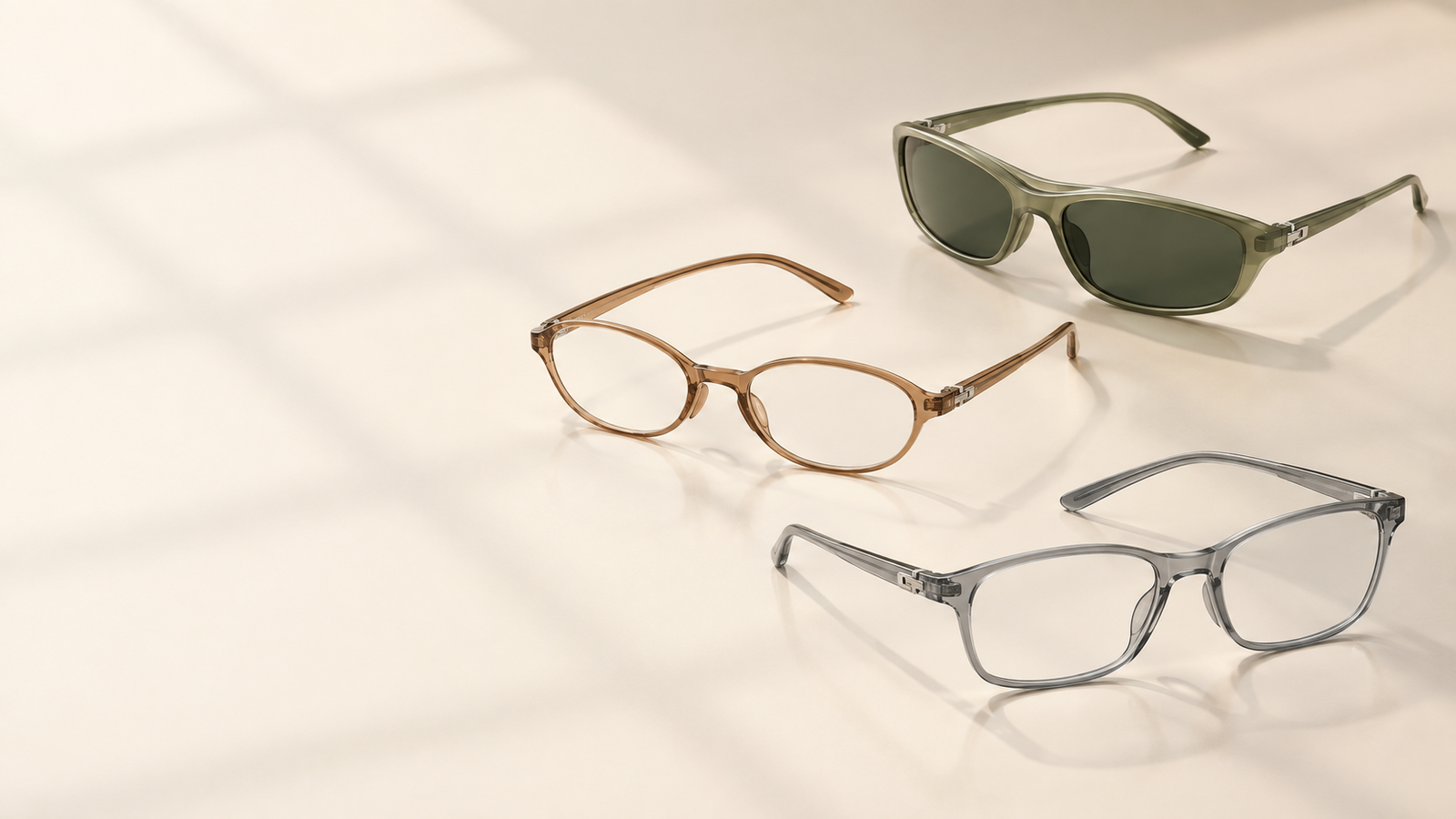
TL;DR: Japanese fit injection frames are a strong 2026 fast-fashion platform when compact proportions, low-bridge stability, cheek clearance and lightweight materials are engineered together. Concept Eyewear combines OEM/ODM development in Hong Kong with scalable Vietnam production to help brands launch trend-led collections quickly and consistently.
English version
Why are Japanese fit injection frames timely in 2026?
Japan’s fast-fashion eyewear customer expects more than a fashionable front shape. The frame must look refined at close range, feel light during long daily wear and stay correctly positioned without constant adjustment. At the same time, retailers need frequent color refreshes, accessible prices and reliable replenishment. That combination makes injection construction commercially relevant: one proven mold platform can support coordinated optical, blue-light and sunglass drops while keeping geometry repeatable.
The 2026 design direction favors expressive but wearable products. Vision Monday’s 2026 trend coverage highlights milky neutrals, quiet luxury, gender-neutral forms and sculptural expression. For Japanese fast fashion, these directions translate well into softly inflated rectangles, compact ovals and controlled wrap shapes rather than oversized fronts copied unchanged from Western assortments.
What frame geometry better serves Japanese consumers?
There is no single “Japanese face,” so fit should be developed as measured geometry rather than an ethnic label. A useful OEM/ODM brief defines bridge contact, nose-pad height, frame width, temple splay, pantoscopic angle, lens depth and lower-rim clearance. Concept Eyewear recommends building two or three fit blocks from wear-trial data, then applying seasonal shapes to those blocks. This protects fit consistency while allowing the collection to evolve visually.
How should the bridge and nose area be engineered?
A low or less prominent bridge often needs a higher contact position and a broader, carefully shaped bearing surface. On an injection frame, the saddle or integrated pads should be designed in the mold rather than corrected late with excessive heating. The objective is stable weight distribution without pressure points, lash contact or a front that slides forward. For fashion sunglasses, lens curvature and frame wrap must also be checked because both can change the effective bridge position.
How can cheek contact and optical alignment be reduced?
Cheek clearance depends on more than raising the bridge. Lower-rim depth, front tilt, wrap angle and temple opening all interact. A compact oval may need a shallower B measurement, while a soft rectangle can use a subtly lifted lower rim. During sampling, teams should evaluate neutral posture, smiling, looking downward and quick head movement. For prescription-ready styles, pupil position, vertex distance and lens edge thickness should be reviewed before the mold is frozen.
Which sizes work for a fast-fashion assortment?
A practical starting architecture uses compact, core and relaxed fit blocks rather than one nominal unisex size. Compact styles can begin around 47–49 mm lens width, core styles around 50–52 mm and relaxed fashion shapes around 53–55 mm, subject to the actual bridge and front geometry. These are development starting points, not universal rules. Physical wear trials with target consumers should determine the final specification.
Which 2026 shapes and colors should brands prioritize?
For fast sell-through, the safest hero shapes are a soft rectangle, a slim oval and a shallow sculpted wrap. Soft rectangles offer broad prescription and fashion appeal. Slim ovals provide a recognizable trend signal for social content and display walls. Shallow wraps add sport-fashion energy without the aggressive curvature that can complicate prescription use or create cheek contact.
Color planning should combine dependable volume colors with limited seasonal drops. Black, dark tortoise, smoke crystal and tea brown can carry repeat orders. Milky grey, butter cream, dusty pink and muted olive create a 2026 update, while cobalt or cherry can be reserved for campaign-led capsules.
| Concept | Fit and Material | Commercial Role | Regional and Standards Focus |
|---|---|---|---|
| Tokyo Core Rectangle | Core-width low-bridge block; lightweight TR90 or polyamide; restrained temple volume | Entry-to-mid tier optical and blue-light SKU; black, smoke and seasonal milky colors | Japan and wider Asia first; ISO 12870 frame workflow |
| Shibuya Slim Oval | Compact eye shape; lifted lower rim; translucent injection resin with polished or fine-matte finish | Fast-fashion social capsule; strong e-commerce thumbnail and color-drop potential | Japan hero, adaptable for EU and US youth channels after fit validation |
| Osaka Soft Wrap | Relaxed fit block; controlled base curve; polyamide or bio-attributed injection option | Mid-tier sun and sport-fashion crossover; gradient, solid or polarized lens programs | Asia, EU and US sun channels; ISO 12312-1, with Z87 development only for claimed protection |
Which injection materials balance speed, quality and price?
TR90-type polyamides are attractive for lightweight, flexible frames with good shape recovery. Other engineered polyamides can support thin sections, smooth surfaces and high-impact lifestyle designs. Cellulose propionate remains relevant where brands want light weight and a different color or surface character. Bio-attributed or partially plant-derived resin options can support a responsible-material story, but claims must match supplier documentation and chain-of-custody evidence.
Material selection should follow the product promise. An entry-price fashion optical frame may prioritize cycle stability, easy assembly and repeat colors. A mid-tier sun frame may justify higher-performance resin, better hinges and premium lens options. Substituting resin after tooling can change shrinkage, warpage and hinge holding, so the final material grade should be confirmed before mold completion.
How does Vietnam production support fast-fashion scaling?
Injection frames require significant decisions before volume begins: 3D geometry, mold flow, gate position, parting lines, shrinkage allowance, hinge architecture and surface texture. Once these are controlled, production can deliver consistent fronts and temples across large runs. Concept Eyewear’s manufacturing capabilities connect design engineering, sampling, tooling, assembly and quality control for brands that need a single accountable development path.
A concrete OEM/ODM example: a Japanese retailer plans three monthly color stories around one soft-rectangle platform. The Hong Kong team aligns the design brief, packaging, lens program and approval calendar; the Vietnam factory manages mold trials, resin conditioning, injection, hinge insertion, finishing, assembly and batch inspection. The brand gains visual freshness through colors and lenses without opening a new mold every drop.
How should quality and compliance be managed?
Quality starts with incoming resin verification and moisture control, then continues through first-piece approval, dimensional checks, warpage monitoring, hinge torque, opening endurance, coating adhesion and cosmetic inspection. Approved color masters, boundary samples and measurable tolerances give the Vietnam production team clearer pass/fail criteria than subjective instructions.
Optical frame programs should be developed around applicable ISO 12870 requirements. General-use sunglasses should follow ISO 12312-1 and related test methods including optical quality, transmittance, UV performance and mechanical requirements. ANSI/ISEA Z87.1 is intended for occupational eye protection and should only be specified when the product is engineered, tested and marked for the relevant protection claim.
How should EU, US and Asia assortments differ?
Japan and nearby Asian markets can lead with compact eye shapes, precise low-bridge geometry, lightweight construction and subtle color stories. EU fashion channels may accept stronger sculptural profiles, bolder translucent colors and bio-attributed material narratives, but CE-related sunglass documentation and market-specific labeling need early attention. US retailers often benefit from a wider size spread, clearer good-better-best pricing and stronger sun or performance segmentation.
Why do Japanese fit injection frames help brands grow strategically?
Japanese fit injection frames help brands grow because they convert fit knowledge into a reusable product platform. A validated architecture supports faster color launches, more predictable costing and consistent consumer experience. Competitors can copy a color trend, but they cannot easily copy a well-tested combination of bridge contact, temple geometry, balance and merchandising data.
Treat the first mold as a platform investment, not a single seasonal style. Launch a focused group, measure returns and fit feedback, then extend the best block into new eye shapes, lenses and price tiers. The visible design changes quickly while the engineering foundation remains controlled.
How can brands start an OEM/ODM program?
- Define the Japanese target consumer, retail price, sales channel and launch calendar.
- Select compact, core or relaxed fit blocks and provide reference samples or scan data.
- Choose the resin, hinge system, finish, lens program and responsible-material claim.
- Approve 2D specifications, 3D surfaces, mold strategy and measurable tolerances.
- Run mold trials, wear tests, compliance tests and pilot production before volume release.
- Plan core-color replenishment and seasonal color drops as separate demand streams.
Partner with Concept Eyewear to develop Japanese fit injection frames through OEM/ODM engineering in Hong Kong and scalable manufacturing in Vietnam. We help brands build commercially focused collections aligned with ISO 12312-1 and, where a genuine protective program is required, ANSI/ISEA Z87.1 performance.
日本語版
要約: Japanese fit injection frames(日本市場向けフィットの射出成形フレーム)は、コンパクトな比率、ローブリッジでの安定性、頬への接触回避、軽量素材を一体で設計することで、2026年のファストファッション市場に適した商品基盤になります。Concept Eyewearは、香港でのOEM/ODM開発とベトナムでの量産を連携し、ブランドの迅速で安定したコレクション展開を支援します。
なぜ2026年に日本市場向け射出成形フレームが重要なのでしょうか?
日本のファストファッション消費者が求めるのは、流行のフロント形状だけではありません。近くで見ても仕上げが美しく、長時間掛けても軽く、頻繁に直さなくても正しい位置を保つことが重要です。射出成形なら、一つの検証済み金型プラットフォームから、オプティカル、ブルーライト、サングラスを連動して展開できます。2026年は、ミルキーニュートラル、静かな高級感、ジェンダーニュートラルが注目されており、日本市場では柔らかな長方形、コンパクトなオーバル、浅めのラップ形状が有効です。
日本の消費者に適したフレーム形状とは何でしょうか?
民族的なラベルではなく、測定可能な形状としてフィットを設計します。ブリッジの接触位置、ノーズ部の高さ、フロント幅、テンプルの開き、前傾角、レンズ縦幅、下リムと頬の距離を仕様化します。Concept Eyewearは、装用テストから2~3種類のフィットブロックを作り、その上にシーズンごとのアイシェイプを展開する方法を提案します。
ブリッジとノーズ部分はどのように設計すべきでしょうか?
低めの鼻梁には、比較的高い接触位置と圧力を分散する適切な面積が必要です。射出成形フレームでは、金型段階でサドルまたは一体型ノーズパッドを設計します。サングラスではレンズカーブとラップ角が実際のブリッジ位置を変えるため同時に確認します。
頬への接触と光学的なずれはどう減らせるでしょうか?
ブリッジを高くするだけでは不十分です。下リムの深さ、フロントの傾き、ラップ角、テンプルの開きが相互に影響します。サンプル評価では、通常姿勢・笑顔・下向き・素早い頭の動きも確認します。度付き対応では、金型確定前に瞳孔位置、頂点間距離、レンズ端厚も確認します。
ファストファッションにはどのサイズ構成が有効でしょうか?
コンパクト(47–49 mm)、コア(50–52 mm)、リラックス(53–55 mm)の3ブロックが実用的です。これは開発の出発点であり、最終仕様は対象消費者の装用テストで決めます。
どの形状とカラーを優先すべきでしょうか?
売れ筋候補は、ソフトレクタングル、細身オーバル、浅めのソフトラップです。カラーはブラック、ダークトータス、スモーククリスタル、ティーブラウンを定番に、ミルキーグレー、バタークリーム、ダスティピンクで2026年らしさを演出します。コバルトやチェリーレッドはキャンペーン用に絞ります。
どの射出素材がスピード、品質、価格を両立するのでしょうか?
TR90系ポリアミドは軽さ・柔軟性・形状回復性に優れます。セルロースプロピオネートは独自の色・表面表現で依然有効です。バイオ由来成分を含む樹脂は環境表示をサプライヤー資料と一致させる必要があります。金型完成後の樹脂変更は収縮・反り・ヒンジ保持力に影響するため、最終材料は金型確定前に決めます。
ベトナム生産はどのようにブランドの拡大を支えるのでしょうか?
射出成形では量産前に3D形状・樹脂流動・ゲート位置・収縮補正・ヒンジ構造を決定します。これらを管理すれば大ロットでも再現性を確保できます。具体例として、日本の小売ブランドが一つのソフトレクタングルで毎月3色を展開する場合、香港チームがデザイン・パッケージ・レンズ・承認日程を整え、ベトナム工場が射出から検査までを担当します。
品質と規格はどのように管理すべきでしょうか?
品質管理は受入樹脂の確認と水分管理から始まり、初品承認・寸法・反り・ヒンジトルク・開閉耐久・コーティング密着・外観検査まで続きます。オプティカルフレームはISO 12870、一般用サングラスはISO 12312-1を基準に開発します。ANSI/ISEA Z87.1は該当する保護性能を設計・試験・表示する商品にのみ適用します。
EU、米国、アジア向け商品はどう変えるべきでしょうか?
アジアではコンパクトなアイシェイプ・ローブリッジ・軽さ・控えめな色が中心。EUでは立体的な形・強い透明色・バイオ素材のストーリーが受け入れられやすいが、CE関連文書の早期準備が必要です。米国では広いサイズレンジと明確な価格階層が有効で、Z87は専用設計商品に限定します。
なぜ日本市場向け射出成形フレームはブランドの戦略的成長に役立つのでしょうか?
Japanese fit injection framesは、フィット知識を再利用可能な商品基盤へ変えます。検証済み構造はカラードロップを速くし、原価を予測しやすくし、消費者体験を安定させます。色は模倣されても、ブリッジ接触・テンプル形状・重量バランス・販売データの組み合わせは簡単に模倣できません。最初の金型をプラットフォーム投資として扱い、フィード返品・フィット評価から最良ブロックを新形状・レンズ・価格帯へ展開します。
OEM/ODMプログラムはどのように始められるでしょうか?
- 対象となる日本の消費者、上代、販売チャネル、発売日程を定義します。
- コンパクト・コア・リラックスのフィットブロックを選び、参考サンプルやスキャンデータを共有します。
- 樹脂、ヒンジ、仕上げ、レンズ、環境表示を確定します。
- 2D仕様・3D面・金型方針・数値公差を承認します。
- 金型試作・装用・規格・パイロット生産を確認してから量産します。
- 定番色の追加生産と季節色のドロップを分けて計画します。
Concept Eyewearは、香港でのOEM/ODM設計とベトナムでの量産を通じ、日本市場向け射出成形フレームの開発を支援します。ISO 12312-1に沿ったサングラス、そして実際に保護性能を必要とする場合はANSI/ISEA Z87.1を視野に入れた商品を、商業性と品質の両面から一緒に構築しましょう。
