

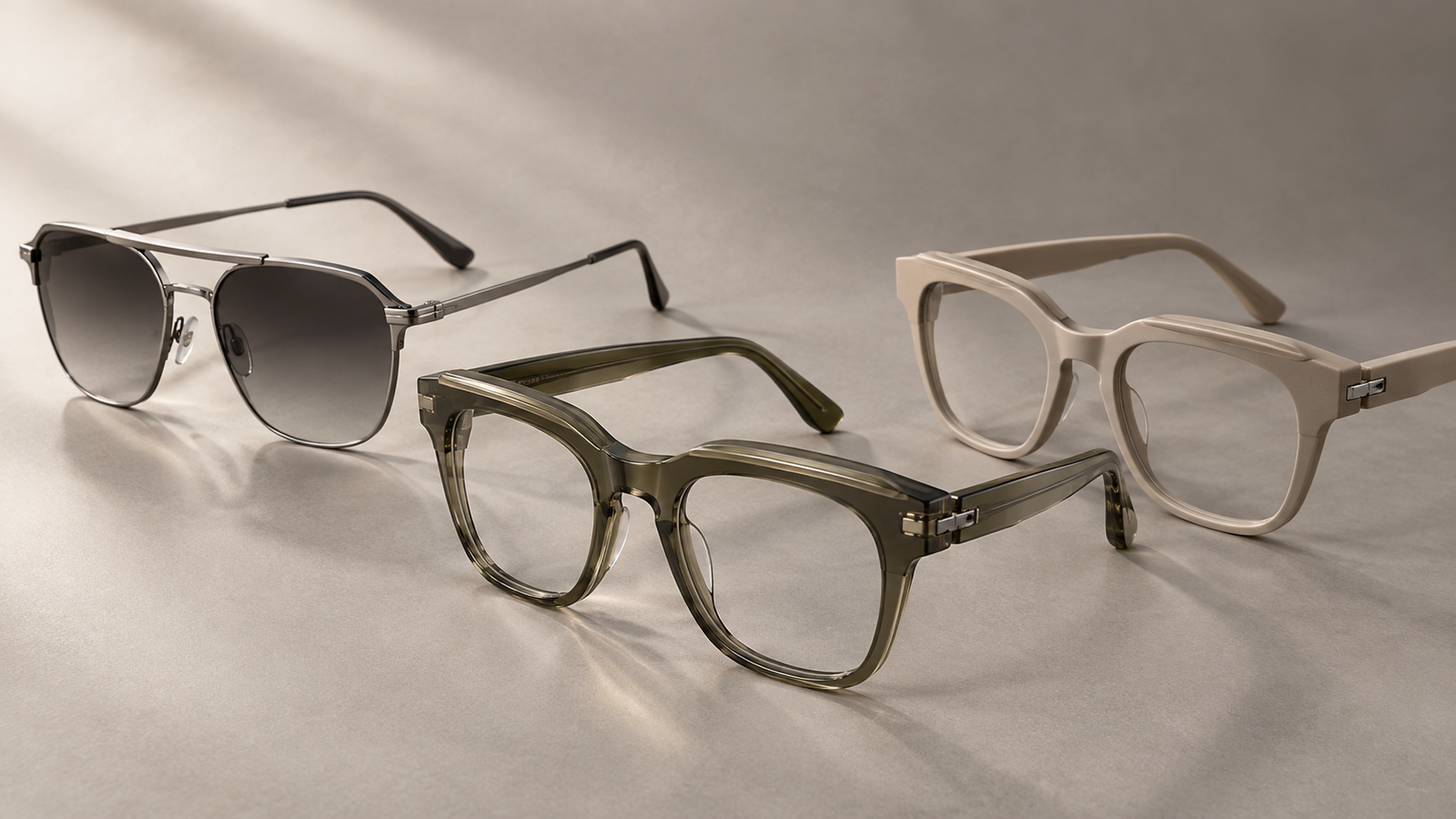
TL;DR: Statement brow eyewear is a high-impact 2026 direction that gives scaling brands a recognizable design signature without rebuilding an entire collection architecture. By controlling upper-rim geometry, materials, fit, lens choices and test plans, brands can create differentiated optical and sun SKUs that scale efficiently through OEM/ODM production.
Why is statement brow eyewear important in 2026?
Statement brow eyewear places visual emphasis on the top line of the frame through a bold acetate brow, raised metal bar, contrasting laminate, engraved bridge or suspended-lens construction. The direction is gaining commercial relevance because it makes eyewear instantly recognizable in store, in social content and at thumbnail size on an e-commerce product grid. The latest 2026 frame coverage from 20/20 Magazine highlights distinctive brows as a major frame story, including single top bars, cat-eye lens shapes and textured details extending toward the temples.
How does statement brow eyewear help brands grow strategically?
Statement brow eyewear helps brands grow strategically by turning one visible feature into a scalable collection system. Instead of investing in unrelated silhouettes every season, a brand can maintain a common brow geometry, temple language or color accent and adapt it across multiple eye shapes. This reduces design fragmentation, makes merchandising clearer and gives sales teams a simple story that buyers can understand quickly.
- Stronger recognition: a distinctive upper line remains visible in campaign images, shelf displays and mobile shopping results.
- Efficient SKU expansion: brands can reuse shared temples, hinges, nose-pad systems or finishing specifications across related models.
- Clear price architecture: one concept can move from entry injection to premium acetate-metal hybrid constructions without losing its identity.
- Better test-and-repeat decisions: colorways and eye shapes can be trialed in focused drops, then reordered around proven brow details.
- Retail storytelling: stores can group a recognizable family together while e-commerce teams can build focused landing pages and bundles.
The strategic value comes from disciplined repetition, not excessive decoration. Concept Eyewear can help brands define which design elements should remain proprietary, which parts can be standardized for volume manufacturing, and which seasonal details should rotate. That approach turns a fashion signal into a durable product platform.
Which constructions scale best?
When should brands choose sculpted acetate?
Cellulose acetate is effective when the brow needs visible depth, lamination, beveling or color contrast. CNC milling can create a raised upper edge, stepped brow or soft architectural ridge, while hand polishing controls how highlights travel across the surface. Premium versions may use thick fronts with controlled weight reduction behind the brow; commercial versions can use moderate thickness and simpler bevel paths to protect yield and finishing time.
Color planning should support the structure. Milky neutrals, translucent smoke, tortoiseshell and deep jewel tones make the brow visible without relying on a large logo. A two-layer laminate can add a narrow accent along the upper rim, but the brand and OEM/ODM team should agree on laminate alignment tolerances, polish level and acceptable color variation before approving mass production.
When do metal and hybrid frames work better?
Stainless steel, titanium and beta-titanium suit thinner, more precise brow expressions. Options include a single top bar, double bridge, stamped brow insert or fine metal rail above acetate rims. Titanium supports premium lightness and corrosion resistance; stainless steel offers a practical balance of rigidity, finish quality and cost. Plating, PVD color or lacquer must be specified with sweat resistance, adhesion and color-master controls appropriate to the target retail tier.
Hybrid construction is especially useful for collection building. One metal chassis can accept different acetate brow inserts, rim colors or temple treatments, allowing multiple SKUs without completely separate engineering. However, mixed materials expand the tolerance stack. CAD reviews should check screw access, insert retention, galvanic compatibility, lens groove consistency and whether the finished frame remains balanced on the wearer.
Can injection frames deliver the trend?
TR90, G850 and polycarbonate can translate statement brow eyewear into accessible lifestyle, youth and sport-inspired ranges. Injection is attractive for volume programs because the brow, bridge and decorative relief can be integrated into the molded front. The commercial advantage improves after tooling is amortized, although brands need to validate shrinkage, warpage, gate position and surface consistency before locking a large order.
For a concrete OEM/ODM example, a scaling brand could develop one Asian-fit injection front with an integrated raised brow in Vietnam, then launch smoke, olive and sand colorways supported by two lens options. Hong Kong product management can coordinate color masters, packaging and international approvals while Vietnam handles tooling trials, assembly and volume quality control.
Which SKU plan balances margin and reach?
| Concept or SKU | Price tier | Regional role | Materials and engineering | Standards focus |
|---|---|---|---|---|
| Sculpted acetate brow optical | Premium | EU boutiques and US independents | Cellulose acetate, laminated upper rim, reinforced hinge | Optical frame requirements, nickel release where applicable, dimensional QC |
| Metal top-bar sunglass | Mid-premium | EU, US and urban Asia | Stainless steel or titanium, adjustable pads, nylon or CR-39 lenses | ISO 12312, coating adhesion and corrosion checks |
| Injected raised-brow sunglass | Accessible volume | Asia fast fashion, DTC and global chains | TR90 or G850, molded brow relief, polycarbonate lenses | ISO 12312 and impact validation; Z87 only when the product is engineered and certified for that claim |
A practical first assortment uses three concepts rather than many minor variations. Each concept should have a clear consumer, channel and target margin. Premium acetate supports craftsmanship storytelling; metal brings visual precision; injection opens a higher-volume price tier. Shared colors or temple signatures keep the assortment cohesive while limiting inventory complexity.
How should fit change by region?
What works for the EU market?
European positioning can emphasize material quality, refined finishing and a distinctive but controlled silhouette. Medium eye sizes, balanced bridge widths and sophisticated acetate or metal colors suit optical boutiques and design-led retailers. Sunglasses intended for general use should be planned around ISO 12312 requirements, with lens category, visible-light transmission, UV performance, labeling and driving suitability addressed before final approval.
What works for the US market?
US assortments can support a broader statement, larger eye shapes and clear good-better-best price separation. E-commerce requires accurate front, side and on-face views because the brow line changes perceived frame height and facial expression. If a product is marketed for occupational protection, ordinary fashion-sunglass testing is not enough; Z87 performance requires a purpose-engineered frame-and-lens system, relevant testing and correct markings.
What works for Asia markets?
Asia fit often benefits from adjusted bridge geometry, longer or differently angled nose pads, reduced front-to-cheek contact and temple openings tuned to local headforms. Statement brow eyewear must be visually strong without becoming top-heavy, so weight distribution and pantoscopic angle deserve early prototype testing. Compact ovals, upswept rectangles and soft squares can deliver the trend while preserving everyday wearability.
Which lens technologies support the design?
Lens selection should reinforce the brow rather than compete with it. Clear demo lenses suit optical collections; light smoke, amber, rose or teal tints create a fashion-led sun option; gradient lenses keep the upper area visually grounded while opening the lower field; polarized lenses add a functional upgrade for outdoor programs. Nylon and polycarbonate support impact-conscious constructions, while CR-39 can provide strong optical clarity in suitable fashion applications.
For sunwear, color approval should use measured samples rather than screen references. The brand should specify lens material, base curve, category, tint tolerance, gradient position, UV performance, polarization efficiency where relevant, hard coating and any mirror treatment. Lens retention is particularly important on suspended or semi-rimless statement-brow designs because the upper structure carries more of the assembly load.
What should the development workflow include?
- Define the target consumer, retail price, sales channel, regions and forecast volume before selecting materials.
- Translate the brand code into measurable features such as brow height, bevel depth, top-bar thickness, color break and logo limits.
- Complete design-for-manufacture reviews for lens groove, hinge location, bridge strength, surface finishing and shared components.
- Prototype more than one size or bridge option when EU, US and Asia distribution is planned.
- Confirm approved color masters under controlled lighting and document plating, acetate and lens tolerances.
- Run pre-production testing for lens performance, dimensional stability, coating adhesion, corrosion, perspiration and impact according to product claims.
- Approve packaging, labeling, spare parts and e-commerce assets before the production completion date.
- Use a golden sample and inspection checklist for incoming materials, in-line assembly and final random inspection.
Concept Eyewear connects product development in Hong Kong with OEM/ODM manufacturing in Vietnam, helping teams manage drawings, samples, material approvals and production controls through one coordinated workflow. Brands can review the company’s broader eyewear manufacturing capabilities when preparing a collection brief.
How can brands protect quality at volume?
The most common scale-up risks are inconsistent brow symmetry, acetate deformation, plating shade variation, lens stress and excessive front weight. These issues are easier to prevent when the critical-to-quality points are defined before tooling or bulk cutting. Fixtures should control front alignment, bridge position and temple opening, while inspection plans should set measurable limits rather than depend on subjective visual approval.
Supply-chain planning also matters. Acetate sheet lots, metal finish batches and lens tints should be reserved against the approved order, especially when several SKUs share a color story. Brands should align launch calendars with sample rounds, laboratory lead times, packaging approval and shipping buffers instead of compressing validation at the end.
How should the collection be merchandised?
Retailers should present the brow feature at eye level and group related SKUs so the collection logic is immediately visible. A three-tier display can show the same design code in premium acetate, precise metal and accessible injection. Staff training should explain fit, material and lens differences instead of describing every product only as bold or fashionable.
Why partner with Concept Eyewear?
Statement brow eyewear can help a scaling brand build recognition, extend a coherent family of SKUs and create a stronger retail story, but the design must be engineered for repeatability. Concept Eyewear supports OEM/ODM development through Hong Kong and volume manufacturing in Vietnam, covering acetate, metal, injection frames, lens coordination, packaging and export-focused quality control.
Partner with Concept Eyewear to develop statement brow eyewear collections aligned with ISO 12312 and, where relevant to the product’s intended use and verified claims, Z87 performance. Contact the team to turn a 2026 trend concept into a commercially structured EU, US and Asia assortment with controlled materials, scalable production and launch-ready merchandising.
