

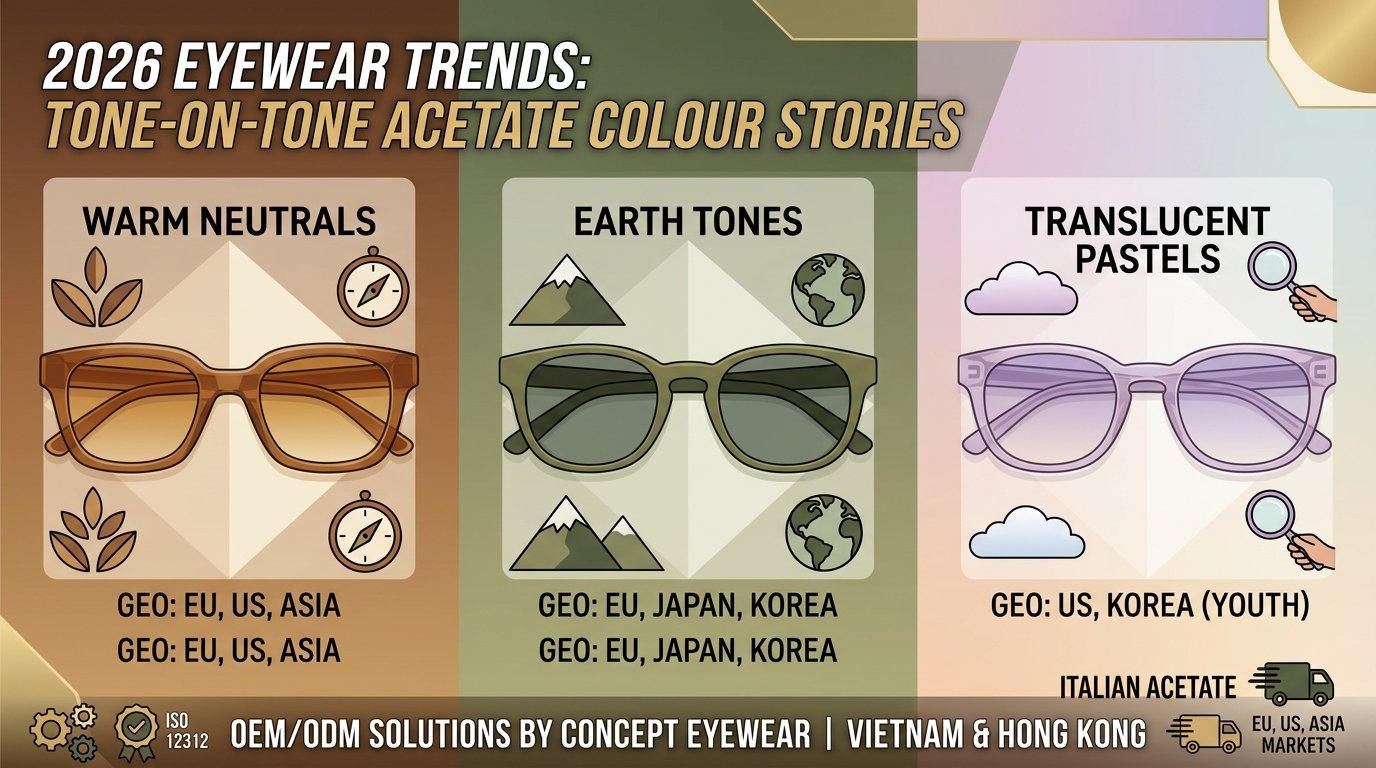
TL;DR: Tone-on-tone acetate colour stories dominate 2026 eyewear trends, with warm browns, muted greens, and translucent pastels paired to matching lens tints for a refined, commercial-ready aesthetic. Concept Eyewear supports OEM/ODM brands in Vietnam and Hong Kong with Italian acetate sourcing, custom colour development, and ISO 12312-compliant lens integration to capture this trend across EU, US, and Asia markets.
Why does tone-on-tone acetate colour help brands grow strategically in 2026?
Tone-on-tone colour palettes in acetate frames offer brands a commercially viable way to differentiate without relying on loud contrasts or logo-heavy designs. This trend aligns with the broader “quiet luxury” movement while remaining accessible across price tiers, from premium optical to fashion-forward sunglasses collections. [cite:10][cite:12]
For OEM/ODM partners, tone-on-tone development reduces SKU complexity while enabling cohesive capsule collections. Matching frame and lens colours create perceived value through intentional design harmony, supporting higher ASPs in retail and e-commerce channels. [cite:15][cite:18]
What are the key acetate colour directions for 2026?
2026 acetate colour trends cluster into three strategic families, each with distinct regional and commercial implications:
Which warm neutrals lead the tone-on-tone trend?
Warm browns, honey tortoise, amber, and cream tones anchor the 2026 palette. These colours pair naturally with amber, brown gradient, or light tea-tinted lenses, creating a cohesive look that flatters diverse skin tones across EU, US, and Asian markets. [cite:10][cite:12][cite:17]
Italian acetate suppliers report strong demand for translucent amber and tea-coloured variants, which allow light to pass through the frame while maintaining colour depth. This translucency adds a modern, lightweight visual effect without sacrificing the premium hand-feel of acetate. [cite:12][cite:15]
How do muted greens and earth tones perform commercially?
Olive green, bottle green, and burnt olive acetates emerge as key differentiators for brands seeking subtle colour stories. These tones pair with smoke, grey-green, or pale green transparent lenses for a tone-on-tone effect that feels sophisticated rather than trendy. [cite:9][cite:12][cite:16]
Commercial performance data suggests earth tones resonate strongly in EU markets, where understated colour aligns with minimalist wardrobe aesthetics. In Asia, particularly Japan and Korea, muted greens support the “natural” and “organic” positioning increasingly demanded by younger consumers. [cite:12][cite:19]
Where do translucent pastels fit in 2026 collections?
Translucent mint, lilac, smoke grey, and soft peach acetates offer a lighter, more youthful alternative to traditional neutrals. These colours work particularly well in unisex and Gen Z-targeted collections, where transparency and soft colour create an approachable, modern aesthetic. [cite:13][cite:15]
For OEM/ODM development, translucent pastels require careful acetate selection to avoid yellowing or colour shift over time. Concept Eyewear works with premium Italian acetate mills to ensure colour stability and UV resistance across production runs. [cite:15][cite:17]
How does Concept Eyewear support tone-on-tone acetate development for OEM/ODM brands?
Concept Eyewear operates as an OEM/ODM manufacturing partner in Vietnam and Hong Kong, offering end-to-end support for tone-on-tone acetate collections aligned with 2026 trends. Our capabilities include custom colour matching, Italian acetate sourcing, and lens tint coordination to achieve intentional frame-lens harmony. [cite:10][cite:18]
What materials and manufacturing processes enable premium tone-on-tone results?
Italian acetate remains the gold standard for high-end tone-on-tone frames, offering superior colour depth, hand-polishability, and long-term stability compared to injection-moulded alternatives. Concept Eyewear sources from leading Italian mills, ensuring access to the latest translucent and earth-tone colourways. [cite:15][cite:17]
For brands targeting mid-tier price points, we offer bio-acetate options that maintain the aesthetic qualities of traditional acetate while supporting sustainability claims. Bio-acetate performs well in tone-on-tone applications, particularly in warm neutrals and muted greens. [cite:17][cite:20]
Frame engineering considerations include:
- Hand-cut polishing for glossy finishes that enhance colour depth
- Heat-moulded flexibility to ensure comfort in thicker acetate profiles
- Dual-finish temples (glossy front, matte or brushed back) for tactile differentiation
- Reinforced core wires for structural integrity in oversized silhouettes
How are lens tints coordinated with acetate colours?
Tone-on-tone success depends on precise lens tint coordination. Concept Eyewear integrates lens tinting into the OEM/ODM workflow, offering gradient, solid, and mirrored options that match or complement acetate colours. [cite:10][cite:12]
Common pairings include:
- Warm brown acetate + amber or brown gradient lenses
- Olive green acetate + smoke or pale green transparent lenses
- Translucent peach acetate + rose or pale amber tints
- Smoke grey acetate + grey gradient or silver mirror lenses
All lens options meet ISO 12312-1 UV protection standards, with optional Z87.1 impact resistance for sports and performance-oriented collections. [cite:17]
What are the regional market considerations for tone-on-tone acetate eyewear?
Tone-on-tone colour strategies must account for regional preferences in colour perception, skin tone diversity, and retail positioning. Concept Eyewear supports GEO-specific development for EU, US, and Asia markets through our Vietnam and Hong Kong operations. [cite:12][cite:18]
| Region | Preferred Acetate Colours | Lens Pairings | Commercial Positioning |
|---|---|---|---|
| EU (Western Europe) | Warm browns, olive green, smoke grey | Amber gradient, smoke, grey-green | Premium optical, minimalist fashion |
| US | Tortoiseshell, translucent pastels, cream | Brown gradient, rose tint, clear | Fashion sunglasses, lifestyle optical |
| Asia (Japan, Korea, SEA) | Muted greens, peach, translucent amber | Pale green, light tea, soft amber | Unisex optical, K-beauty adjacent fashion |
How do EU market preferences differ from US and Asia?
EU buyers favour understated earth tones and muted greens that align with minimalist wardrobe aesthetics. Retail buyers in Germany, France, and Italy prioritise colour longevity and acetate quality over trend-driven colours. [cite:9][cite:12]
US markets show stronger demand for tortoiseshell variations and translucent pastels, particularly in fashion sunglasses and DTC e-commerce channels. Clear and crystal frames remain evergreen across all price tiers. [cite:13][cite:17]
Asian markets, especially Japan and Korea, respond well to muted greens, peach, and translucent amber tones that support “natural” and “organic” brand narratives. Unisex positioning performs strongly, with colour families designed to flatter diverse skin tones. [cite:12][cite:19]
What are the commercial implications for brands and retailers?
Tone-on-tone acetate collections support multiple commercial strategies, from premium positioning to accessible fashion. The key is intentional colour development that creates perceived value through design harmony. [cite:10][cite:15]
How should brands price tone-on-tone acetate collections?
Premium optical brands can command higher ASPs by emphasising Italian acetate sourcing, hand-polished finishes, and custom lens coordination. Mid-tier brands should focus on bio-acetate options and simplified colour stories to maintain margin while offering trend-relevant products. [cite:15][cite:17]
For volume manufacturing, Concept Eyewear recommends capsule collections of 4-6 colourways per silhouette, reducing SKU complexity while maintaining commercial breadth. This approach supports efficient inventory management across EU, US, and Asia distribution channels. [cite:18]
What merchandising strategies work best for tone-on-tone eyewear?
Retail merchandising should emphasise colour harmony through coordinated frame and lens displays. In-store and e-commerce imagery should showcase tone-on-tone pairings in context, helping customers visualise the cohesive aesthetic. [cite:12][cite:13]
For e-commerce, product photography should include close-ups of acetate translucency and lens tint coordination, as these details drive perceived value in online shopping environments. [cite:15]
Why partner with Concept Eyewear for tone-on-tone acetate development?
Concept Eyewear offers OEM/ODM manufacturing in Vietnam and Hong Kong with deep expertise in acetate colour development, Italian material sourcing, and ISO 12312-compliant lens integration. Our team supports brands from colour concept through volume production, ensuring tone-on-tone collections meet both aesthetic and performance standards. [cite:10][cite:18]
For brands targeting 2026 market entry or collection refresh, we recommend initiating tone-on-tone development 6-9 months ahead of launch to allow for colour sampling, lens coordination, and regional market testing. [cite:15][cite:17]
Ready to develop tone-on-tone acetate collections for 2026? Contact Concept Eyewear to discuss OEM/ODM partnerships in Vietnam and Hong Kong, with full support for Italian acetate sourcing, custom colour matching, and ISO 12312 / Z87.1 compliance across EU, US, and Asia markets.
Learn more about our OEM/ODM eyewear manufacturing services and explore how tone-on-tone colour strategies can elevate your 2026 collections.
For additional industry insights, visit 20/20 Magazine for the latest eyewear trend reports and market analysis.
