

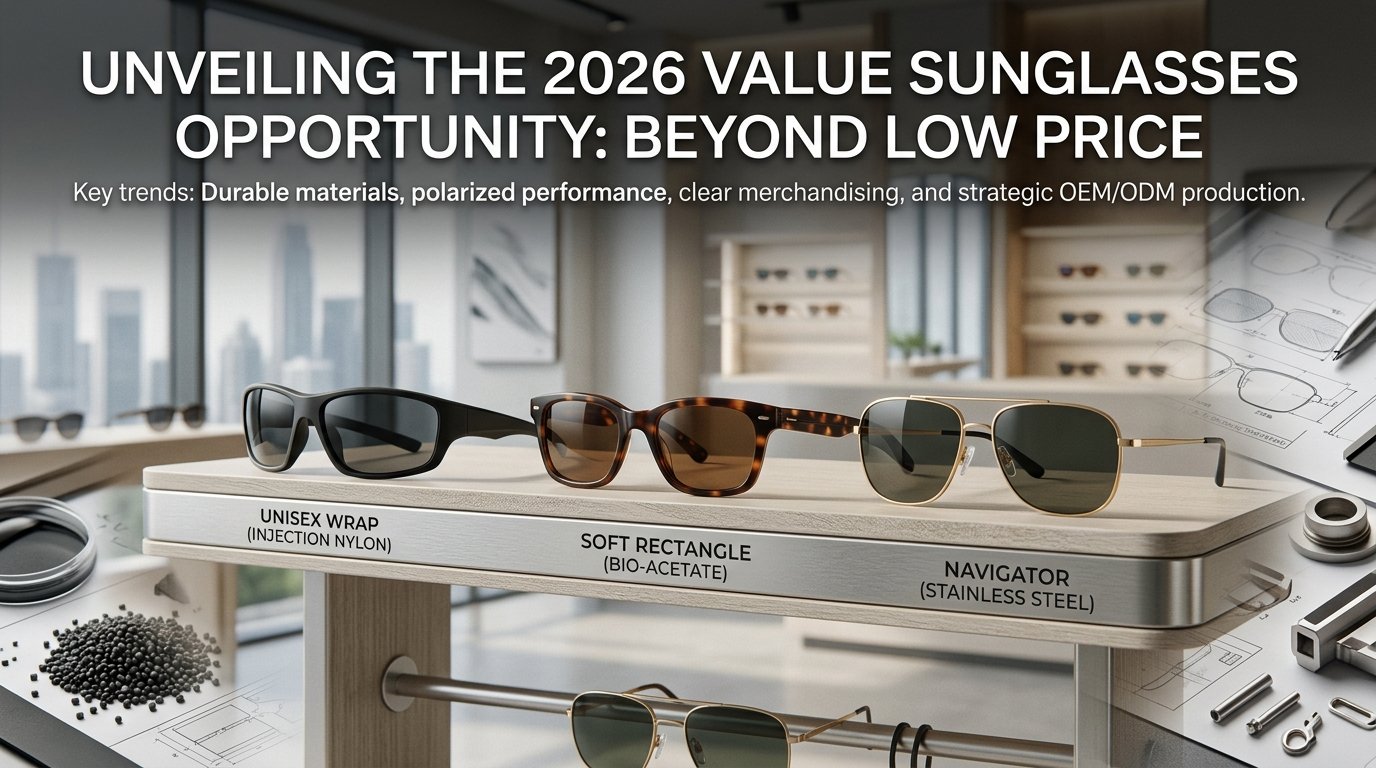
TL;DR: 2026 value sunglasses are moving beyond low price: brands can win with durable materials, credible UV performance, clear merchandising, and flexible OEM/ODM production in Vietnam and Hong Kong.
Why are value sunglasses a major 2026 opportunity?
Value sunglasses are becoming a strategic growth category because shoppers want dependable protection and attractive design without paying luxury prices. Recent U.S. consumer reporting points to lower price points, fewer purchases, and stronger interest in value-priced sunglasses. For brands, that does not mean competing only on cost. It means engineering a product that communicates quality quickly across retail shelves, marketplaces, and social commerce.
The 2026 opportunity is to create value sunglasses with a deliberate balance of frame durability, lens performance, fit, and visual identity. A well-developed collection can use a controlled material palette—such as injection nylon for lightweight sport styles, bio-acetate or standard acetate for fashion-led models, and stainless steel or monel for refined metal options—while keeping tooling and color counts commercially manageable.
For an eyewear brand, the strategic question is simple: how can a product remain accessible while still earning repeat purchase, positive reviews, and retailer confidence? The answer is disciplined product architecture supported by a reliable OEM/ODM workflow.
What makes value sunglasses commercially credible?
Which materials support the right price tier?
Acetate remains useful for premium-value sunglasses because it offers rich color, polished surfaces, and design depth. Brands can reduce unnecessary cost by selecting a focused sheet range, standardizing hinge components, and developing shared front geometries across multiple colorways. Injection-molded nylon or TR-based materials are effective for lightweight active styles and can support consistent high-volume production after tooling is validated.
Metal frames create a different value signal. Stainless steel can deliver a clean, modern profile, while adjustable nose pads and replaceable components may improve perceived serviceability. For entry and mid-market collections, the goal is not to use the most expensive material; it is to match the material, finish, and construction to the customer promise.
How should lenses be specified?
Lens selection should begin with the selling environment and intended use. Standard tinted lenses can serve fashion-led models, while polarized lenses add a clear performance story for driving, travel, boating, and outdoor lifestyles. Polycarbonate lenses can support impact-conscious sport concepts, whereas CR-39 remains a familiar option for many everyday sun applications. UV protection claims should be supported by documented testing rather than treated as a decorative marketing phrase.
Brands should define tint density, base curve, visible light transmission, polarization efficiency where applicable, optical quality, coating durability, and color stability in the technical pack. Mirrored, gradient, and low-reflective treatments can create shelf differentiation, but each added finish should be reviewed for yield, scratch resistance, and target price.
How can OEM/ODM teams design for volume?
A practical example is a three-SKU launch for a digitally native brand: an injection-molded unisex wrap, an acetate soft-rectangle, and a stainless-steel navigator. Concept Eyewear can coordinate design refinement, material selection, sampling, tooling review, quality checkpoints, and production planning through its OEM/ODM capabilities in Vietnam and Hong Kong. The Vietnam production route can support scalable manufacturing, while Hong Kong coordination can simplify communication, development control, and international sourcing management.
To protect margin, brands should approve a platform before expanding colors. A shared temple construction, common hinge specification, and limited lens family can reduce complexity. The team should also separate must-have features from optional upgrades: polarized lenses, premium hardware, custom packaging, and special coatings can be assigned to higher tiers rather than added to every SKU.
Which workflow reduces development risk?
- Confirm the consumer, target price, channel, and regional fit before sketch approval.
- Build a technical pack covering dimensions, tolerances, materials, colors, logos, lenses, and packaging.
- Review 3D data and first samples for bridge comfort, temple pressure, balance, lens retention, and cosmetic quality.
- Validate tooling, pilot quantities, assembly consistency, and color approval before mass production.
- Complete performance and compliance testing, then retain reports with the production and shipping records.
Where do EU, US and Asia markets differ?
One value sunglasses concept rarely fits every region without adjustment. Regional differences affect lens expectations, face fit, color response, product claims, packaging language, and retail price architecture. The following framework helps product managers brief a collection without creating unnecessary SKU complexity.
| Concept/SKU | Price tier and construction | Regional positioning and standards focus |
|---|---|---|
| Everyday soft-rectangle | Accessible acetate or durable injected frame; standard UV lens | EU fashion and optical retail; emphasize finish, fit, documentation, and ISO 12312 alignment |
| Active wrap | Mid-tier injection nylon; polarized or polycarbonate lens option | US outdoor and e-commerce; emphasize impact-conscious design, UV protection, and relevant Z87 performance where specified |
| Asian-fit navigator | Mid-tier stainless steel or acetate; adjusted bridge and temple geometry | Greater Asia and Hong Kong; emphasize nose fit, compact proportions, localized color, and efficient replenishment |
What should brands change by region?
EU buyers often respond to a combination of fashion credibility, responsible material stories, and clear documentation. US buyers may prioritize value, polarized performance, outdoor utility, and strong digital merchandising. Asian markets can require closer attention to bridge height, temple length, lens width, and proportion, especially for Asian-fit collections. These are commercial tendencies, not rigid rules, so local retailer feedback and sell-through data should guide final decisions.
For standards planning, teams should map claims to the destination market and product type. ISO 12312 is an important reference for non-prescription sunglasses, while ANSI Z87-related performance may be relevant when a product is marketed for occupational or impact-protection applications. The latest U.S. standards discussion also makes it sensible to review applicable requirements early with a qualified testing laboratory. Brands can consult The Vision Council’s coverage of ANSI Z80.3-2025 and maintain a documented test matrix rather than relying on a general “UV protected” statement.
Why does this trend help brands grow strategically?
Value sunglasses help brands grow strategically because they create a repeatable bridge between brand reach and operational discipline. An accessible hero product can attract first-time buyers, increase conversion in e-commerce, and introduce a brand to retailers that may later purchase higher-margin optical or premium sun collections. The key is to treat value as a designed proposition—not as a reduction in quality.
When a brand standardizes components and develops a clear tier structure, it can test demand without overcommitting inventory. The same production partner can then scale successful shapes, add regional colors, and coordinate replenishment more efficiently. This is especially valuable when freight, lead times, and demand volatility make excessive SKU proliferation risky.
Concept Eyewear supports this strategic approach by connecting product development with manufacturing realities in Vietnam and Hong Kong. For example, a brand may begin with a low-volume development run, validate customer response through its online store, and then move the strongest style into a larger Vietnam production order while maintaining Hong Kong-based communication and sourcing coordination. That path gives the brand evidence before it commits its full seasonal budget.
How should brands merchandise and sell value sunglasses?
Retail and e-commerce presentation should make the value proposition visible within seconds. Product pages should explain the frame material, lens type, UV protection, fit, use case, and care instructions in plain language. Images should show front, side, and on-face proportions, while short videos can demonstrate flexibility, polarization, or outdoor use without making unsupported technical claims.
In stores, a three-tier wall or table display can guide shoppers from everyday fashion to active performance. Color naming should be consistent across packaging and online listings. For e-commerce, brands can use bundles—such as a primary polarized style with a lower-priced everyday companion—to raise basket value while preserving a clear entry point.
- Use one recognizable hero shape to anchor the collection.
- Offer two or three price tiers with visible functional differences.
- Show regional fit information and frame measurements clearly.
- Keep packaging compact, protective, and aligned with the product story.
- Monitor returns by fit, lens expectation, color, and hinge or cosmetic defects.
How can brands start a 2026 collection?
Begin with a commercial brief that states the target customer, channel, landed-cost range, order quantity, market, and performance claims. Then ask the OEM/ODM partner to translate that brief into a small platform of shapes rather than a large collection of disconnected ideas. Early factory feedback can reveal whether a detail is likely to create tooling cost, assembly risk, or long-term quality variation.
Concept Eyewear invites eyewear brands, sourcing teams, retailers, and product managers to develop 2026 value sunglasses collections with an experienced OEM/ODM partner in Vietnam and Hong Kong. From acetate, metal, and injected frames to lens specifications, fit engineering, testing workflows, packaging, and volume manufacturing, the team can help align commercial design with ISO 12312 and, where relevant, Z87 performance requirements. Explore the Concept Eyewear OEM/ODM manufacturing service to discuss your next collection and build a value proposition that customers can trust.
