

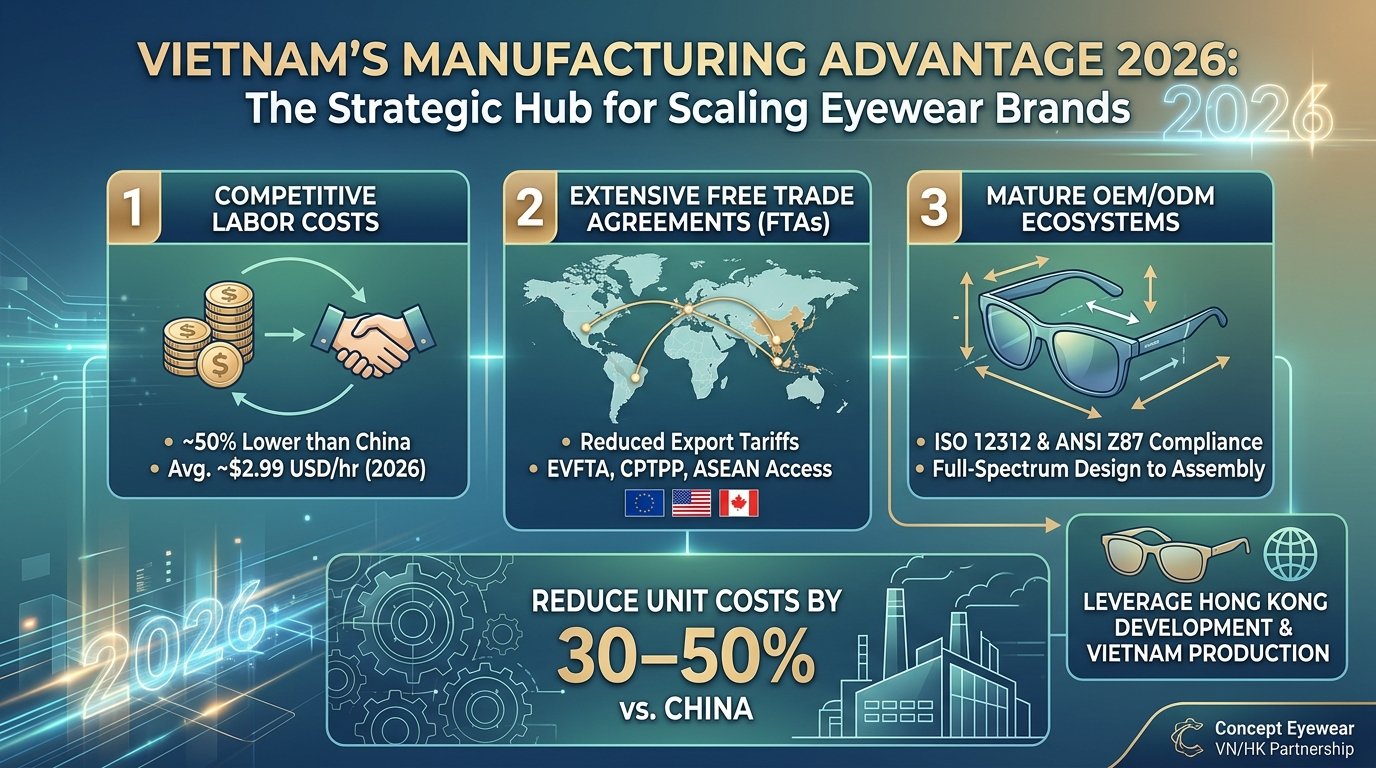
TL;DR: Vietnam’s manufacturing advantage in 2026 combines competitive labor costs, strategic free trade agreements, and mature eyewear OEM/ODM ecosystems to help scaling brands reduce unit costs by 30–50% versus China while maintaining ISO 12312 and Z87 compliance through partners like Concept Eyewear in Vietnam and Hong Kong.
Why does Vietnam’s manufacturing advantage matter for scaling eyewear brands in 2026?
Vietnam has evolved from a low-cost assembly base into a high-value manufacturing hub for eyewear, offering brands a strategic alternative to China amid tariff pressures and supply chain diversification needs. [web:2][web:5][web:8] For eyewear brands targeting EU, US, and Asia markets, Vietnam provides cost-competitive frame and lens production with established OEM/ODM workflows that meet international standards including ISO 12312 for sunglasses and ANSI Z87 for impact-resistant safety eyewear. [web:10][cite:13]
The Vietnam manufacturing advantage rests on three pillars: labor costs roughly 50% lower than China’s at around US$2.99 per hour, extensive free trade agreements including EVFTA and CPTPP that reduce export tariffs to key markets, and geographic proximity to China that maintains access to raw materials and components while diversifying geopolitical risk. [web:2][web:4][web:9] For eyewear brands scaling from startup to mid-market volumes, these factors translate into lower landed costs, faster time-to-market, and improved margin structures without sacrificing quality or compliance.
What specific cost and compliance advantages does Vietnam offer eyewear OEM/ODM?
Vietnam’s eyewear manufacturing sector now supports full-spectrum OEM/ODM services from design translation and 3D engineering through injection molding, acetate machining, lens coating, and final assembly. [cite:13][cite:21] Leading OEM/ODM partners such as Concept Eyewear operate vertically coordinated facilities in Vietnam with Hong Kong-based product development and export coordination, enabling brands to leverage modular frame platforms, standardized components, and rapid sampling cycles. [cite:13]
On the compliance front, Vietnam-based eyewear factories increasingly embed ISO 12312 testing workflows into production, ensuring UV protection, optical quality, and mechanical safety for sunglasses destined for EU and global markets. [cite:13][cite:15] For brands targeting work-sport crossover segments or industrial safety channels, Vietnam OEM/ODM partners can engineer frames and lenses toward Z87-level impact resistance, using polycarbonate and Trivex lens materials with appropriate coatings and frame reinforcements. [cite:13][cite:19]
How do labor costs and trade agreements improve unit economics for eyewear brands?
Vietnam’s average manufacturing labor cost of US$2.99 per hour is approximately half that of China’s US$6.50 per hour, directly reducing frame molding, finishing, and assembly costs for eyewear SKUs. [web:2][web:9] When combined with corporate income tax incentives of 10–15% for high-value manufacturing projects and up to four years of CIT exemption followed by nine years at 50% reduction for eligible investments, the total cost advantage for eyewear brands can reach 30–50% on comparable SKUs versus China-only production. [web:6][web:8]
Free trade agreements amplify these savings. The EU-Vietnam Free Trade Agreement (EVFTA) and CPTPP reduce or eliminate tariffs on eyewear exports to Europe, Canada, and other member economies, improving landed cost competitiveness for brands selling into these regions. [web:2][web:5] For US-bound shipments, Vietnam’s participation in ASEAN trade frameworks and bilateral agreements still offers tariff advantages relative to China under Section 301 measures, making Vietnam an attractive base for brands balancing EU, US, and Asia distribution. [web:3][web:10]
How does Vietnam compare to China and other ASEAN countries for eyewear manufacturing?
Vietnam’s eyewear manufacturing ecosystem benefits from proximity to China’s mature supply chains while offering lower labor costs and reduced tariff exposure. [web:4][web:10] Raw materials such as acetate sheets, metal alloys, hinges, and lens blanks can still be sourced from China with short cross-border lead times, while final molding, finishing, and assembly occur in Vietnam to capture cost and trade advantages. [web:4]
Compared to other ASEAN manufacturing bases like Thailand or Indonesia, Vietnam stands out for its combination of young, educated labor force, extensive FTA network, and government support for high-tech and green manufacturing initiatives. [web:5][web:8] For eyewear brands, this means access to skilled workers capable of handling precision frame engineering, lens coating, and quality control processes required for ISO 12312 and Z87-compliant products, alongside infrastructure improvements in seaports and industrial zones that support efficient export logistics. [web:8][web:9]
| Manufacturing Base | Labor Cost (USD/hour) | Key Trade Advantages | Eyewear OEM/ODM Maturity |
|---|---|---|---|
| Vietnam | ~2.99 | EVFTA, CPTPP, ASEAN FTAs; reduced US tariff exposure | High: full OEM/ODM, ISO 12312 and Z87-capable factories |
| China | ~6.50 | Mature supply chains; Section 301 tariffs to US | Very high: broadest component and design options |
| Thailand | ~3.50–4.00 | ASEAN FTAs; more limited EU/US preferential access | Moderate: growing eyewear base, fewer specialized OEM/ODM partners |
| Indonesia | ~2.50–3.00 | ASEAN FTAs; larger domestic market | Moderate: emerging eyewear manufacturing, less export-focused |
What role do Hong Kong and Vietnam play together in eyewear OEM/ODM strategies?
For global eyewear brands, the Vietnam–Hong Kong manufacturing corridor offers a powerful combination: Vietnam provides cost-competitive, standards-compliant production capacity, while Hong Kong serves as a regional hub for product development, client communication, and international logistics. [cite:13][cite:20] OEM/ODM partners like Concept Eyewear leverage this structure to offer brands end-to-end support from trend translation and 3D engineering in Hong Kong through mass production and compliance testing in Vietnam. [cite:13]
This dual-location model is particularly valuable for scaling brands that need rapid iteration on designs, materials, and fits while maintaining tight control over quality and lead times. [cite:13] Hong Kong-based teams can quickly prototype new frame geometries, test sustainable material blends such as bio-acetate and recycled TR90, and coordinate with EU and US buyers on fit and styling preferences, while Vietnam factories execute volume production with established ISO 12312 and, where relevant, Z87 performance workflows. [cite:13][cite:21]
How can brands structure OEM/ODM partnerships to maximize Vietnam’s manufacturing advantage?
Brands should approach Vietnam OEM/ODM partnerships with clear briefs covering target price tiers, regional fit requirements (EU, US, Asia), material and sustainability priorities, and standards compliance needs. [cite:13] Working with an experienced partner like Concept Eyewear allows brands to leverage modular shield platforms, interchangeable temple systems, and standardized nose-pad components, reducing tooling costs while enabling rapid SKU differentiation for 2026 collections. [cite:13]
For injection-molded eyewear, brands can specify TR90 nylon, bio-based polymers, and titanium components engineered for lightweight durability and ISO 12312 compliance, with optional Z87-inspired impact protection for work-sport crossover products. [cite:13][cite:21] For acetate and metal frames, Vietnam OEM/ODM partners can coordinate material sourcing from China and Europe, apply advanced surface treatments and coatings, and implement rigorous quality control aligned with international buyer expectations. [cite:13]
Why does Vietnam’s manufacturing advantage help brands grow strategically?
Vietnam’s manufacturing advantage helps brands grow strategically by providing a scalable, cost-efficient, and compliance-ready base for eyewear production that supports both margin improvement and market expansion. [web:5][web:8] Lower unit costs enable brands to invest more in design innovation, marketing, and distribution while maintaining competitive retail pricing. [web:2][web:9] Access to EVFTA and CPTPP preferential tariffs improves competitiveness in EU and other FTA partner markets, supporting geographic diversification beyond China-centric supply chains. [web:2][web:5]
From a risk management perspective, Vietnam reduces exposure to single-country manufacturing concentration, tariff escalation, and geopolitical disruptions that have affected China-focused supply chains. [web:3][web:9] For eyewear brands, this means more resilient operations, predictable lead times, and the ability to respond quickly to shifting demand patterns across EU, US, and Asia channels. [web:8][web:10]
Strategically, Vietnam also positions brands to capture emerging trends in sustainable and performance eyewear. [cite:13] Vietnam-based OEM/ODM partners are increasingly equipped to handle bio-based materials, recycled components, and advanced lens technologies that align with 2026 consumer expectations for eco-conscious and high-performance products. [cite:13][cite:21] By partnering with manufacturers like Concept Eyewear in Vietnam and Hong Kong, brands can translate these trends into commercially viable collections that meet ISO 12312 and, where relevant, Z87 standards while maintaining cost structures that support healthy margins and reinvestment in growth.
What should brands consider when launching 2026 eyewear collections with Vietnam OEM/ODM partners?
Brands planning 2026 eyewear collections should align their product briefs with Vietnam’s manufacturing strengths: injection-molded performance frames, sustainable material integration, and standards-compliant lens technologies. [cite:13][cite:21] Key considerations include:
- Target price tiers and volume expectations to match Vietnam’s cost advantages with appropriate material and finishing specifications.
- Regional fit and styling preferences for EU, US, and Asia markets, leveraging Hong Kong-based product development for rapid iteration.
- Standards compliance requirements, ensuring all SKUs meet ISO 12312 for sunglasses and, where relevant, Z87 performance for work-sport crossover products. [cite:13][cite:15]
- Sustainability priorities, specifying bio-acetate, recycled TR90, and other eco-friendly materials that Vietnam OEM/ODM partners can source and process at scale. [cite:13]
For brands seeking to move from trend insights to production-ready roadmaps, Concept Eyewear offers end-to-end OEM/ODM support from design translation and 3D engineering through sampling, testing, mass production in Vietnam, and export coordination via Hong Kong. [cite:13][cite:21] This integrated approach enables on-time launches of 2026 collections that meet ISO 12312 and, where needed, Z87 performance targets while capturing Vietnam’s manufacturing advantage in cost, compliance, and scalability.
To explore how Vietnam’s manufacturing advantage can support your brand’s 2026 eyewear strategy, partner with Concept Eyewear as your OEM/ODM manufacturer in Vietnam and Hong Kong for trend-aligned, standards-compliant collections that scale efficiently across EU, US, and Asia markets.
